
Sudan’s Most Powerful Military Assets: From Chinese Type 96 Tanks to Soviet Su-24 Strike Fighters
Military Watch Magazine Editorial Staff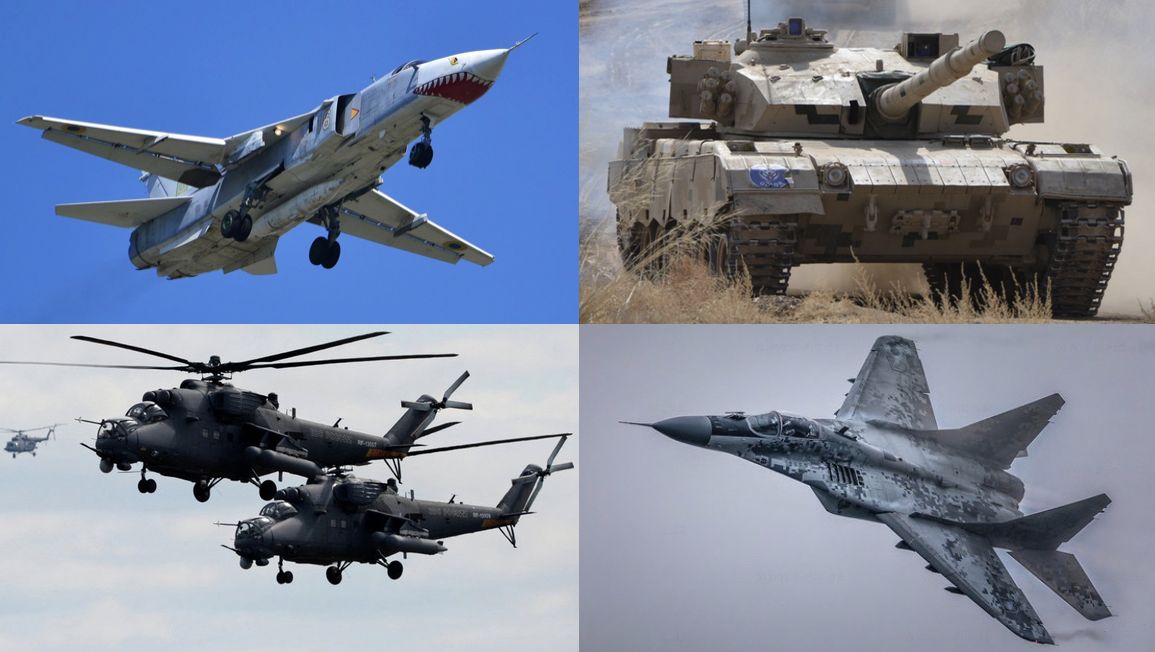
(from top left) Su-24 strike fighter, Type 96 tank, MiG-29 fighter, Mi-35 gunship
Though relatively small in size, Sudan’s armed forces have long been major recipients of military hardware particularly from China and Soviet successor states. While the country’s military has primarily been tasked waging civil conflict and counterinsurgency in recent years, its investments in conventional assets in light of often poor relations with both Egypt and the Western Bloc have not been insignificant. While we have yet to see Sudan’s more capable assets deployed against an enemy state, with Israeli airstrikes on the country in 2009 and again in 2012 going practically unopposed, an assessment of their capabilities can give some indication as to the country’s combat potential if operated under an effective command structure. Five of the most capable assets deployed by Sudan's armed forces are assessed below.
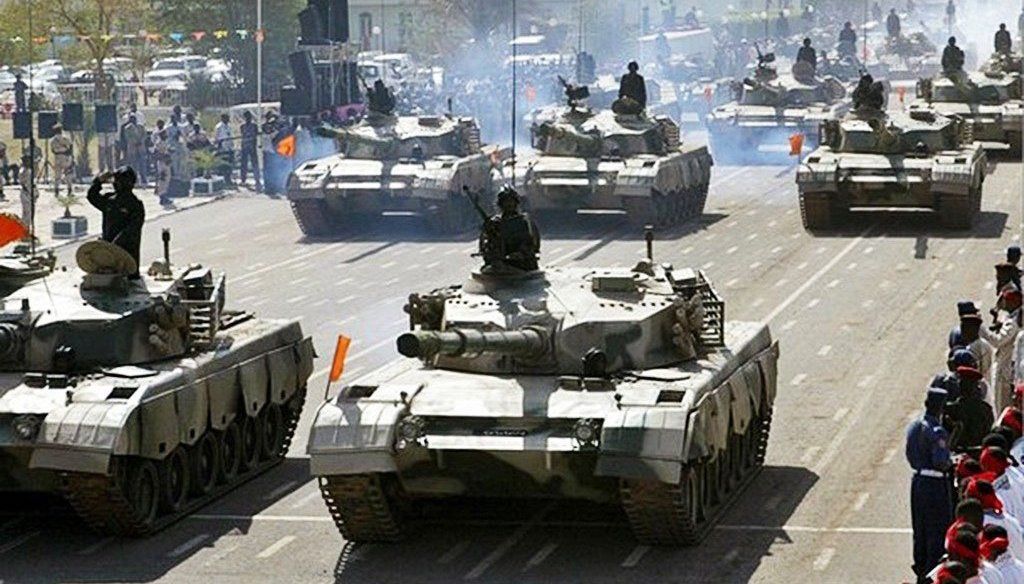
Type 96 Battle Tank
Sudan is the only foreign operator of a modern heavyweight Chinese battle tank, and to complement domestic production of various armoured platforms such as the Al Bashir it is though to have received a small contingent of Type 96 tanks in the early 2000s. With other Chinese defence clients being marketed lighter platforms, some designed for export and not used by the Chinese People's Liberation Army itself, the fact that Sudan it the only country to deploy a modern PLA frontline battle tank bears testament to the closeness of defence ties between the two states. Little is known regarding the Type 96's specifications, but the tanks are thought to be superior to the Russian T-72 and early variants of the T-90 which the Chinese platform was designed to supersede. Development of the Type 96 notably benefitted from advanced Soviet technologies, some transferred through sales and some acquired through study of platforms such as the T-80, and the tank is expected to outperform platforms fielded by neighbouring states such as the Egyptian M1 and Ethiopian Chonma Ho - sourced from the U.S. and North Korea respectively.
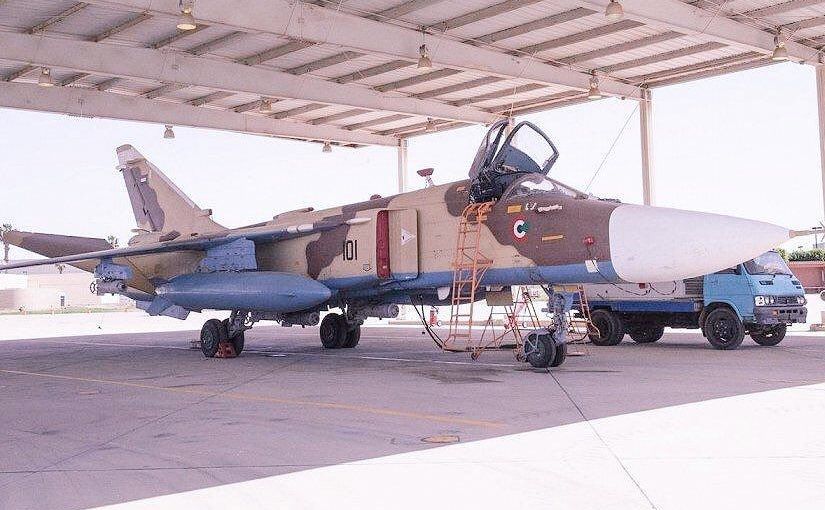
Su-24M Strike Fighter
The heaviest combat jet in the Sudanese Air Force, the Su-24 served as Russia’s prime strike fighter until 2014 and continues to form the bulk of the Russian strike fleet. The aircraft were the first fourth generation combat jets to enter Soviet service, and their presence was seen as a major threat by the Western Bloc in the latter years of the Cold War. The platform is compatible with a wide variety of guided standoff missiles such as the Kh-59 and Kh-31, although the variants acquired for the Sudanese fleet are though to be older and less sophisticated and were purchased second hand from Belarus. Sudan reportedly deploys a dozen Su-24M, of which three are currently deployed for operations in the Middle East, with all jets integrating systems for aerial refuelling and deploying reasonably advanced radar designators and a Tekon track and search system for better utilisation of guided weapons. The aircraft have reportedly used unguided munitions manufactured indigenously to reduce costs, and have taken part in both counterinsurgency operations and ongoing hostilities in Yemen alongside Royal Saudi Air Force F-15SA strike fighters. The state of Sudan's strike fleet and the munitions available remain unknown, but if properly refurbished and equipped they can provide a formidable high endurance strike asset capable of penetrating deep behind enemy lines.
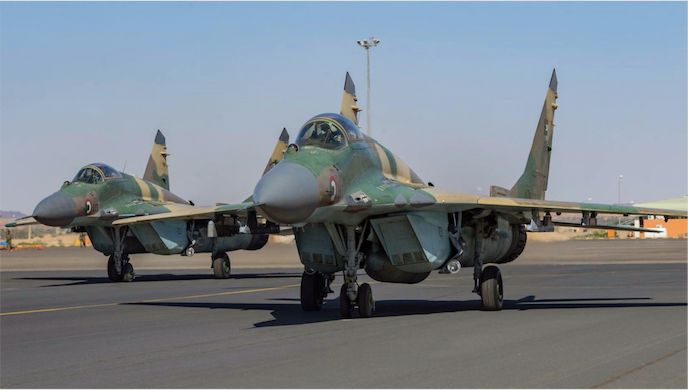
MiG-29 Fulcrum Fighter with R-77 Air to Air Missile
The source of Sudan’s MiG-29 fleet and the models in service remains uncertain, but reports indicate that the country purchased a small number second hand from Belarus before placing a larger order of modernised variants from Russia. The medium weight multirole fourth generation fighters formed the backbone of the Warsaw Pact’s fleet, and when later flight tested by the German Air Force it was reportedly more manoeuvrable than any Western fighter including U.S. Navy and Air Force's respective F-18 and F-15 fighters. Sudanese MiG-29s are significantly more capable than the early Soviet variants, deploying new sensors and avionics and active radar guided R-77 air to air missiles. These missiles provide a standoff engagement range of over 100km, allowing them to comfortably outperform the Su-27 fighters of neighbouring Ethiopia and Eritrea and the F-16 fleet of Egypt in beyond visual range combat. None of these aircraft are equipped with active radar homing missiles or any missiles with comparable ranges or reliability - in the former cases due to cost and in Egypt's case due to political restrictions on American air to air missile exports. Sudan fields no other classes of fighter in frontline service, and with an extremely limited surface based and no ship based anti aircraft capability the MiG-29 is thus relied on to shoulder almost the entire burden of defending the country’s airspace.
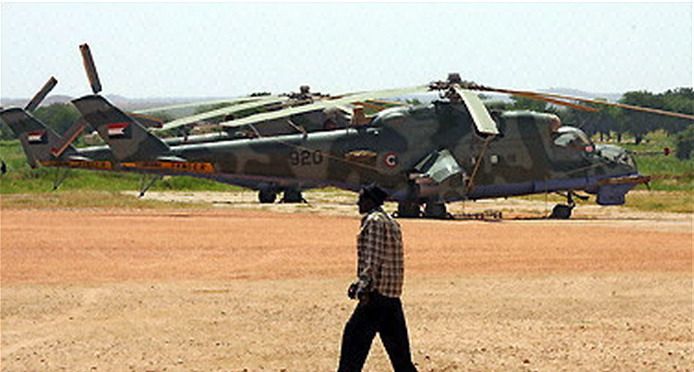
Mi-24 and Mi-35 Hind Helicopter Gunship
Sudan received its first Mi-24 attack helicopters in 1995, and has since placed multiple followup orders to today form two full squadrons comprised of a number of variants. These have seen extensive use in counterinsurgency operations, and remain some of the heaviest, best armed and best protected rotary wing aircraft in the world - hence dubbed ‘flying tanks’ in the Soviet Union. The Mi-35P and Mi-24P notably bring the most firepower to bear and complement rockets with fixed side mounted twin-barrel 30mm autocannons. The Mi-24V, which is a more specialised tank hunter with 9K114 Shturm radio guided anti tank missiles, is also deployed.
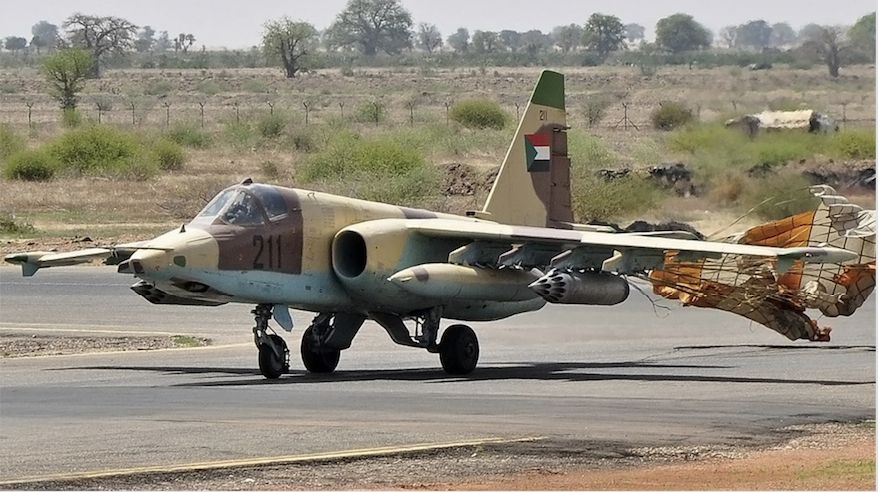
Q-5 and Su-25 Attack Jets
The Sudanese Air Force’s apparently strong focus on strike assets appears to come as a result of the is long counterinsurgency operations, and the service currently deploys advanced Chinese Q-5 and Soviet Su-25 attack jets. These platforms form the mainstay of the Chinese and Russian strike fleets today, and modern variants are capable of deploying a variety of modern munitions for anti tank and anti personnel roles including guided munitions. Both jets are prized for their extreme durability and low maintenance requirements, and their deployment serves to heavily compensate for the relatively small size of the country’s armoured units. It remains uncertain whether the Q-5 is still deployed, with some sources indicating it has recently been retired from service.
