
Fifty Years of the Su-24; A Strike Fighter Which Proved its Mettle in Syria
Military Watch Magazine Editorial Staff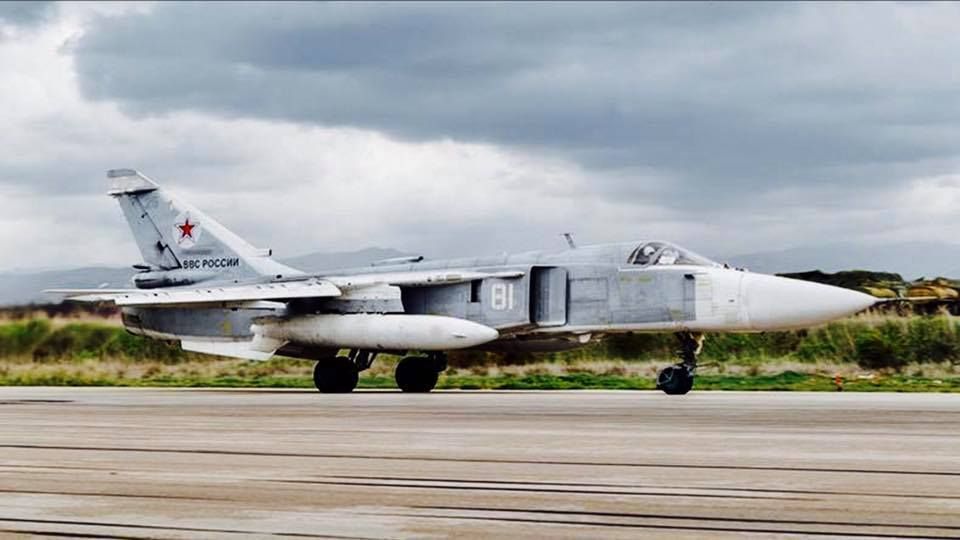
Su-24 Strike Fighter
In production since 1967, the Soviet Su-24 strike fighter continues to provide the bulk of Russia's light bombing capabilities. The fighters have since undergone extensive upgrades and modifications, and until the introduction of the Su-34 in 2014 they were still the most advanced strike fighters in the Russian inventory - or in service anywhere in the world other than the American F-15E. Modernisation include systems which allow the fighter to carry precision guided munitions, improved defensive air to air combat capabilities GLONASS satellite navigation systems and a modern display.
Able to strike targets up to 400 miles away without aerial refuelling, and with a capacity to carry almost 18,000lbs of munitions, the Su-24 in many respects exceeds the capabilities of even the American F-15E. Designed to penetrate enemy airspace the fighters were ideal for striking NATO military targets throughout Europe during the Cold War. They are also capable of carrying out reconnaissance roles. With a relatively low cost of under $30 million, the Su-24 can be fielded in large numbers even by smaller state lacking in funds - costing well under a third the amount of the F-15E. 270 fighters are currently in service in the Russian Air Force, while Algeria, Syria, Iran, Sudan and Ukraine also maintain sizeable fleets. Iran's fleet originated in the Iraqi Air Force, with several fighters fleeing to Iran during the 1991 Gulf War to avoid destruction by the U.S. Air Force. While the deployment of eight new Su-34 and four Su-35 fighters each to Syria drew much media attention, the twelve Su-24 fighters carried out the bulk of the airstrikes and proved their effectiveness. With a deployment of just 36 fighters in total, at times with support from a carrier strike group, Russia was able to turn the tide of the war. The high sortie rate of the low maintenance Su-24, able to fly approximately three sorties per day, proved invaluable and the destruction they wrecked even when relying heavily on unguided munitions served as a critical lesson to those which would challenge the strike capabilities of the Russian Air Force. With the Su-24 set to be gradually replaced by more modern Su-34, the strike capabilities of the Russian Air Force are set only to increase in future.
