
Newly Built Russian Su-57s Begin Flight Testing: What Makes Fifth Generation Fighter Production Challenging?
Military Watch Magazine Editorial Staff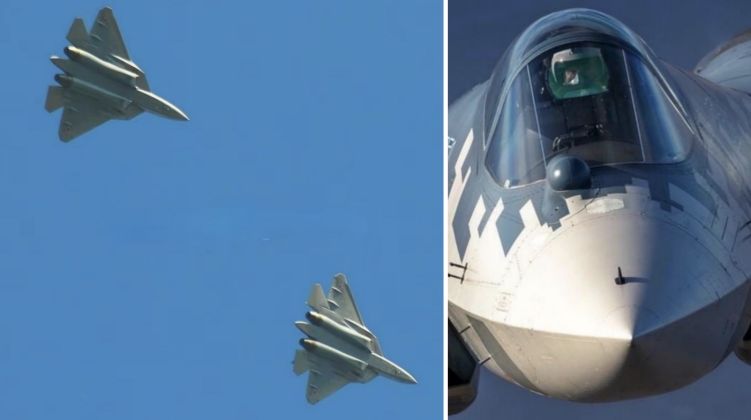
New Su-57 Fighters in the Russian Far East (left) and Su-57
New footage from the Russian Far East near the country’s largest production facility for fighter aircraft, the Komsomolsk-on-Amur Aviation Plant, has shown two newly produced Su-57 fifth generation fighter aircraft in flight. The aircraft are already flying in what appear to be Russian Aerospace Forces colours, rather than factory primer, and may be undergoing trials before delivery to the Armed Forces. This would follow the reported delivery of a prior large batch on February 9. The importance of increasing production of the Su-57 has increased due to multiple converging factors, foremost among which are the growing orders being placed by foreign clients, and the mounting pressure being placed on Russian defences by multiple NATO members.
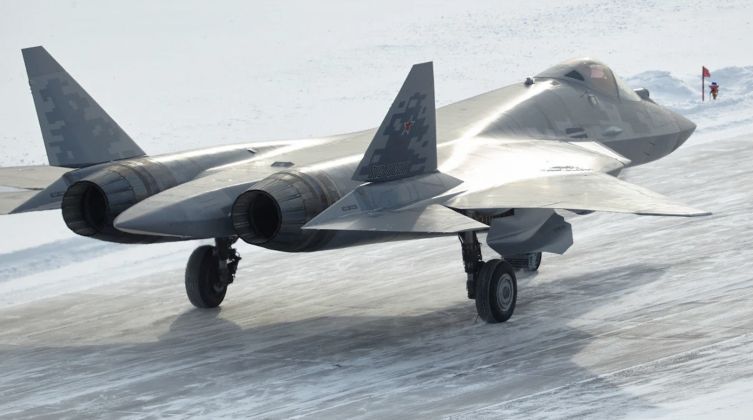
In July 2025 Deputy Commander-in-Chief of the Russian Aerospace Forces Lieutenant General Alexander Maksimtsev confirmed that preparations were underway for the deliveries of Su-57 fighters at an accelerated rate. Russian industry had set a highly ambitious target of a 67 percent surge in the production of Su-57s in 2024, with 20 fighters having been expected to enter service that year compared to just 12 fighters in 2023 and only six fighters in 2022. Actual production levels have remained unknown since 2024, although they were sufficient to begin export deliveries in 2025. While the head of the Russian state tech corporation Rostec, Sergei Chemezov, in early May 2026 reported success in doubling the production of combat aircraft since the start of full scale hostilities in the Ukrainian theatre in 2022, production of the Su-57 is estimated to have increased considerably more, primarily due to delays bringing the type into serial production which meant production rates were outstandingly low in 2022.
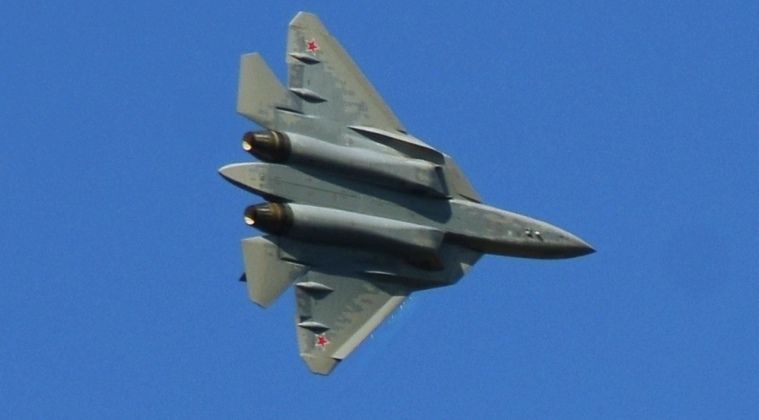
The Su-57 is significantly more complex that other Russian fighter types, with flyaway a cost well over double that of the Su-35S and close to triple that of the Su-30SM despite its similar size and use of a common engine type with the former. The new fighter incorporates more complex technologies and manufacturing processes, and requires greater precision and more sophisticated materials to built. One of the biggest challenges is the stealth airframe, as its fuselage is shaped to reduce its radar cross-section, requiring tight manufacturing tolerances and carefully aligned panel edges, inlets, and control surfaces. Even small imperfections can increase radar reflections. By contrast, the Su-30 and Su-35 can be manufactured using more conventional techniques not much more advanced than those used for the Soviet era Su-27 fighter, with less demanding tolerances.
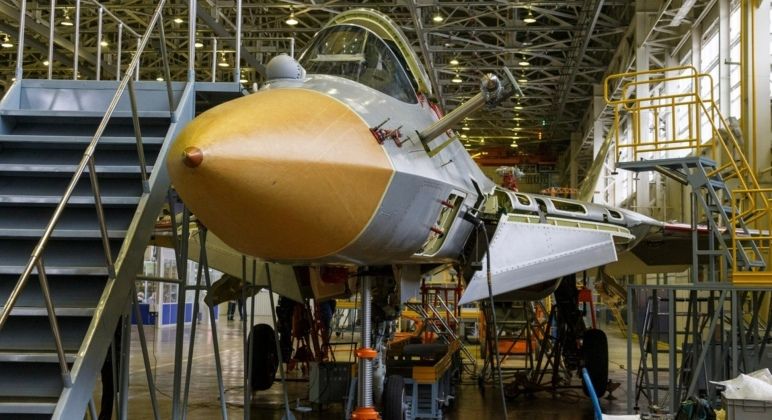
The Su-57 also makes extensive use of composite materials, which are lighter and contribute to radar signature reduction, but are also considerably more difficult and expensive to manufacture than traditional aluminium alloys. Large composite structures require specialised facilities, precision curing processes, and rigorous quality control, all of which increase production time and cost. Its internal weapons bays add another layer of complexity. Unlike the Su-35, which carries all weapons externally, the Su-57 stores many of its missiles inside the fuselage to preserve its stealth characteristics. Producing reliable bay doors, launch mechanisms, and internal carriage systems that operate correctly at high speed and under combat conditions is a technically demanding task. The aircraft’s avionics architecture is also far more sophisticated. These factors have made it highly challenging for Russia’s much diminished post-Soviet industrial base to bring the aircraft into large scale serial production, although revenues from multiple export deals, and close to three decades of work on the program, are expected to allow for a significantly greater production rate in 2026 compared to previous years.
