
Russian Su-34 Strike Fighter Conducts Guided Glide Bomb Strike on Ukrainian Personnel Concentration
Military Watch Magazine Editorial Staff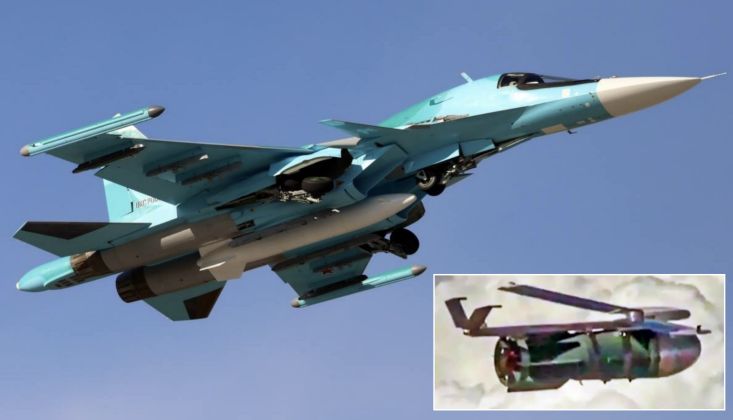
Su-34 and FAB-3000 Glide Bomb in Flight
A Russian Aerospace Forces Su-34 strike fighter operating under Battlegroup South has launched guided glide bombs against a concentration of Ukrainian personnel and military equipment. Commenting on the operation, the Russian Defence Ministry reported: "The crew of a Su-34 multirole supersonic fighter-bomber of the Aerospace Forces delivered a strike on amassed Ukrainian manpower and armour in the responsibility area of the Battlegroup South.” After receiving a confirmation from reconnaissance that the targets at the designated coordinates had been destroyed, the aircraft safely returned to its airfield, the ministry elaborated. The Su-34 is the world’s heaviest and longest ranged fighter type, and has shouldered the primary burden of providing air support among Russia aviation assets during almost four years of high intensity hostilities.
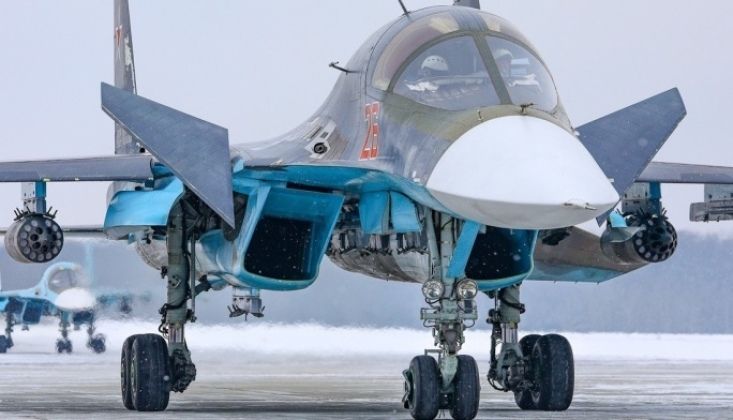
Following initial heavy losses employing air power against Ukrainian frontline units, the Russian Aerospace Forces from early 2023 began to rely increasingly heavily on using glide bombs to launch attacks from safer distances. The first unified gliding and correction modules allowed bombs to travel 40-50 kilometres when dropped from altitudes of 10-12,000 meters, before this range was later increased to 80 kilometres. In October 2025 the deputy head of Ukraine’s Main Directorate of Intelligence Vadim Skibitsky stated that a new type of glide bomb had demonstrated a range of 193 kilometres, stressing that this could fundamentally alter the dynamics on the frontlines, and was a game changer for the ability of aviation assets to launch low cost mass strikes on targets far deeper behind the frontlines. The bomb referred to appeared to be a recently unveiled design with a rocket engine.
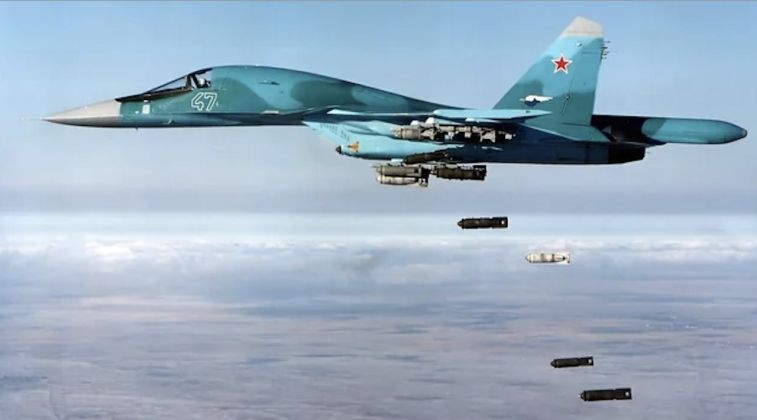
Ukrainian Army frontline personnel speaking to various Western media outlets have widely singled out the effects of mass glide bomb attacks, stressing that such attacks using bombs with up to 500 kilograms of explosives were obliterating their underground bunkers. One serviceman compared their impact to “hell’s gates,” stressing that the Russian Aerospace Forces “would send them two by two by two, eight in an hour… It sounds like a jet coming down on you.” These strikes have reportedly been a primary contributor to the extreme casualty rates suffered by the Ukrainain Army, which had in several cases approached 80-90 percent, with life expectancy for personnel on high intensity frontiers having at times been as low as just four hours. In April 2023 Ukrainian ambassador to the United Kingdom Vadim Pristaiko stated that authorities were concealing the full number of wartime casualties, stating that “it has been our policy from the start not to discuss our losses,” but that “when the war is over, we will acknowledge this. I think it will be a horrible number.”
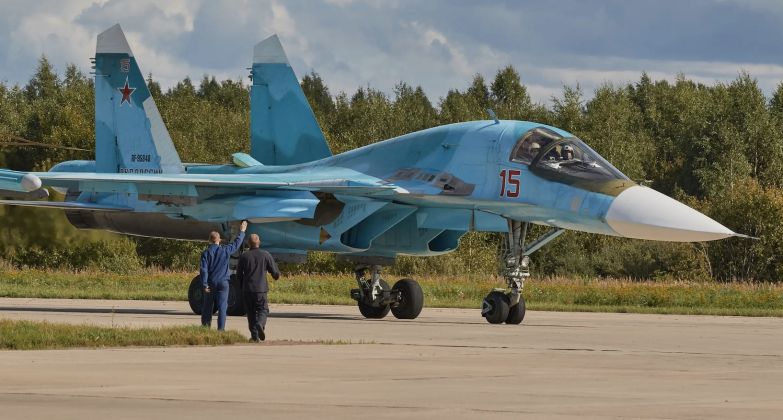
The Russian Aerospace Forces has continued to receive a new batch of Su-34s built to the updated Su-34M standard, following sustained efforts to expand production rates to over double peacetime levels. The aircraft have frequently been filmed launching intensive bombardment of Ukrainian and supporting Western forces, including using particularly large FAB-3000 glide bombs, bombs with thermobaric warheads, and a wide range of air-to-surface missile types. Alongside air-to-air and air-to-ground operations, the Su-34 is also relied on heavy for reconnaissance roles, which is enabled by the integration of a new dedicated interface for three different types of sensors including UKR-RT pod for electronic searching, the UKR-OE camera pod and the UKR-RL which integrates a synthetic aperture radar. This has allowed the aircraft to replace the Soviet Su-24MR in service.
