
Russian Shipbuilding Chief Claims Refurbished Kirov Cruiser Will Be World’s Top Surface Combatant - Is He Right?
Military Watch Magazine Editorial Staff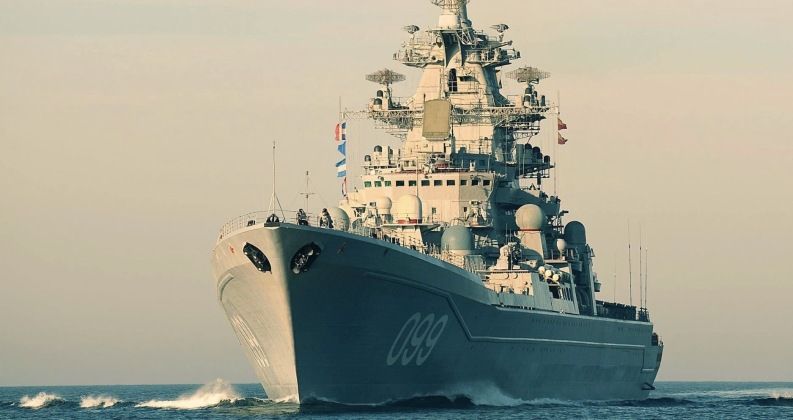
Russian Navy Kirov Class Battlecruiser
In the final years of the Cold War Soviet shipyards laid down four nuclear powered Kirov Class battlecruisers, which were designed to engage carrier strike groups of the U.S. Navy at long range and allow the Soviet Navy to do battle in blue waters far from its shores. Following the superpower’s collapse the Russian Navy inherited the Kirov Class ships, and while the much smaller small size and lower growth rates of the post-Soviet Russian economy forced it to retire the bulk of its surface fleet including two of the heavy cruisers, the country has invested heavily in refurbishing and modernising the remaining two. While one of the cruisers, the Pyotr Velikiy, is currently in frontline service, the second, the Admiral Nakhimov, has been under refurbishment since 2018. CEO of the Severnoye Design Bureau Andrei Dyachkov told TASS on April 22nd regarding improvements to the cruiser: “The high modernisation potential integrated in these ships upon their designing helped carry out certain works and outfit the Admiral Nakhimov with the most advanced weapons, which makes it the world’s strongest surface combat ship.” The Severnoye Design Bureau became a part of the United Shipbuilding Corporation following the collapse of the USSR, and marks its 75th anniversary in April 2021.
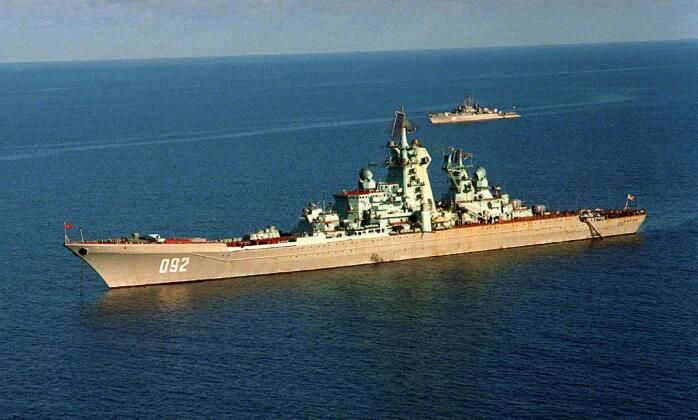
The warship Admiral Nakhimov was commissioned by the Soviet Navy in 1988, and was initially designed to operate a navalised variant of the S-300P surface to air missile system - the S-300F. Much as the S-300P has since been phased out of service, so too is the air defence system on the Admiral Nakhimov set to be replaced by a new navalised variant of the S-400. This will allow the warship to intercept aircraft - including stealth platforms, ballistic and cruise missiles at hypersonic speeds and at extreme ranges of up to 400km. The S-400 provides over half a dozen major munition types for the Admiral Nakhimov, which has the potential to provide unmatched versatility in an air defence role. The navalised S-400 used by the Admiral Nakhimov is expected to have 96 launch cells - accommodating the world’s largest arsenal of surface to air missiles on any warship. Complementary shorter ranged air defence systems include the Pantsir-ME, to replace the battlecruiser’s six Kashtan close in weapons systems, and a navalised variant of the S-350 Vityaz known as the Redut to replace the 44 4K33 ‘OSA-M’ missiles perviously in use.
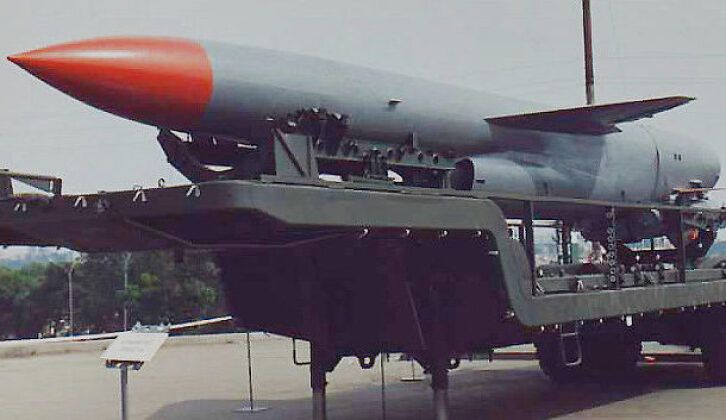
Beyond surface to air missiles, the Kirov is set to integrate a range of new sensors and offensive weapons. The battlecruisers were initially designed to accommodate 20 massive P-700 Granit ‘carrier killer’ anti ship cruise missiles - which had an unrivalled performance for their time and could approach speeds of Mach 3 and strike ships up to 625km away. These are expected to be replaced by 80 launch cells for smaller more modern cruise missiles, including for anti shipping the P-800 Oniks, the 3M54T Kalibr and the Zircon. The Zircon entered service in the Russian Navy in December 2019, and is considered the world’s foremost anti ship cruse missile today with a Mach 9 speed and 1000km range. The cruiser’s ability to carry up to 80 of these missiles alongside its formidable air defences allows it to pose a very serious threat to enemy surface fleets several time its size, and complements its very large and powerful sensor suite.
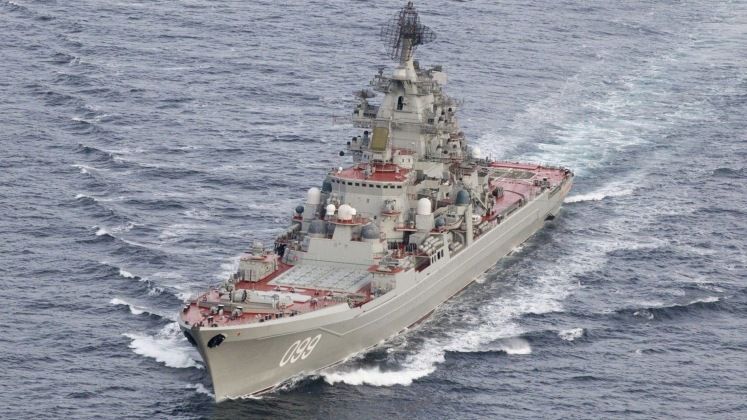
The 80 new launch cells will also be able to accommodate 3M14T Kalibr missiles for long range precision strikes against ground targets, with advanced inertial guidance systems providing an effective land attack capability. Although subsonic, the missile carries a large 450kg warhead and retains a formidable range of up to 2500km. The Admiral Nakhimov’s firepower and the sheer size of its sensor suite and air defence arsenal are totally unrivalled worldwide, and could well make the ship the most capable surface combatant in the world once its refurbishment its complete. Although its firepower is formidable however, it remains to be seen to what extent refurbishment will improve the reliability of the ship’s propulsion systems, and to what degree new electronic warfare systems and access to longer ranged missiles can compensate for the ship’s lack of stealth features that are found on more modern warships such as the Chinese Type 055 Class and American Zumwalt Class.
