
Russian Shahed Drones Take Out Ukraine’s High Value Attack Helicopters in Unprecedented Deep Strike Operation
Military Watch Magazine Editorial Staff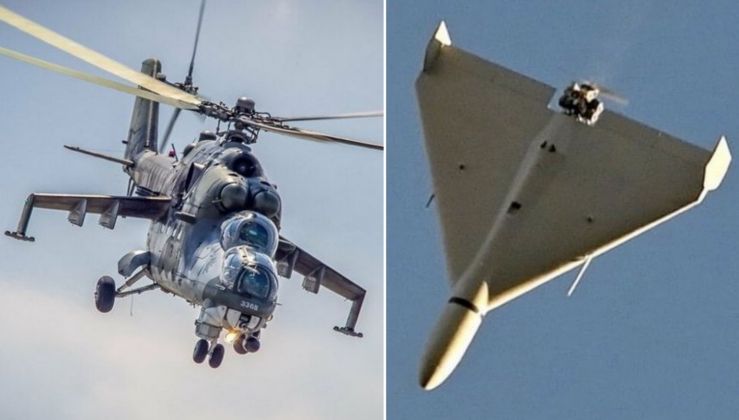
Mi-24 Helicopter and Shahed 136 Drone
The Russian Defence Ministry has published footage of a strike operation launched by single use attack drones to destroy two Ukrainian military helicopters deep behind the frontlines. One of the aircraft was a Soviet Mi-24 attack helicopter, which is one of the most high value aircraft in Ukrainian service and is particularly difficult to replace, while the other was an Mi-8 multirole helicopter which has been used to provide air support multiple times in the past. The video shows two separate hits achieved at Kanatovo Airfield, and an operator appearing to assist the drones’ inertial targeting systems. Commenting on the attack, Ukrainian electronic warfare specialist and advisor to the Ukrainian Defence Minister Sergey Beskrestnov observed that no additional Russian drones were nearby to relay commands during the attack. “Those [drones] were piloted manually at a low altitude to stay under the radar,” he concluded.
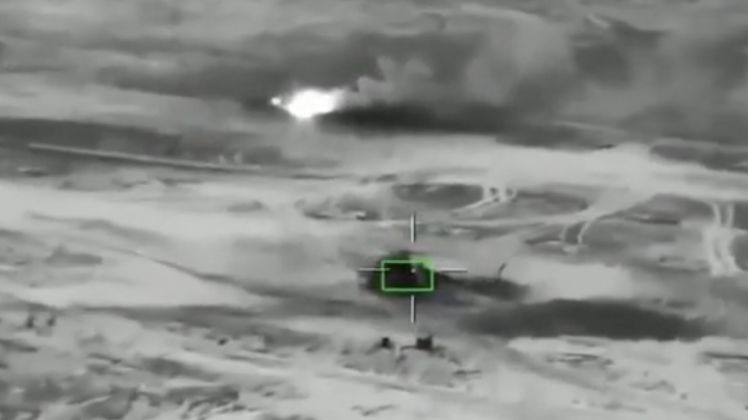
The location of Kanatovo Airfield in the Kirovograd region has fuelled considerable speculation that the unmanned aircraft involved in the strike were guided via satellite link, which would allow them to be controlled remotely deep behind enemy lines. This revolutionary capability would have significant implications not only for Russia, but also for Iran which supplied the Shahed 136 single use aircraft and associated technologies to allow for license production in Russian under the designation Geran 2. The aircraft have seen their targeting capabilities modernised considerably, and in October were reported to have demonstrated a new capability to strike dynamic moving targets near the frontlines. The aircraft have also been modified for new roles including limited air-to-air combat and mine warfare.
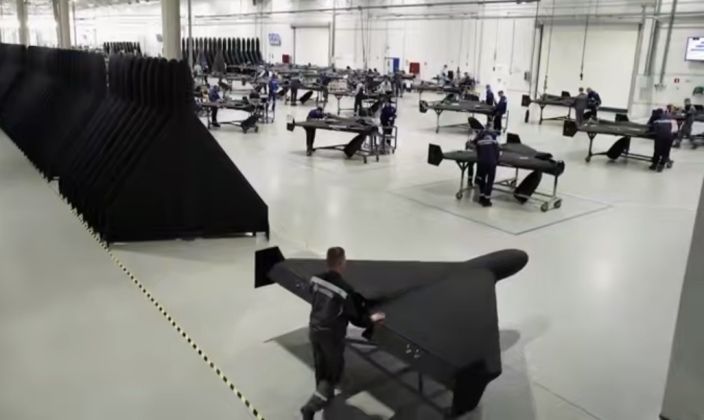
The Russian defence sector’s capacity to produce Geran 2 aircraft has expanded very significantly since the type was first introduced into service in late 2022, with The Economist reporting in May 2025 that output at the primary production facility, the Alabuga Factory in Tartarstan, had increased more than tenfold from 300 a month to over 100 per day. Industry was reported at the time to be on track to be able to produce 500 of the aircraft daily. Support from 25,000 North Korean workers has reportedly played a significant role in facilitating the expansion of production at the facility, as part of broader contributions by the East Asian state to the Russian war effort. Improvements to targeting capabilities have complemented the increase in numbers. It remains possible that only a portion of the aircraft intended for deep strike operations are being equipped with satellite data links, while those intended to strike targets nearer the frontlines are not in order to avoid an increase in costs across the fleet.
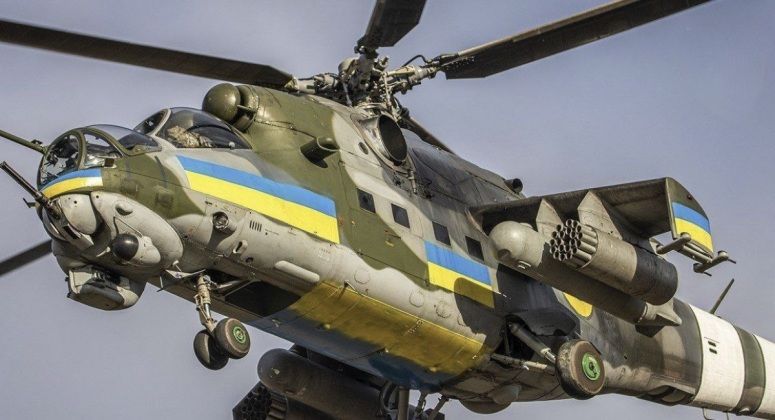
Ukraine inherited its Mi-24 fleet from the Soviet Union, with the aircraft having first entered service from 1972. They were widely being considered the most formidable attack helicopter type of the Cold War era, and have seen high intensity combat in multiple theatres. Preceding the outbreak of full scale hostilities in the country, the modernised Mi-24P variant established a favourable combat record in the Syrian theatre against heavily armed Turkish-backed jihadist terror groups. While the latest variant, the Mi-24P-1M, boasts an AESA radar, new modular direct infrared countermeasures system, and an improved autopilot, power supply unit and an OPS-24N-1L navigation and targeting station, those in Ukrainian service rely on avionics that are widely considered obsolete. Although the Mi-24 has widely been phased out of Russian service, and replaced by the newer Mi-28, the Mi-35 helicopter gunship was developed as a derivative of the Soviet design and remains in production to equip the Russian Armed Forces and multiple export clients.
