
Russian Analysts Claim the Su-57 Stealth Fighter Can’t Match the U.S. F-35: Are They Right?
Military Watch Magazine Editorial Staff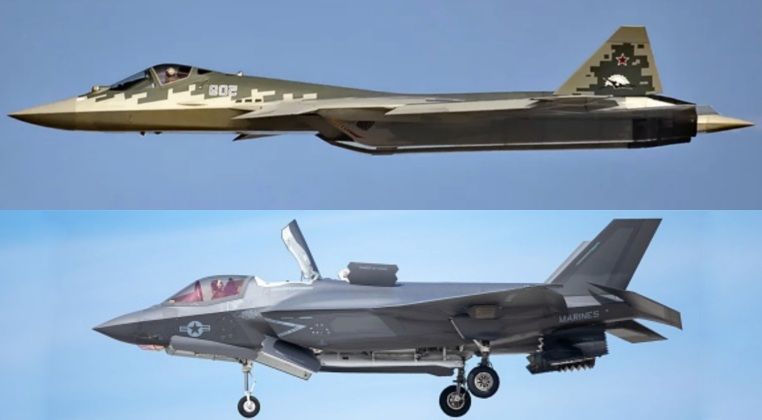
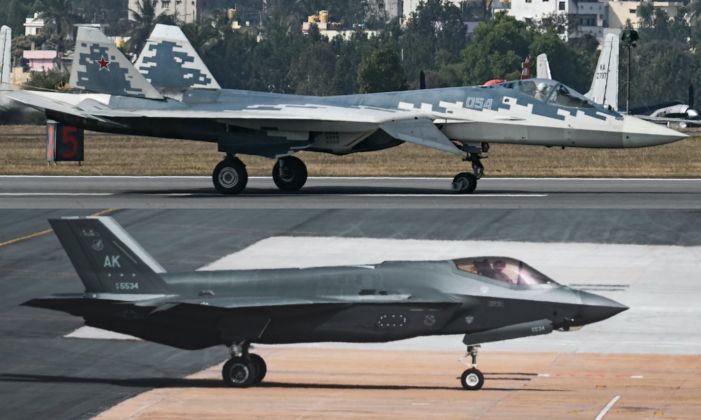
Russian Su-57 (top) and U.S. F-35 Fighters
Russian military analysts have engaged in a heated debate regarding the performance of the Su-57 fifth generation fighter program and the capabilities of the aircraft itself, with a statement by President Vladimir Putin referring to the fighter as the most capable in the world appearing to have sparked this discussion. Military analyst Maksim Kalashnikov, one of Russia’s more prominent defence commentators, strongly disputed the president’s statement, claiming that the Su-57’s limited operations evidenced that it was not comparable to the U.S. F-35. “If the Su-57 is a better aviation complex than the notorious F-35, then where is it in Ukraine?… The F-35s in the Israeli Air Force worked against Iran as if there was no air defence there at all. They struck air defence systems and hit critically important targets. But do we see analogous actions by the Su-57 in Ukraine? No, just drones and missiles. Do the Su-57s even follow behind their waves? In this life, deeds matter, not words. We’ve already been fed enough words,” he argued.
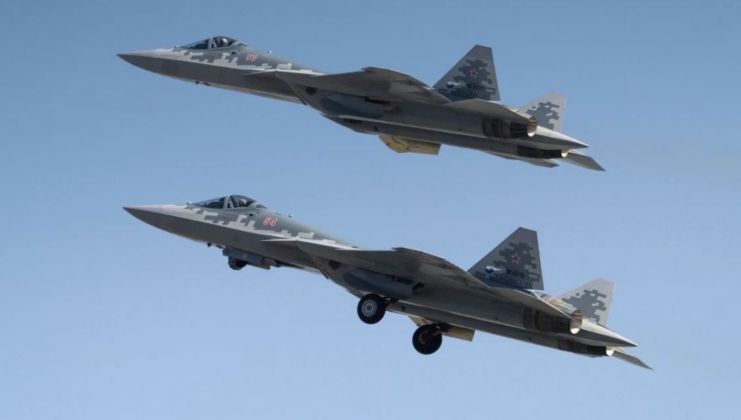
A separate line of commentary appearing beneath coverage of President Putin’s remarks extended the criticism further, addressing the aircraft’s technical status rather than just its operational employment. Also criticising the Su-57’s performance, one Russian commentator observed: “Without the S-70 Okhotnik, the Su-57 is also a museum rarity that never even became a true fifth-generation aircraft — not in terms of engines, not in avionics, not in stealth. Everyone can see the result of this state of affairs in the special military operation [Russian-Ukrainian War], where the Russian Aerospace Forces have failed to achieve air superiority over contested territory and have lost air superiority over Russian territory itself.” The S-70 referenced is an unmanned fighter developed to serve as a loyal wingman supporting Su-57 operations, extending its sensor reach and providing additional strike capacity while keeping the crewed aircraft out of the most dangerous engagement envelopes. The aircraft is thought to have superior stealth capabilities to the Su-57 itself, allowing it to more safely operate in heavily contested airspace.
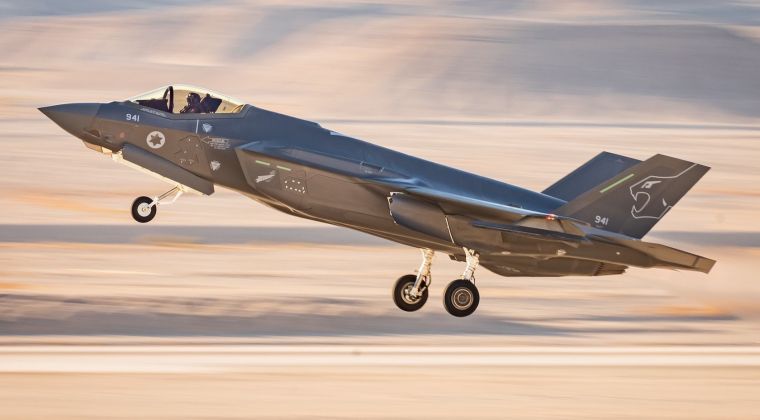
Regarding the argument that the Su-57 has played a much more limited role in the Ukrainian theatre than the F-35 has played in the Middle East, this argument has a number of caveats. The first is that the Su-57 is in service in far fewer numbers, with an estimated 50-60 operational compared to over 1,000 F-35s, which reflects Russia’s limited ability in the post-Soviet era to scale up production of complex new types of weaponry, rather than a flaw with the fighter itself. Less than six fighters were estimated to be in service when full scale hostilities in the Ukrainian theatre began, which inevitably prevented the type from playing as central a role as other fighter types. Nevertheless, Western and Ukrainian assessments indicate that the fighters have been deployed for a wide range of roles including air-to-air combat, suppression of hostile air defences, and complex precision strikes, while the intensity of operations had steadily risen as the size of the fleet has grown, and as the rate of fleet growth has accelerated.
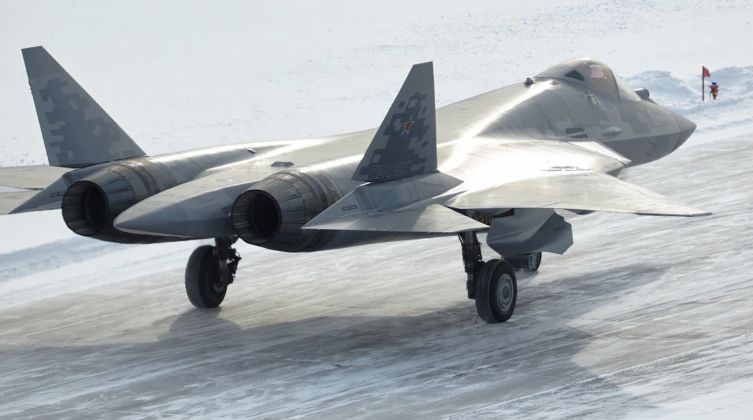
A further factor undermining the augment made by Maksim Kalashnikov is that the extent of the F-35’s operations in the Middle East have remained highly limited. Without Block 4 software, the fighters cannot integrate any air-to-ground missiles, unlike the Su-57 which integrates multiple types of missiles and has used them extensively against a variety of targets. Insight into the scope of F-35 operations by the Israel Air Force was provided by an Israeli Air Force officer, speaking under the pseudonym Lieutenant Colonel I. who in mid-2025 indicated that the aircraft were not involved in Israeli kinetic attacks on Iranian air defences that had been launched from June 13 that year. He observed:
“Most of the F-35 missions were intelligence and gave us a lot of information that other planes like the F-16I don’t have. They have a lot of equipment that helps them determine which missiles are heading towards us. And they actually can say to the F-16I, be aware you’re going to meet this kind of missile or another kind. And after we get this information, we do our attack mission that is more precise and more specific. So what we do in our formation is let the F-35 go first, see what’s going on, gather the intelligence and information and give it to us and to the other planes, and then we take this information and attack.”
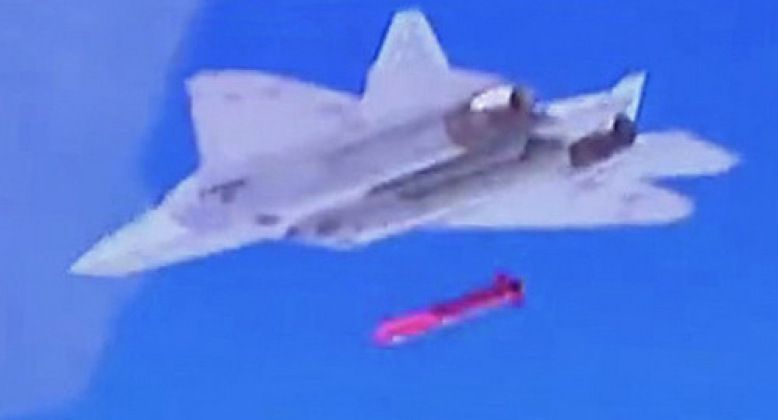
While the F-35’s intelligence collection capabilities and its network centric warfare capabilities are likely to significantly surpass those of the Su-57, its strike capabilities are in many respects far more constrained, which will remain the case until the aircraft are brought up to the Block 4 standard in the early 2030s. Furthermore, it is notable that while the Su-57 was designed to have similar maintenance needs and operational costs to fighters from the preceding generation, such as the Su-30 and Su-35, the F-35’s maintenance needs and operational costs are very considerably higher. Transitioning to the F-35 has thus had devastating effects for the U.S. Air Force’s availability rates, flight training hours, and for the size of its combat fleet as the F-35 cannot provide a one-for-one replacement for fighters of the preceding generation.
The scope of the Su-57’s operations in the Ukrainian theatre, despite the very small size of the fleet, are one notable indication of its maintenance-friendly design, with the scope of F-35 operations against Syria and Iran having been relatively limited when considering the sheer numbers in service. It is likely that when assessed per fighter, rather than by comparing fleets of vastly different sizes, the Su-57 has made a significantly greater contribution in terms of kinetic action to the Russian war effort against Ukraine, than the F-35 has to the U.S.-led war efforts against Syria and Iran. The F-35 and Su-57 program both have notable outstanding strengths and weaknesses, with the F-35 having pioneered a range of new technologies that make it by far the most sophisticated fighter outside China, while the Su-57 program has produced a fighter with far less performance issues, cost overruns, a much longer range and superior flight performance, and a greater emphasis on missile strike rather than bombing capabilities.
