
Russia’s Su-57 Fighter Gets Cutting Edge Helmet Mounted Targeting System
Military Watch Magazine Editorial Staff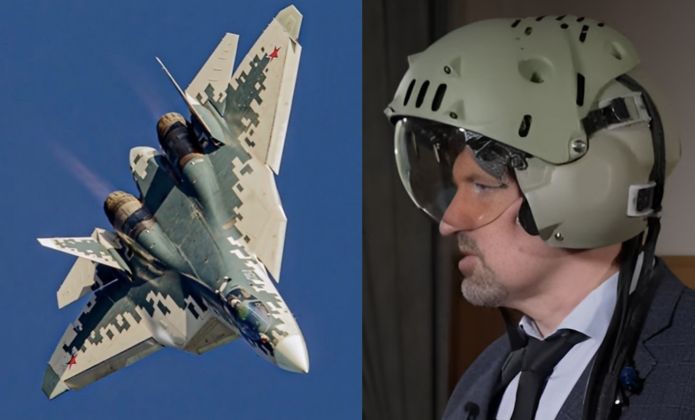
Su-57 and New Helmet System
Russian state media has unveiled a new helmet-mounted targeting system for the Su-57 fifth generation fighter, which is expected to narrow a key performance gap the aircraft suffered compared to its Chinese and American rivals the J-20 and F-35. Much like the helmets on these competing aircraft, the Su-57’s new helmet projects critical information directly onto the visor, including flight and targeting data. The helmet reportedly provides a comprehensive view of the operational environment, and pairs with the fighter’s sensors to significantly improve situational awareness.
A notable shortcoming of the Su-57’s system is that it is not paired with a distributed aperture system - a subsystem unique to the F-35 and China’s J-20 and FC-31 which allows pilots to ‘see through’ their aircraft using their helmets paired with using optical sensors, while also providing warnings of incoming threats. The Su-57 partly compensates for this with its unique suite of five active electronically scanned array radars - with some sources reporting a sixth radar deployed as well. These are dispersed across the airframe, in contrast to the J-20 and F-35 which deploy just a single radar. The fighter also remains hampered in the utility which its pilots can make of helmet mounted sights for high off boresight targeting due to a lack of comparable missiles to the Chinese PL-10 and American AIM-9X Block II, although such a missile was confirmed in 2021 to be under development.
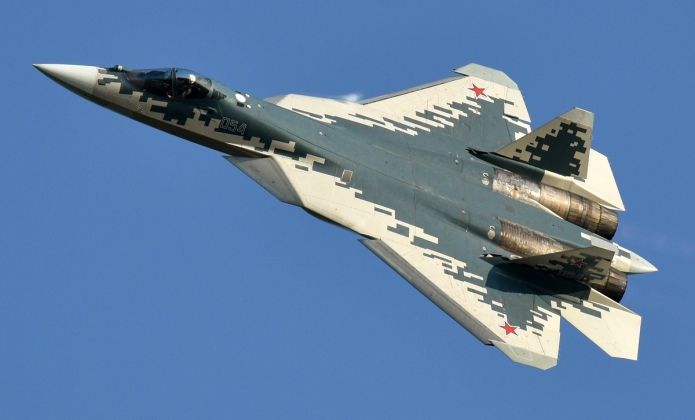
Russian industry has invested heavily in incrementally modernising the Su-57, with the unveiling of a new helmet for the fighter occurring less than 48 hours after the first footage of a radar cross section reducing nozzle for its engines was released. Russia is expected to remain considerably behind China and the United States in developing a sixth generation fighter, which makes it critical to maximise performance of its fifth generation aircraft, particularly as Su-57s are beginning to be produced on a much larger scale. There is a significant possibility that a decision on the procurement of new helmets may have been influenced by experience operating the Su-57 in the Ukrainian theatre, with the aircraft having seen far higher intensity combat testing than any other fighter of its generation. Operations having included air defence suppression, air to air combat, and operations in heavily defended enemy airspace, as well as a range of precision strike missions. Another significant possibility is that exercises with Chinese fighter aircraft, including the fifth generation J-20, may have led the Russian Air Force to appreciate the importance of advanced helmet systems for fighter operations in the 2020s.
