
Russian Su-30SM2 Long Range Fighters Adopt Offensive Weapons Configuration For Flight Near NATO Airspace
Military Watch Magazine Editorial Staff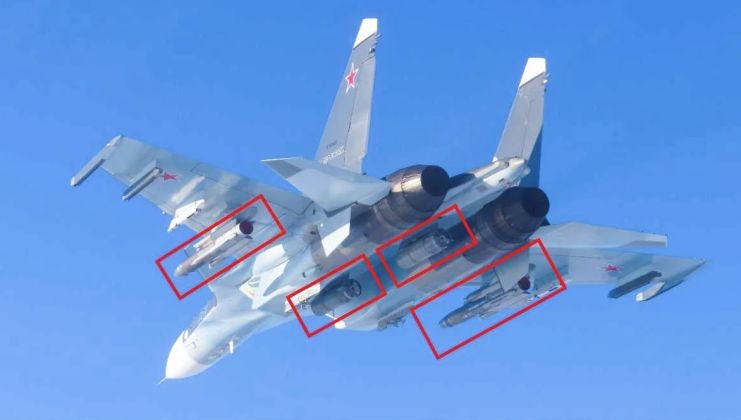
Russian Navy Su-30SM2 with Kh-31 Missiles and RBK-500 Bombs
Russian Armed Forces Su-30SM2 long range fighters were deployed for operations over the Baltic region with an unusual weapons configuration, which included a mixed load of Kh-31 anti-radiation missiles and RBK-500 cluster bombs. Footage released by the Spanish Ministry of Defence revealed this loadout, after Spanish Air Force F-18 fighters operating from Siauliai Air Base in Lithuania were scrambled to intercept the Russian aircraft, and after making close approachs took photos of them. Spanish aircraft were vectored by the NATO Combined Air Operations Centre to climb, visually identify the intruders and escort them away from NATO airspace, in line with standard procedures. The Su-30SM2 was operated by the 4th Guards Naval Attack Aviation Regiment based at Chernyakhovsk Air Base in Russia’s Kaliningrad region.
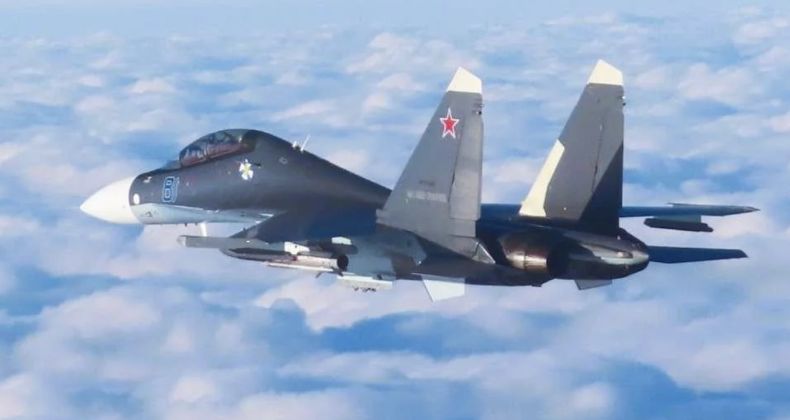
The carriage of air-to-ground weapons, rather than air-to-air missiles, may be a response to the current state of high tensions between Russia and NATO members, signalling that the Navy and Aerospace forces are ready to take to the offensive against critical ground targets, including launching precision strikes on radar and air defence systems using Kh-31 missiles. Fighters based in Kaliningrad have long had some of the highest intensities of operations, and engaged NATO aircraft most frequently, with Su-27 air superiority fighters having gradually been phased out from early 2022 as they are replaced by Su-30SM2 fighters. The Su-30SM2 is the newest fighter type in the Russian Armed Forces, and has a significantly larger sensor suite, longer range, higher weapons carrying capacity, and higher levels of manoeuvrability than any fighter type in the Western world.
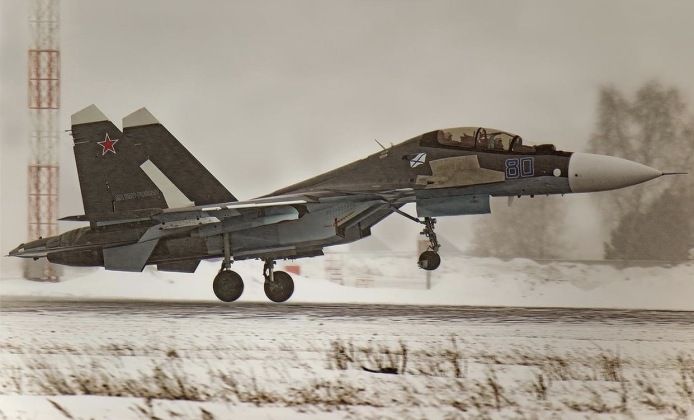
The Su-30SM2 has been intensively combat tested since it began to enter service in early 2022, with the Russian-Ukrainian War providing significant opportunities to further refine operational tactics. According to Russian state defence production conglomerate Rostec the aircraft “have confirmed their effectiveness” and “have a record of hundreds of destroyed aerial and ground targets, including Patriot systems.” “Thanks to its powerful radar, the Su-30SM2 can ‘see’ farther and more accurately, which facilitates the crew’s operation. In turn, its advanced electronic warfare system allows the fighter to effectively counter enemy air-launched weapons,” the report added. The reported destruction of Patriot air defence systems indicates that the aircraft serving in either the Navy or the Aerospace Forces may have employed Kh-31 missiles for air defence suppression operations in the past.
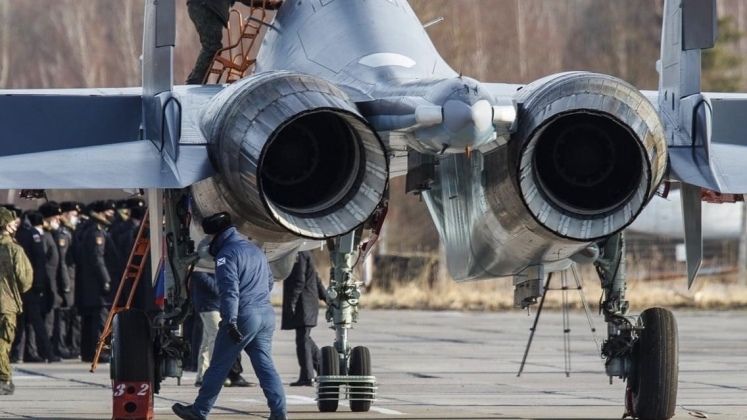
A primary improvement of the Su-30SM2 over older Su-30 variants is the integration of the new AL-41F-1S engine, which was developed for the Su-35 air superiority fighter, and which significantly improved its range, flight performance, and the power available for onboard systems. The engine’s thrust levels, fuel efficiency, and thrust/weight ratio are more comparable to those of fifth generation fighters such as the U.S. Air Force F-22’s F119 engine. The AL-41F-1S has significantly lower maintenance requirements and longer lifetimes than the older AL-31 series that powered the older Su-30SM variant, and has three dimensional thrust vectoring capabilities which allow for very high levels of low speed manoeuvrability. The Su-30SM/SM2 is itself a significantly lower maintenance design than the Su-35, and is less specialised in air-to-air operations, with its twin seat configuration allowing for the accommodation of a weapons’ systems officer to more effectively utilise air-to-ground weapons by distributing workload.
