
What Makes Russia’s Delayed T-14 Tank Much More Capable Than its Current T-90M Frontline Tank
Military Watch Magazine Editorial Staff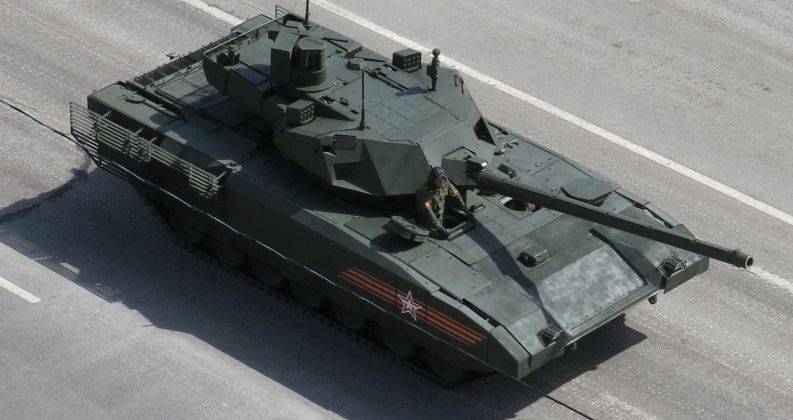
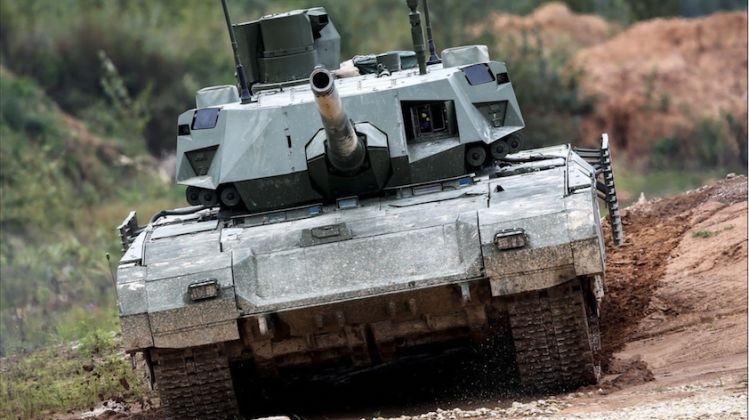
Russian T-14 Tank Prototype
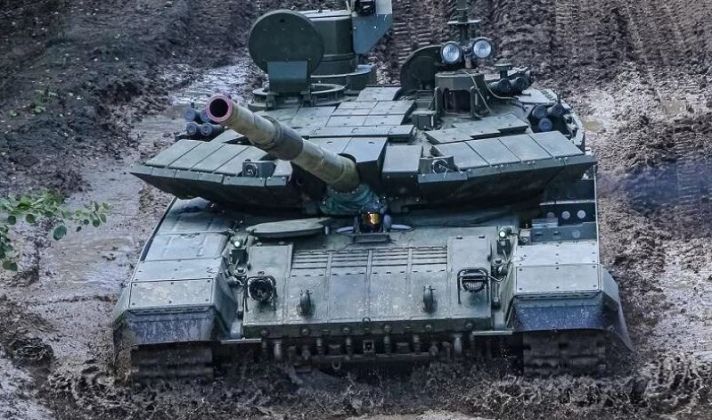
The Russian defence sector has been widely assessed by Western analysts to have achieved considerable successes in expanding production of the country’s most capable type of operational main battle tank, the T-90M, as the rapid wartime depletion of Soviet era tank reserves has made it critical to rapidly replace losses with new T-90s. Having achieved an approximate tripling of output from 90-110 T-90 tanks per year in 2020-2021, to 280-300 tanks in 2024, an assessment by the Conflict Intelligence Team in 2025 indicated that output will reach a landmark 1,000 T-90M tanks by mid-2028, and 3000 by mid-2035. The concentration of investment on providing urgently needed new T-90s, and on conservatively modernising the design, has raised serious questions regarding the status of Russia’s next generation main battle tank, the T-14, as the country falls further behind China in tank development, and appears poised to potentially fall behind South Korea and the United States unless T-14s can be brought into service.
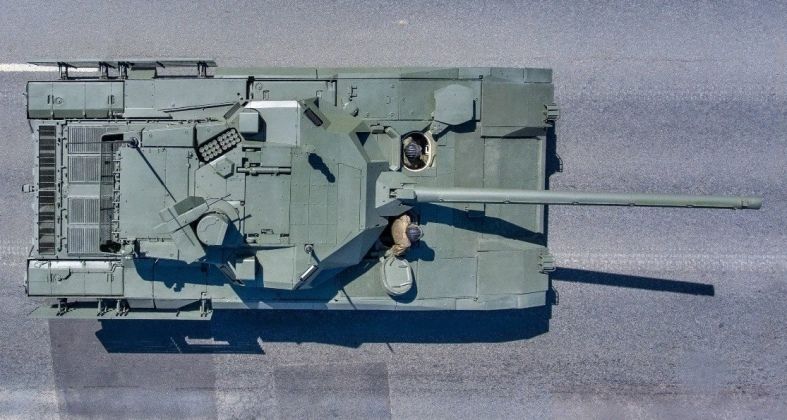
Where the T-90M represents a very heavily enhanced derivative of the T-72 tank, which first entered service in 1973, the T-14 is a clean sheet design that prioritises crew survivability, digital networking, and future growth potential. One of its most important innovations is its unmanned turret and armoured crew capsule. Instead of placing crew members inside the turret as on the T-90M, all three crew members sit together in a heavily protected compartment at the front of the hull, minimising the risk of casualties. Its design is highly efficient, with its turret being very significantly lighter than those of currently operational Russian tanks, allowing for a much heavier chassis with greater crew protection without a significant increase in the vehicle’s overall weight over tanks like the T-90. In addition to composite armour and explosive reactive armour, the T-14 also integrates the Afganit active protection system, providing a far superior hard-kill active protection capability.
The T-14 employs a multi-layered defensive concept combining passive composite protection, explosive reactive armour, active protection systems, electronic countermeasures, smoke and aerosol launchers, and crew compartment isolation into a single integrated defensive package. The objective is to defeat threats at multiple stages - from preventing detection, to disrupting guidance systems, to intercepting incoming projectiles, and finally resisting penetration if all other measures fail. This layered approach reflects modern trends in armoured vehicle design and represents a significant conceptual advance over the more traditional protection philosophy embodied by the T-90M. Designers also sought to reduce the tank’s radar, infrared, and visual signatures through the use of angular armour shaping, heat management systems, and shielding around the engine compartment. A lower infrared signature can make the tank more difficult to detect with thermal imaging equipment, while reduced radar reflectivity may complicate targeting by certain guided munitions.
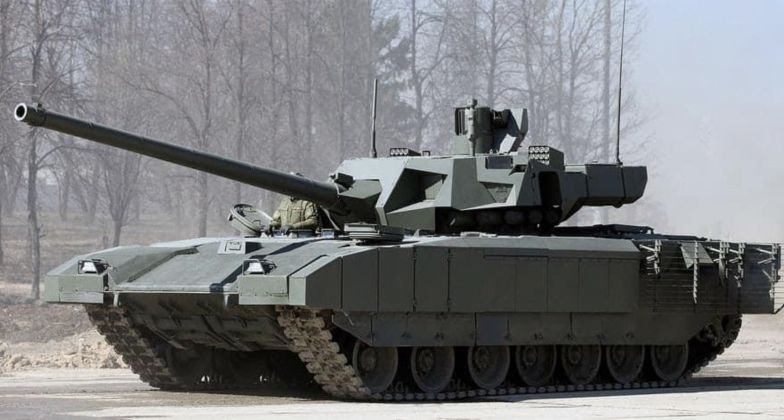
The T-14 further benefits from a far more advanced sensor suite and battlefield management system than the T-90M. It incorporates multiple electro-optical cameras providing near-360-degree situational awareness, advanced thermal imagers, digital displays, and integrated communications that allow it to share targeting information across the battlefield. This gives commanders a much clearer picture of threats than the T-90M’s more conventional sights and optics. The T-14 was engineered with a much greater emphasis on network-centric warfare than the T-90M. Its digital architecture allows the tank to function as a node within a larger battlefield information network, sharing target coordinates, reconnaissance data, and threat information with other armoured vehicles, artillery units, drones, and command posts. The extensive use of digital architecture also simplifies future upgrades and integration with unmanned systems.
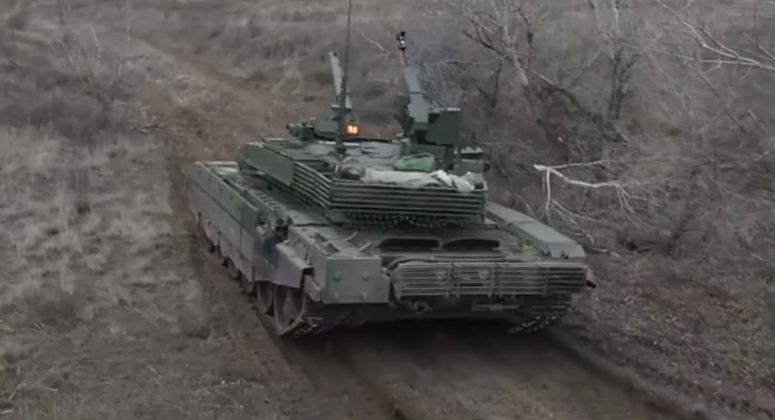
The T-14’s 2A82-1M smoothbore gun is reported to offer higher chamber pressures, improved accuracy, and greater muzzle energy than the 2A46M gun used by the T-90M, enabling the use of more powerful armour-piercing ammunition and provides greater growth potential. Its redesigned autoloader is capable of accommodating longer and more advanced kinetic-energy penetrators such as the reported Vakuum-1 round, improving armour penetration capabilities. The new tank’s emphasis on artificial intelligence-assisted target processing is also noteworthy, with Its fire-control system is designed to automatically detect, classify, and prioritise potential targets using information from thermal imagers, optical cameras, and radar sensors, shortening reaction times and reducing workload. The T-14’s major advances in protection levels and firepower are complemented by its significantly superior mobility, as its integration of a 1,500 horsepower was intended to provide an outstandingly high power-to-weight ratio.
While the T-90M represented a major improvement over preceding Russian tank designs when it was brought into service in April 2020, it falls far short of the promise of the T-14 program. From an operational perspective even a small number of T-14s could provide significant benefits, both for more demanding missions such as armoured breakthroughs, and to function as command tanks using their advanced sensors, communications, and protection systems to serve as force multipliers. The tank’s potential on export markets was also seen to be very considerable. While the Soviet Union was able to pioneer new generations of tank technologies, however, post-Soviet Russia has struggled to make similarly major leaps forward, which has left the future of the T-14 program highly uncertain. This has significant implications for the future of the country’s armed forces and its defence sector, as while a primary advantage of the T-90M is that its simpler design is likely to make the rapid expansion of production more feasible, fielding T-14s would potentially be far less costly due to their far greater survivability and much greater ability to support important advances. Thus although the feasibility of introducing the tank into service in wartime remains questionable, the years long delays that prevented it from being introduced before full scale hostilities began in early 2022 have been highly detrimental to the Russian Army.
