
Plan to Reuse Nimitz Class Aircraft Carriers’ High Output Nuclear Reactors to Power AI Boom Pitched By Texas Firm
Military Watch Magazine Editorial Staff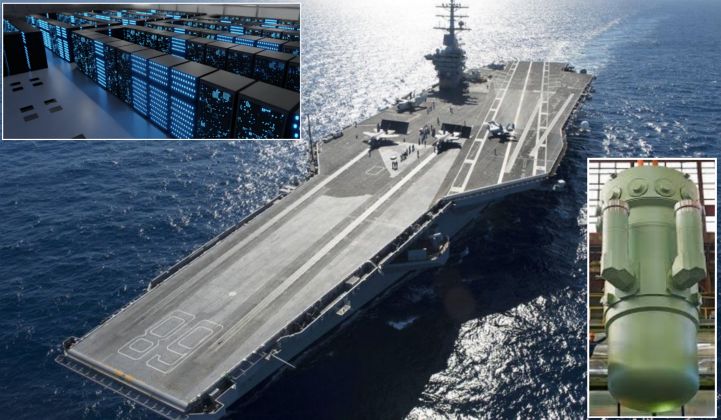
USS Nimitz, AI Data Centre, and A4W Reactor
The Texas-based firm Intelligent Energy has proposed using retired nuclear reactors currently integrated onto the U.S. Navy’s first Nimitz class supercarrier, USS Nimitz, to supply electricity for artificial intelligence data centres at Oak Ridge National Laboratory in Tennessee. First deployed in March 1975, the 50 year old carrier is scheduled to be decommissioned in 2026, with the dismantling and recycling a aircraft expected to unfold across five phases, each taking up to a decade, with total costs expected to exceed $1 billion. The firm Huntington Ingalls Industries in December 2025 received a $33.5 million contract modification to begin preparations for inactivation and duelling of the ship.

Should Intelligent Energy’s plan to repurpose the aircraft carrier’s reactor proceed successfully, it would set a precedent for the retirement of nine more Nimitz class ships, providing a total of 20 550MW A4W reactors. These can each produce 4.3–4.5 terawatt-hours (TWh) per year, sufficient to serve as a primary power source for a large city or a major industrial ecosystem, and to power 400,000–500,000 average homes in the United States. Intelligent Energy has estimated that the reactors could be repurposed and set up on land at a cost of around $2 billion, a fraction of the cost of building new civilian nuclear power stations. The proposal leverages decades-old supply chains, which have significant overlap with those of the A1B nuclear reactors being built and sustained to power the new Gerald Ford class supercarriers.

The ability to power AI data centres has very significant strategic implications for the United States, as the country remains in a highly contested AI race with China.Artificial intelligence is considered a dual use technology, and is expected to have the greatest impact on both countries’ military modernisation in the coming two decades. A single large AI training run can consume tens to hundreds of gigawatt-hours (GWh) of electricity, while power density for AI data centres can see their power density exceed 50–100 kW per rack, compared to 5–10 kW for traditional information technology.

The AI industry converts electrical power directly into intelligence at an industrial scale, which has raised questions regarding how they will be powered due to infrastructure shortcomings the United States. One of the biggest obstacles to repurposing naval nuclear reactors, however, remains the cost and risks involved with obtaining weapons-grade highly enriched uranium fuel. The 93% uranium-235 fuel could be used to make nuclear weapons, while the reactor technology, despite its age, remains a highly sensitive technology which could be difficult to approve for transition to civilian operators.
