
North Korea Celebrates 70 Years Since its Founding - The Military Parade in Pictures and What to Expect in the Coming Decade
Military Watch Magazine Editorial Staff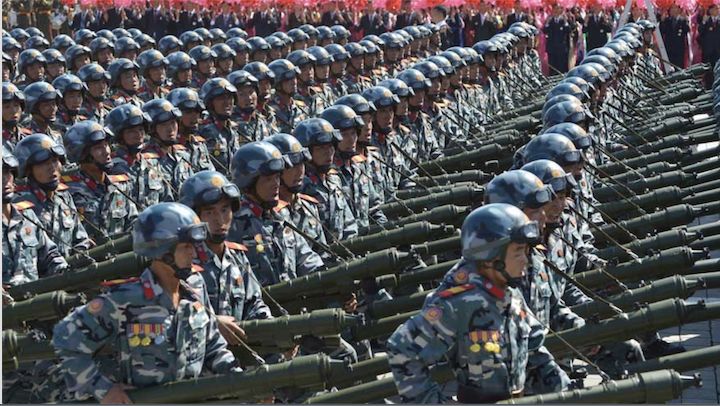
North Korean Soldiers with Heavy Weapons on Parade
Marking 70 years since its founding on September 9th 1948, North Korea staged a large military parade in Kim Il Sung square to mark the occasion. While the country's advanced new nuclear capable ballistic missiles, previously displayed on parade seven months prior in February marking seven decades since the foundation of the Korean People's Army, advanced indigenous hardware, from KN-06 surface to air missile batteries and Kumsong-3 anti ship missile systems to Pokpung Ho battle tanks and Koksan artillery pieces were all placed on display. The country's special forces played a prominent role in the display of military force, alongside tens of thousands of soldiers, sailors and airmen. New weapons systems including heavy weapons, rifles and armoured personnel carriers were displayed - with a far grater emphasis placed on cutting edge conventional capabilities rather than on nuclear arms. Despite spending only a very small fraction of its defence budget on foreign acquisitions since the 1990s, the evolution of the Korean People's Army over two decades has been considerable, and the vast quantities of modern hardware on display demonstrate the strength of and continued innovation within the country's defence sector despite considerable Western pressure both on the country's economy and on the country's defence clients across the world to seek alternative sources of arms.
Alongside a show of force and display of some of the latest military hardware, a sizeable civilian parade also took place displaying popular slogans relating to national reunification, economic progress and other patriotic themes - with statues of the country's deceased leaders Kim Il Sung and Kim Jong Il also displayed in the wake of a massive national flag. Overhead Soviet Su-25 strike fighters and indigenous variants of the An-2 biplane, a platform manufactured in large numbers and relied on to infiltrate special forces behind enemy lines, held a simultaneous airshow displaying national colours and the number 70 respectively. The parade was attended by numerous foreign representatives, from relatively small Korean partners such as Syria and Mauritania to high profile envoys from Russia and China, and was concluded by a speech by Presidium President Kim Yong Nam focusing heavily on plans for renewed economic development in the wake of the country's successful development of a viable nuclear deterrent. North Korea has evolved considerably both as a nation and in terms of its defence capabilities in the past ten years, since leader Kim Jong Il failed to make an appearance at a major parade in 2008 marking 60 years since the country's founding, which also marked the beginning of the rise to power of the current leader, Kim Jong Un, due to his father's ailing health. What the next ten years will hold for North Korea remain to be seen, but a renewed focus on economic development and major improvements in living standards - accompanied by a potential contraction and eliteisation of the armed forces into a smaller, better armed, nuclear backed and more professional body which will free up funds and manpower for economic projects - remains highly likely. Indeed, the growing emphasis on special forces and elite personnel armed with high end munitions in military parades held since April 2017, a considerable departure from the past where quantities of manpower were the key emphasis, indicates that such a transition is likely already well underway - to better suit the country's modernising economy and defence capabilities.
