
Mass Produced U.S. MQ-9 Combat Drones Expand Anti-Submarine Capabilities For New Pacific Operations
Military Watch Magazine Editorial Staff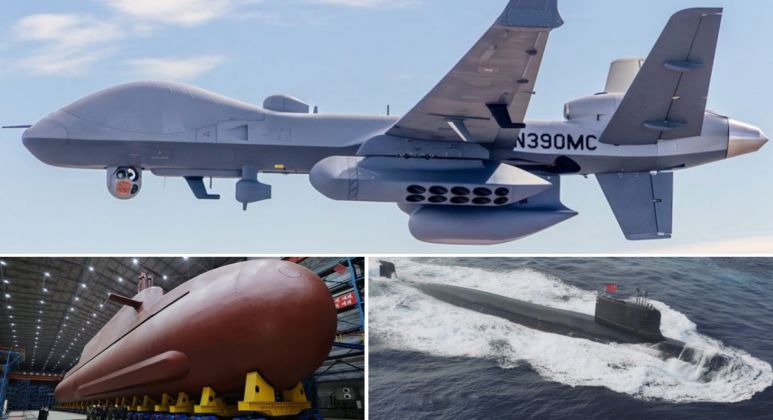
MQ-9 with Sonobuoys and Chinese and North Korean Nuclear Submarines
The primary developer of the MQ-9 unmanned combat aircraft General Atomics Aeronautical Systems has confirmed the demonstration of the new expanded Anti-Submarine Warfare capability in December, namely a significantly improved capability to deploy sonobuoys pods for detection of underwater targets. The tests were specifically conducted using the MQ-9B SeaGuardian variant, which has an endurance of over 18 hours and integrates the 7500E V2 radar optimised for detecting surface targets. The test was sponsored by the U.S. Navy, took place at an unknown location, and was supported by the Naval Air Warfare Center Aircraft Division’s AIRWorks department to certify the aircraft’s new Sonobuoy Dispensing System (SDS).
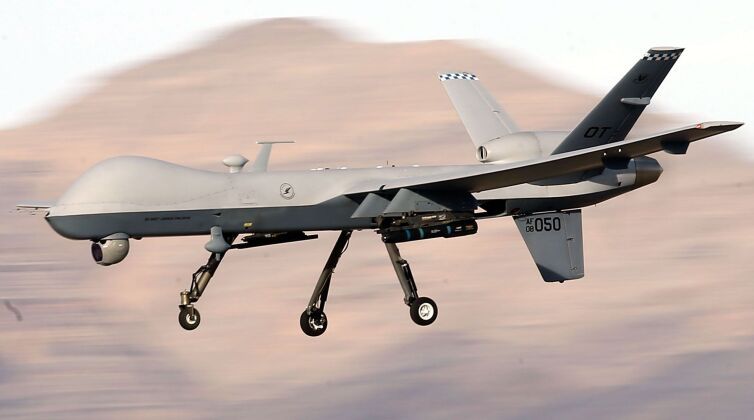
General Atomics specified that the pods were “more than previously tested, doubling the number of sonobuoys available,” with images showing the aircraft carrying two SDS pods. The firm studied testing a sonobuoy launch capability from the MQ-9B as early as 2016, with the aircraft having proven able to carry and control them while send information back to the ground station by satellite. The MQ-9B was designed to be flown over the horizon via satellite link for extended periods, which is a particularly valuable capability when operating over the vast distances of the Pacific. While the MQ-9’s combat capabilities remain highly limited, which restricts its viability operating against adversaries with advanced anti-aircraft capabilities, the use of the aircraft to detect enemy submarines over wide areas of ocean could significantly increase their utility in East Asia for non-combat roles.
The MQ-9 first entered service in 2007, and is prized for its very low training and operational costs, and quickly became the world’s most iconic multirole unmanned combat aircraft. Costing approximately $150 million each, the aircraft mad headlines 2023-2024 for the significant numbers that were shot down by Yemeni Ansuruallah Coalition paramilitary units, with over ten reported to have been destroyed in the theatre over a period of little over a year. Deployment for anti-submarine warfare operations would complement the deployment of a wide and growing range of both manned and unmanned assets capable of increasing the United States and its strategic partners’ situational awareness in the Pacific, including the P-8 Poseidon fleet which forms the backbone of the U.S. Armed Forces’ airborne anti-submarine warfare capability, as well as aircraft such as unmanned the RQ-170 and MQ-7C Triton which are designed for very long range reconnaissance operations.
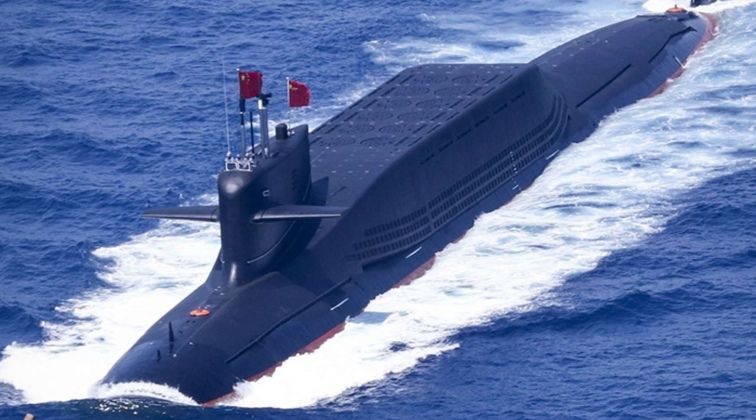
Investment in enhancing the MQ-9’s anti-submarine warfare capabilities has occurred at a time when China, Russia and North Korea are all rapidly modernising and expanding their submarine fleets. The U.S. Navy has perceived a fast growing challenge from China’s submarine fleet, with the service entry of new generations of vessels and associated armaments having occurred at an unparalleled rate. The latest estimates for the size of the Chinese nuclear powered submarine fleet indicates that it is now the world’s second largest, primarily due to the large scale production of the Type 093B class attack submarine, while first the revolutionary next generation Type 095 and Type 096 class ships have already begun construction. Russia has expanded planned production numbers for its Yasen-M class attack submarines and Borei class ballistic missile submarines, with eight of the latter in service and four more planned, while the former has seen its capabilities enhanced from 2025 with the integration of Zircon hypersonic cruise missiles. North Korea is expected to begin operating its first nuclear powered submarine before 2030.
