
Latest Batch of Su-34 Strike Fighters Delivered to the Russian Air Force Benefit From New Modifications
Military Watch Magazine Editorial Staff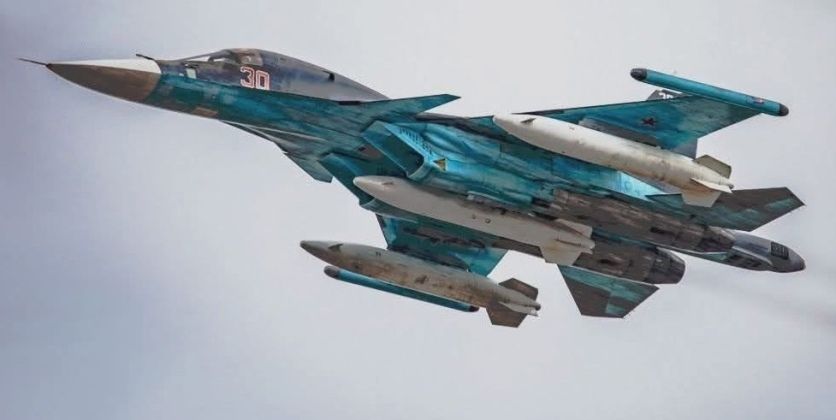
Su-34 with 3000 Litre External Fuel Tanks
A new batch of Su-34M strike fighters delivered to the Russian Aerospace Forces are confirmed to have benefitted from a new modification, with their new dorsal antenna fairing appearing to be intended to improve connectivity, mission flexibility, and responsiveness, which is critical for precision strikes. The antenna is thought to integrate satellite communications, advanced datalinks, or electronic mission systems, with its location on the aircraft indicating that communications and positioning systems are most likely. Introduced into service from 2014 to rapidly phase the Soviet Su-24 fleet out of service, the Su-34 has benefitted from continuous modernisation, with a landmark in this process being the transition of production in 2021 from the baseline variant to the enhanced Su-34M variant with heavily improved avionics.
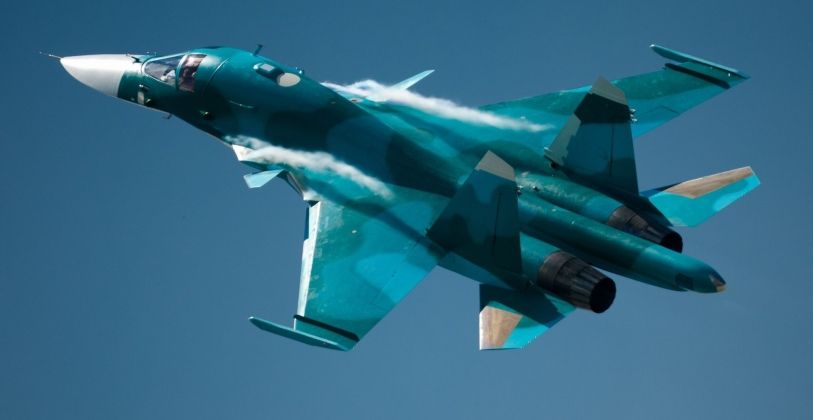
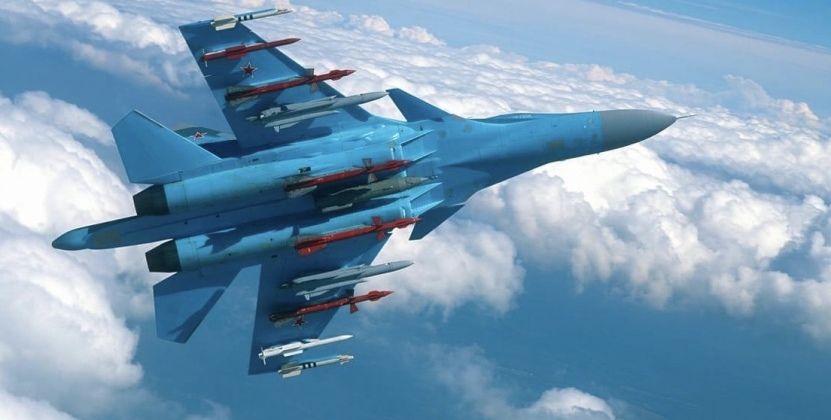
The Su-34 is by far the longest ranged fighter type in the world, and has an outstandingly high weapons carrying capacity, while also being significantly less costly to procure than more complex Su-35 and Su-57 fighters. Beyond service as a strike fighter and direct successor to the Su-24M, the Su-34 was also intended to replace Russia’s primary close air support aircraft the Su-25, an analogue to the American A-10, while also potentially replacing the much larger Tu-22M3 bomber in service. Developed as a derivative of the Su-27 Flanker air superiority fighter, albeit with an approximately 50 percent greater weight, the fighters retain a formidable secondary air-to-air combat capability, allowing them to operate without escorts, and to at times be equipped purely for air-to-air operations. The fighters were in mid-June involved in an engagement with Swedish Gripen fighters over the Baltic Sea.
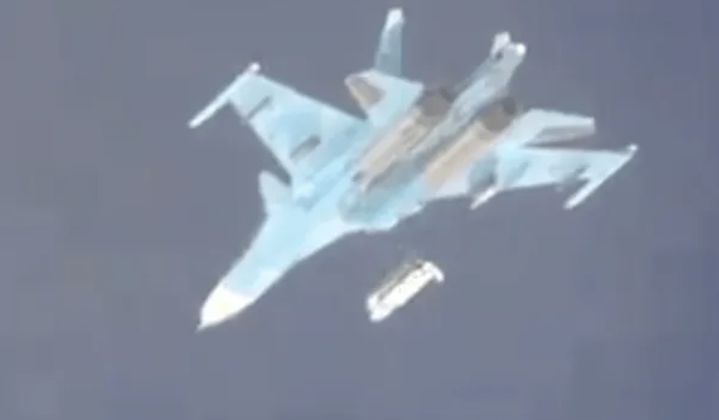
Su-34 fighter units have played a particularly central role in the Russian-Ukrainian War, with loss rates remaining low relative to the intensity with which they are flown near the front lines. The Russian Aerospace Forces from early 2023 began to rely increasingly heavily on using glide bombs to launch attacks from safer distances, with the first unified gliding and correction modules allowing bombs to travel 40-50 kilometres when dropped from altitudes of 10-12,000 metre altitudes, before this range was later increased to 80 kilometres. In October 2025 the deputy head of Ukraine’s Main Directorate of Intelligence Vadim Skibitsky stated that a new type of glide bomb had demonstrated a range of 193 kilometres. Improvements in glide bomb technologies have been a primary factor enhancing the combat potentials of Su-34 units.
Ukrainian frontline personnel speaking to various Western media outlets have widely singled out the effects of glide bomb strikes, stressing that these were obliterating their underground bunkers. One soldier compared their impact to “hell’s gates,” stressing that the Russian Aerospace Forces “would send them two by two by two, eight in an hour… It sounds like a jet coming down on you.” These strikes have been a primary contributor to the extreme casualty rates suffered by the Ukrainian Army’s frontline units, which had in several cases approached 80-90 percent. Russia is expected to continue to procure the Su-34 on a much larger scale than other fourth generation fighter types, with Su-57 fifth generation fighter production expected to be brought up to a similar level.
