
Russian Su-34 Long Range Strike Fighters Engaged By Swedish Gripens Jets Over the Baltic Sea
Military Watch Magazine Editorial Staff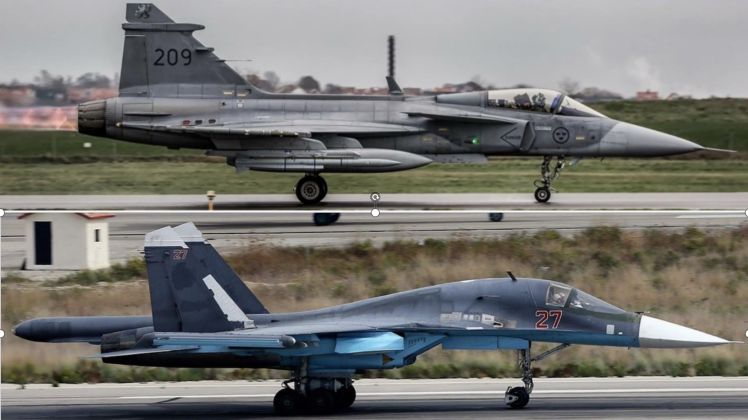
Gripen (top) and Su-34 Fighters
The Swedish Air Force launched Gripen C/D lightweight fighters to intercept Russian military aircraft operating near the country’s airspace over the Baltic Sea, with separate incidents occurring in the southern and northern parts of the Baltic on the same day. The Russian aircraft involved were identified as a Su-34 strike fighters and the type’s direct predecessor the Su-24M. Images from the incident show a Russian Air Force Su-24MR, the dedicated tactical reconnaissance variant of the aircraft, suggesting at least one of the Russian aircraft was conducting intelligence collection rather than being on a combat patrol. Vice Admiral Ewa Skoog Haslum, Head of the Swedish Armed Forces’ Joint Operations Command, commented regarding the engagements: “The Russian behaviour is serious and represents a recurring pattern that threatens both our territorial integrity and security… Swedish and allied combat aircraft acted swiftly, resolutely and clearly by intercepting the Russian aircraft and securing the territory of Sweden and the Alliance.”
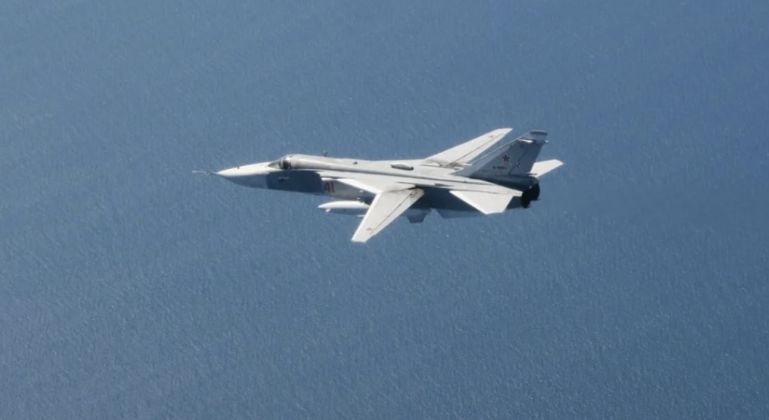
The Su-34 is by far the longest ranged fighter type in the world, and has been introduced into service from 2014 to rapidly phase the Soviet Su-24 fleet out of service, replacing them in combat and reconnaissance roles, while also providing a formidable secondary air-to-air combat capability which the Su-24 lacked. The Su-34 intercepted over the Baltic may have been conducting reconnaissance, with the aircraft integrating three variants of the Sych universal reconnaissance pod system allowing the aircraft to operate in a much wider range of roles, and collect real-time intelligence while still remaining armed for strike operations. The pods are required to be mounted externally, with the three variants respectively having been designed for radio-technical, radar, and optical surveillance. Russian fighters are nevertheless highly restricted in their intelligence gathering capabilities compared to the U.S. F-35 and EA-18G and Chinese J-16D and J-15D, which integrate vast arrays of passive sensors for electronic intelligence built into their airframes. F-35s have been flown extensively near Russian to collect electronic intelligence.
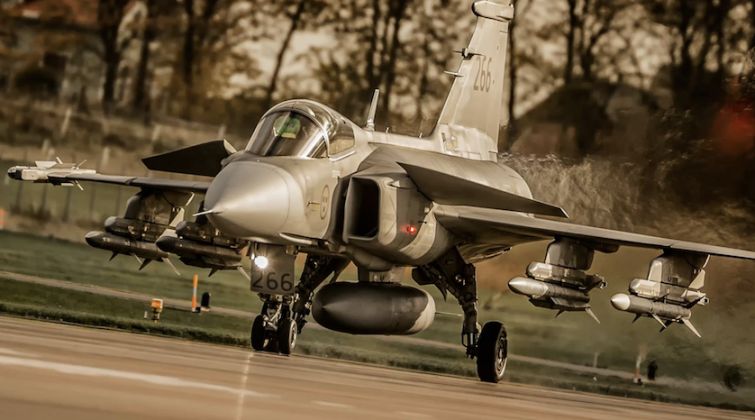
Swedish frontline fighter units have since the country’s accession to NATO been among the least capable of the alliance’s major air forces, with the Gripen C/D not only being a very lightweight design with limited capabilities, but also being largely obsolete. The Swedish Air Force received its first Gripen E/F ‘4+ generation’ fighter only on October 20, 2026, with the rate of service entry expected to remain limited. The Gripen C/D uses a mechanically scanned array radar that is among the weakest of any fighter type built in the post-Cold War era, and is highly susceptible to jamming. The limited power of the radar not only creates electronic warfare vulnerabilities, but also limits situational awareness, forcing the Gripens to rely on supporting aircraft such as F-35s or E-7 AEW&Cs to be able to engage targets at longer ranges. While the Gripen E/F integrates a more modern sensor suite, it is still limited by the very small size of the radar it can carry, with the fighter having been evaluated during tenders abroad to have very limited combat capabilities compared to rival fighter types, most notably the F-35. The Gripen is nevertheless prized for its very low operational costs and maintenance needs, allowing operators to maintain high availability rates.
