
Last American F-15C/D Air Superiority Fighters Leave Frontline Deployment Near Taiwan After 45 Year Presence
Military Watch Magazine Editorial Staff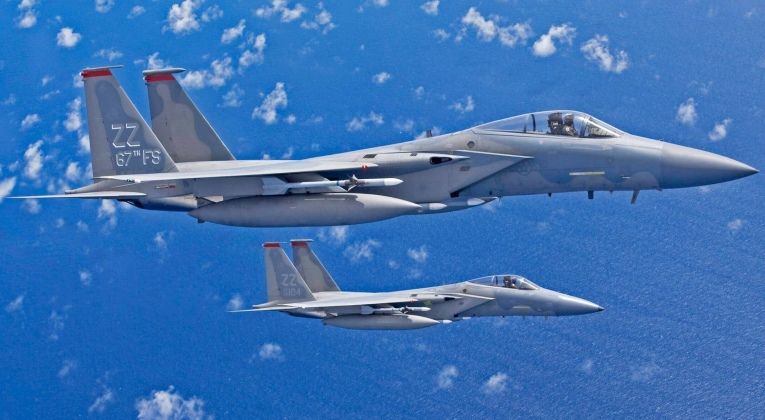
F-15C/Ds at Kadena Air Force Base
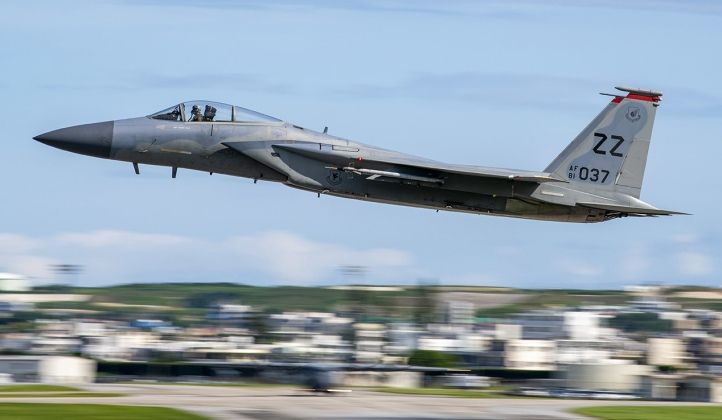
The last F-15C/D Eagle air superiority fighter has been withdrawn from Kadena Air Base on Okinawa, Japan, over 45 years after the class was first stationed at the facility on permanent deployment. This marks the end of an era for the U.S. Air Force’s forward presence in Northeast Asia, with Kadena Air Base seen as a key location due to its close proximity to the Taiwan Strait, where the Chinese Civil War between the rival Taipei-based Republic of China and Beijing-based People’s Republic of China governments is still ongoing. U.S. Air Force Major Peter Gawor, the director of operations for the 67th Fighter Squadron which operates F-15C/Ds at the facility, flew the final F-15C/D flight of the near half century long permanent deployment. “The Air Force placed that aircraft specifically in Kadena. It's actually the tip of the spear with relation to the threats we have around us. It has helped support us in that concept of air superiority,” he stated regarding the position.
The decision to withdraw the F-15C/Ds was announced in October 2022, and was considered over a decade overdue, with the Cold War era fighters having served long past their expected operational lives. The large majority of F-15C/Ds in the fleet were for decades expected to be replaced by F-22 fifth generation air superiority fighters, although serious issues with the new aircraft, ranging from excessive maintenance requirements to an unusually short range, ultimately led the Air Force to cut 75 percent of orders. This left the F-15C/Ds at Kadena without replacement.
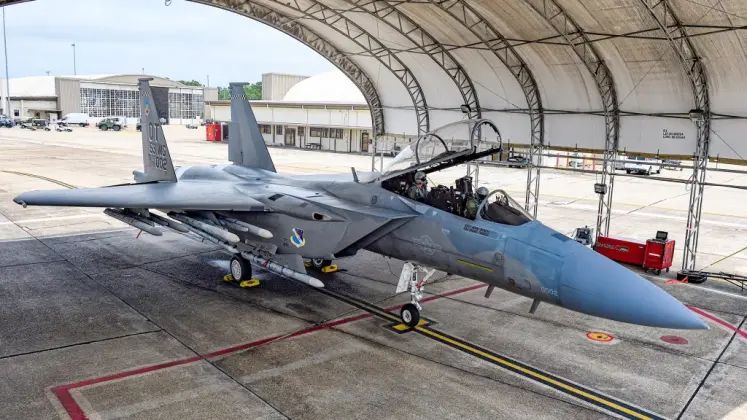
It was initially uncertain which fighter class would replace the F-15C/Ds at Kadena on permanent deployment, with rotational deployments of F-35s, F-22s and F-16s having serious limitations. Twenty-one months after the announced withdrawal, however, the Pentagon on July 3, 2024 confirmed that a permanent deployment of 36 F-15EX fighters would replace the Cold War era F-15 models. While the U.S. Air Force has since 2021 sought to begin retirements of its troubled F-22s, it has resumed acquisitions of the very fighter class the F-22 was intended to replace, with the new F-15EX requiring much less maintenance and having significantly more sophisticated avionics than either the F-15C/D or the F-22, as well as a much longer range and higher weapons carrying capacity. Its AN/APG-82 radar is also considered by far the most powerful deployed by any Western fighter class, and is around 50 percent larger than the F-35’s AN/APG-81 while boasting comparable levels of sophistication. Although the number of F-15s permanently deployed at Kadena will be 25 percent lower, the Air Force is compensating for this by increasing the number of fighters deployed further north at Misawa Air Base, where 48 F-35As are replacing 36 F-16s. More F-35s have been stationed in Japan by the Navy and Marine Corps.
The F-15 was considered the Western world’s premier class of air superiority fighter when it first entered service in 1975, although it would face a close match from the previous generation in the Soviet MiG-25 Foxbat interceptor which it engaged multiple times. The last engagement ended in a victory for the MiG-25, with a two-on-two fight over Iraq seeing one F-15 damaged, and according to Iraqi sources shot down, while MiG-25s took no losses. By the end of the Cold War the F-15’s international standing had diminished considerably, with the Soviet Su-27 air superiority fighter and MiG-31 interceptor entering service from 1984 and 1981 respectively and boasting very significant performance advantages over the F-15. The Eagle’s standing would recover after the end of the Cold War, with improvements to the design including the integration of the AN/APG-63 active electronically scanned array radar from the year 2000 providing it with an edge over the latest Russian fighters of the time. The AN/APG-82 integrated onto the new F-15EX significantly further expands the F-15EX’s situational awareness advantage over Russian fighters.
As a fourth generation fighter the F-15’s performance remains limited in the 2020s, with its lack of stealth capabilities, or of key subsystems such as distributed aperture systems, leaving it at a sharp disadvantage if facing modern Chinese fifth generation fighters such as the J-20. This is particularly significant when considering that J-20s have been deployed near the Taiwan Strait in considerable numbers. The selection of the F-15EX to replace older F-15s highlights the U.S. Air Force’s lack of a fifth generation fighter suitable of serving in this position, and remains fare from ideal when considering recent advances in Chinese combat aviation capabilities.
