
Korean Leader Kim Jong Un Pledges Nuclear Weapons Will Prevent Future Wars - Commemorates 67th Victory Day
Military Watch Magazine Editorial Staff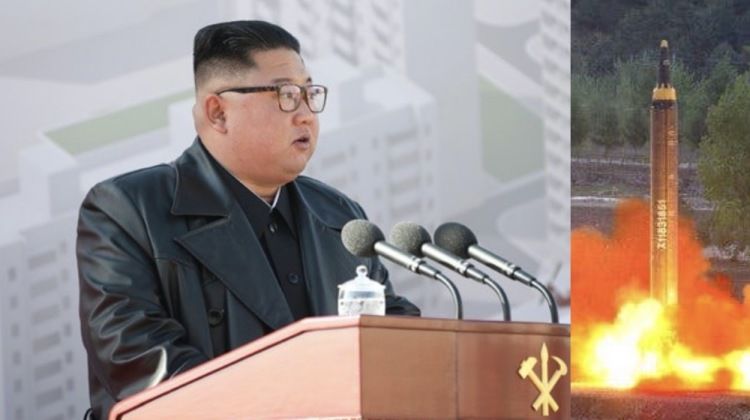
Chairman Kim Jong Un and Hwasong-12 Nuclear Capable Missile
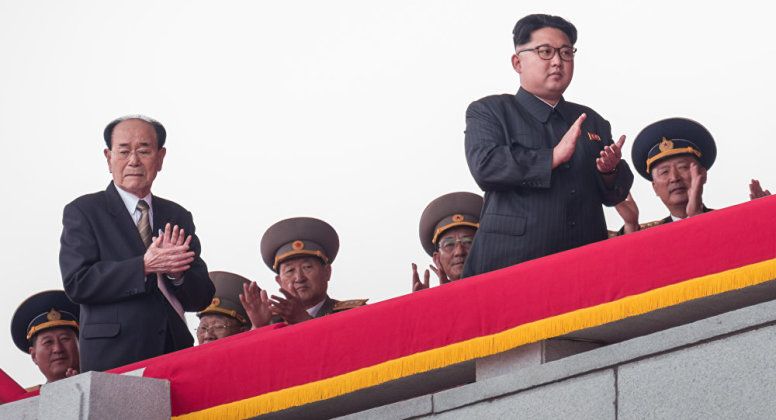
North Korean leader Chairman Kim Jong Un has pledged that nuclear weapons will provide a guarantee of security against external military threats to prevent the recurrence of war on the Korean Peninsula. The statement was made during the commemoration of the 67th anniversary of the Korean War’s end on July 27th, which in North Korea is referred to as Victory Day for the Patriotic Fatherland Liberation War. “Now we are capable of defending ourselves in the face of any form of high intensity pressure and military threats from imperialist and hostile forces… Thanks to our reliable and effective self-defensive nuclear deterrent, there will no longer be war, and our country’s safety and future will be firmly guaranteed forever,” the leader promised. Kim Jong Un has been leader of North Korea since 2011, but was only appointed as head of state in 2019 after the country’s Presidium President Kim Yong Nam retired at 91 years old. Kim Yong Nam notably experienced the Korean War firsthand in his 20s, and oversaw the country’s nuclear and strategic missile programs during his 21 years in office.
The Korean War is currently technically ongoing, but has been frozen under an armistice since 1953. The war was followed in 1957 by a unilateral abrogation of parts of the armistice (Article 13 (d)) by the United States, which proceeded to deploy over 950 nuclear warheads to South Korea. Washington came close to authorising nuclear attacks on the north on multiple occasions under the Lyndon Johnson and Richard Nixon administrations, which involved strikes with thermonuclear warheads several times as powerful as those used against population centres in Japan. North Korea tested its first nuclear weapon in 2006, and would subsequently develop a miniaturised thermonuclear warhead which was declared combat ready in 2017. 2017 also saw the country complete development of two intercontinental range ballistic missiles, the Hwasong-14 and Hwasong-15, which both demonstrated a capability to deliver strikes against the United States mainland. This was seen to have brought about a more equal balance of power between the two longstanding adversaries, as the U.S. had retained the capability to strike the Korean homeland for over 70 years.
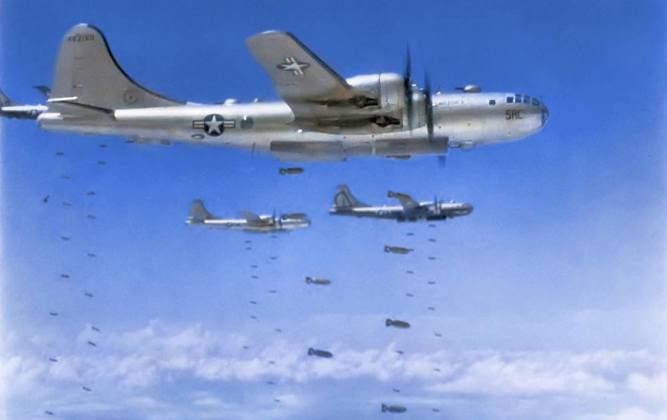
Chairman Kim’s statement showing the country’s nuclear arsenal to be a guarantee against a reoccurrence of the Korean War is no unprecedented. Addressing war veterans on July 25th, 2015, the chairman had pledged: “Our strength is not what it was in the 1950s, when we had to fight with rifles in our hands against the U.S. imperialists who were armed to the teeth. We now possess the strength with which to fight any form of warfare that may be chosen by the United States. We have the power to deter the United States from unleashing a nuclear war. Gone forever is the era when the United States blackmailed us with nuclear weapons.” The Korean War saw an estimated 20-30% of the North Korean population killed, largely by U.S. firebombing raids which had saturated population centres across the country with napalm and other incendiaries, but also under multiple massacres of civilians carried out under orders by U.S. forces. Historical memory of the wartime experience continues to exert a major influence in North Korea today, from performing arts to education and foreign policy, and has provided a major incentive to develop a viable deterrent to potential future attacks.
