
Japan's Dire Need for a Domestic Fifth Generation Air Superiority Fighter; Causes and Implications of the Indigenous Fighter Program - Part Two
Military Watch Magazine Editorial Staff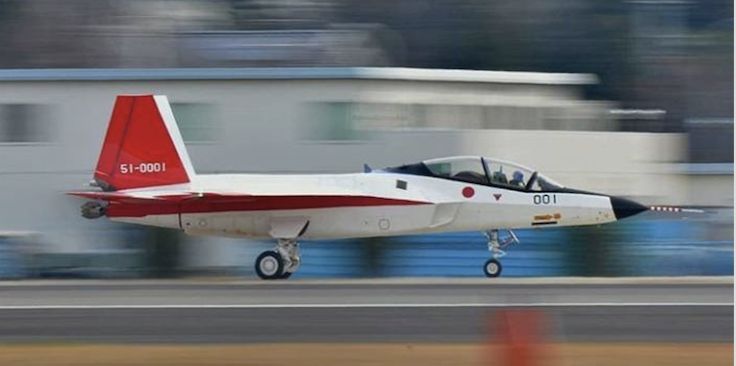
Shinshin X2 Next Generation Fighter Prototype
Unable to acquire the American F-22 Raptor, Japan's position in the Pacific only worsened with time. China threatened not only to match Japan's fighters technologically with far superior numbers, but from the 2010s appeared increasingly set to acquire platforms which significantly surpassed the technological capabilities of the F-15J in air to air combat. Chinese J-11 and Sukhoi fighters came equipped for beyond visual range combat with the 100km range PL-12, the 110km range R-77 and the 130km range R-27 air to air missiles. The Japanese F-15J fighters by contrast have long been equipped with the AIM-120B with a range of just 75km, and there are no signs of the country developing a longer ranged platform in future. China by contrast is well on its way to inducting the PL-21 and PL-12D into service in large numbers, platforms with ramjet powered engines which are expected to have a range well over 200km and be fitted onto Chinese light fighters such as the J-10C as well as its heavy air superiority platforms. Japan's disadvantage appears to only be growing. The PL-15, with an estimated range of 150km, is already operational on next generation Chinese jets such as the J-16.
China has not only been acquiring new missiles for its fighters, but also all new fighter platforms which far surpass the capabilities of the F-15J. Acquisition of the Russian Su-35, a leading air superiority fighter dubbed '4++ generation' by its manufacturers with unmatched manoeuvrability and firepower, which according to U.S. military experts only the F-22 can be relied on to engage combat, was the first such development which seriously hindered Japan's security interests. North Korea has also reportedly shown interest in the Su-35, and should the international ban on weapons exports to the country be lifted there is a significant chance it would acquire at least one unit of these platforms. China is also set to induct the J-11D fighter into service in the near future, an advanced air superiority platform with capabilities similar to those of the Su-35 and far outmatching those of the already formidable original J-11. Worse still for Japan's position came China's development of its own fifth generation fighters, the J-31 and J-20, the latter which is an air superiority fighter equivalent to the F-22. Russia's simultaneous development of the fifth generation Su-57, an air superiority fighter with the potential to surpass the F-22 and to be sold across the Asia-Pacific to states such as Vietnam, has further boded ill for Japan's security situation.
While Japan has inducted a modern fifth generation platform into service, the F-35A, the capabilities it offers leave much to be desired compared to the F-22. As a short range singe engine light multirole platform with a small arsenal of just four air to air missiles, the F-35 hardly presents an adequate solution to counter the J-11 or Su-30 - let alone more advanced air superiority fighters such as he Su-35 or J-20. The fighter has suffered numerous technical difficulties resulting in poor reliability, while its longest range missile the 105km AIM-120C is a low manoeuvrability variant far surpassed in its capabilities by existing Russian and Chinese missiles in service with rival states. U.S. military officials and numerous think tanks have repeatedly stressed that the F-35 is not an air superiority platform and cannot replace the F-15. Former Air Force chief of staff Gen. Mark Welsh stated regarding the light stealth platform that it "was never designed to be the next dog fighting machine. It was designed to be the multipurpose, data-integration platform that could do all kinds of things in the air-to-ground arena including dismantle enemy, integrated, air defenses. It had an air-to-air capability, but it was not intended to be an air-superiority fighter. That was the F-22." Air Combat Command chief General Mike Hostage similarly stated regarding the F-35's lack of air superiority capabilities: "If I do not keep that F-22 fleet viable, the F-35 fleet frankly will be irrelevant. The F-35 is not built as an air superiority platform. It needs the F-22.” Stressing the Raptor’s importance General Hostage added that, while the F-35 was unsuitable for an air superiority role, he predicted the F-15 would be obsolete by 2024.
With Japan unable to acquire the F-22 and facing a fast worsening balance of forces in East Asia, the country embarked on a program to develop its own fifth generation air superiority fighter equivalent to the American Raptor. This was a bold step, as Japan had not developed an independent fighter since the Second World War - with the third generation F-1 light attack fighter based on the British Jaguar and the F-2 fourth generation light multirole fighter being closely based on the America F-16. The program, at prototype stages known as the Shinshin X2, represents Japan's dire need for a modern air superiority fighter and the extent to which the United States had compromised the strategic advantage of its ally by failing to make more capable platforms than the F-15J available for export.
Japan remains the world's third largest economy with one of the most advanced civilian technological bases, and with a long history of aircraft construction and design. This includes vastly improving the capabilities of the F-16 to build the F-2, the construction of domestic variants of U.S. fighters throughout the Cold War, and the Imperial era construction and design some of the world's best combat aircraft such as the Nakajima Ki-84 - all of which indicate that Japan has potential in the field. As a result while several nations such as Turkey, Iran and South Korea have looked into developing next generation light fighters, Japan is perhaps the only nation other than Russia, China and the United States capable of developing a high performance heavy air superiority fighter similar to the F-22 - with the smaller and less ambitious programs of smaller countries aiming for lighter less costly jets with capabilities closer to those of the F-35.
Continued in Part Three
Part One is available here
