
Japan's Dire Need for a Domestic Fifth Generation Air Superiority Fighter; Causes and Implications of the Indigenous Fighter Program - Part Three
Military Watch Magazine Editorial Staff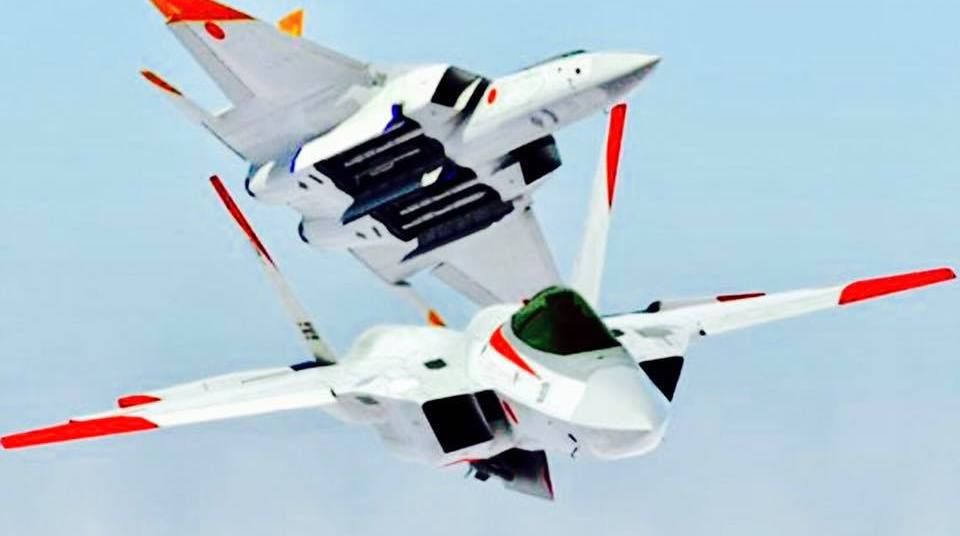
Japanese Fifth Generation Air Superiority Fighter Concept Design
A prototype technology demonstrator of Japan's indigenous fighter, the Mitsubishi Shinshin X2, saw its first flight in April 2016 and appeared highly promising. The fighter featured potent active electronically scanned array (AESA) radars, fly by optics fire control systems, and several other advanced features. Most notably however, the Japanese fighter incorporates three dimensional thrust vectoring, giving it supermaneuverable capabilities previously found only on the most advanced Russian fighters - the Su-35, Su-57 and MiG-35. This would make Japan's fifth generation air superiority platform considerably more manoeuvrable than the F-22, and potentially a more potent fighter in visual range combat. Another outstanding feature under development for the fighter was a 'Self Repairing Flight Control Capability' to allow the aircraft to detect failures or damage in its flight control surfaces automatically - and use remaining control surfaces to calibrate accordingly and retain controlled flight. These features are notably absent on the F-22 as well as the J-20, and could well give the new Japanese fighter the ability to outperform all contenders for air superiority in the Pacific.
Japan's air superiority fighter program remains highly promising, and should it succeed it will have significant impacts not only for the balance of power in East Asia, but also for both the nature Japan's foreign relations and for the country's future as an arms exporter. With the United States unwilling to sell the F-22, the production of which has now been terminated, and with China's willingness to export its J-20 as of yet uncertain, Russia will maintain an effective monopoly of fifth generation air superiority fighters on world export markets with its Su-57. Should Japan export its own fighter it would not only be a major source of revenue, but would also be a highly attractive platform for U.S. allies unable to acquire the F-22 and prohibited for acquiring the Su-57 as a result of their defence ties to the West - particularly in light of the recent U.S. policy of sanctioning Russian arms clients. Potential clients include Israel, Saudi Arabia, Singapore and Taiwan among others.
To contend with rival platforms, the Japanese fifth generation platform would need to develop a suitable air to air missile - particularly a long ranged platform to contend with the Russian K-77 and Chinese PL-12D, PL-21 and PL-15. With the United States somewhat lagging in its air to air missile technology, developing such a system indigenously would be highly desirable for the Japanese Air Force. Japan has recently taken unprecedented steps to develop highly capable indigenous air launched missile platforms, and it would hardly be beyond the country's capabilities to develop a capable beyond visual air to air missile exceeding the capabilities of the somewhat limited AIM-120. Cooperation with neighbouring Russia could well be ideal were it not for political concerns in relation to the United States, but Taiwan also remains a potentially highly capable partner. With Taipei having recently developed the Sky Sword II, a long range system with a range rivalling the AIM-120C and light enough that even the country's small Ching Kuo fighter can carry up to four of the missile, its capabilities in the field are already formidable. A joint Taiwanese-Japanese program could well sea a heavier and longer ranged missile suitable for the X2 quickly developed. The X-2 could alternatively rely on U.S. made missiles such as the AIM-120D and AIM-9X - with European fighters notably relying heavily on these American made air to air munitions due to their relatively poor military industrial base's inability to produce similarly capable systems.
With Japan having relied heavily on the United States for its defence since 1945, the development of an indigenous fighter equivalent to the F-22 Raptor would be an unprecedented step with significant implications for the two powers' defence relationship. With the U.S. having inducted F-22 fighters to meet just 25% of its Air Force and none of its naval requirements, fighters are stretched thin and adequate forces cannot be deployed to bases in Japan to match even a fraction of those fielded by Beijing. Combined with the United States' refusal to sell the Raptor to Tokyo, should Japan induct its own equally capable air superiority fighter it would indicate that the country is far more capable of defending itself independently than it would be if relying on the United States. This in turn could strengthen calls for Japan to take responsibility for its own defence and reduce its reliance on the U.S. military - as the induction of an indigenous superiority fighter would provide a concrete example of how doing so better served national interests. Amid rising nationalist sentiments in the country, success in developing the indigenous fighter program could well mark a turning point in Japanese history towards increased military self reliance.
Part One is available here
Part Two is available here
