
Japan Developing Supersonic Glide Bombs to Target Chinese Positions in the East China Sea, Protect Territorial Claims
Military Watch Magazine Editorial Staff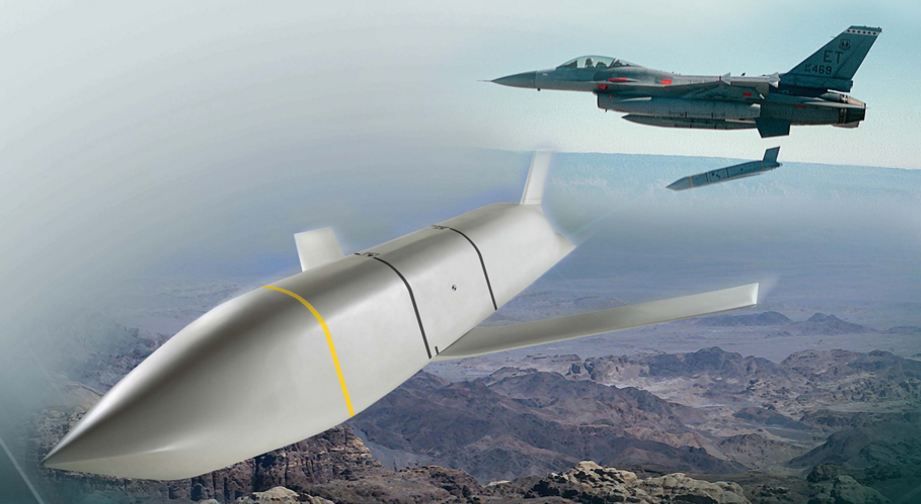
F-16 Fires JASSM-ER Cruise Missile
Japan’s armed forces have ordered the development of a new glide bomb with the specific purpose of targeting Chinese assets in the East China Sea. Both Tokyo and Beijing lay claim to the Senakaku/Diaoyu Islands, a dispute which has since the early 2010s led to escalating tensions between the two East Asian powers, and many of the recent developments in Japan’s armed forces have specifically been at least partially in response to the dispute in preparation for an armed conflict with the Chinese People’s Liberation Army. Other prominent developments in the Japanese armed forces which have seriously strengthened the country’s position militarily have included the induction of the Maya Class destroyer and Izumo Class carrier warships - the latter which are designed to deploy F-35B stealth fighters - though orders for these jets have yet to be placed. The induction of JASSM-ER radar evading cruise missiles, one of the most advanced systems of their kind in the world, had meanwhile provided Japan’s armed forces with a retaliatory strike capability against Chinese military facilities on the mainland should a potential conflict between the two parties escalate.
Japan’s new glide bomb is expected to be deployed and fully operational by 2025, shortly after the creation of a viable prototype, according to officials from the Defence Ministry. The munitions are expected to be deployed from land based launchers, which may lead to their reclassification as a new weapons type altogether following their induction given that guided bombs are conventionally only launched from combat aircraft. Whether a variant of the munitions will be developed for Japanese fighter jets such as the F-15J or F-35A remains to be seen, but depending on the final design of the land based variant it could be a possibility. The weapons system's induction is set to provide a much needed enhancement to the country's precision strike capabilities, and a shorter ranged complement to the U.S. manufactured JASSM-ER.
Japan’s new glide bombs are expected to fulfil a complementary role to the country’s cruise missiles, and are set to be deployed to Japanese controlled islands near the Senakaku/Diaoyu Islands in the East China Sea from the mid 2020s. The Ishigaki and Miyako islands, which are respectively 210km and 165km from the disputed territory, are potential ideal positions for the stationing of the weapons platforms. The bombs are expected to reach altitudes of little over 19km, lower than an F-15’s flight ceiling but far higher than an F-35, before descending at supersonic speeds and striking with precision. It remains possible that these munitions will be developed with the ability to adjust course to strike moving targets, which would allow them to pose a threat to enemy warships such as China’s Type 052D Class destroyers. With the latest Chinese warships fielding some of the most advanced defence systems in the world, and with the country’s military industries continuing to advance at breakneck speed, whether Japan’s new weapons will be at all threatening to the PLA surface fleet at the time of their induction in 2025 remains in highly questionable.
