
As Tokyo Calls for North Korea’s Complete Disarmament, Japan Acquires Cutting Edge Strike Capabilities to Target Pyongyang
Military Watch Magazine Editorial Staff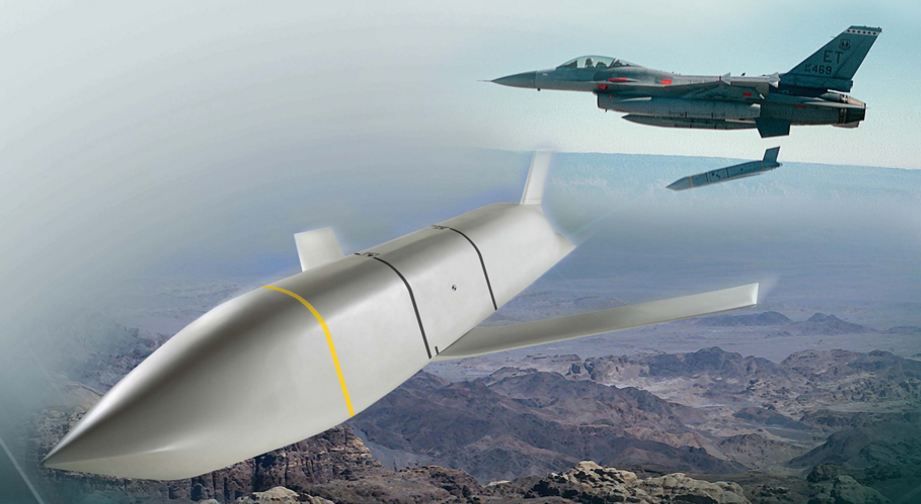
F-16 Fires JASSM-ER Cruise Missile
Lockheed Martin
Amid a recent detente on the Korean Peninsula and a pledge by North Korea on April 21st to cease testing of nuclear weapons and ballistic missiles, Japan has notably shown itself to be perhaps the least enthusiastic of all parties regarding potential negotiations and an inter Korean detente. Japanese Prime Minister Shinzo Abe has notably called for the harshest negotiating terms with Pyongyang, noting that a halt to weapons testing was far from sufficient for his country’s security interests. The Japanese leader instead called not only for North Korea’s complete denuclearisation, but also for its conventional disarmament including stripping the country of all ballistic missiles capable of striking Japan. With Japan under 1000km from North Korea, this would mean the dismantlement of the vast majority of Korean missile platforms and would leave Pyongyang near defenceless against attacks from beyond the peninsula. With such requests highly unlikely to be met or even considered, Prime Minister Abe’s demands are likely to lead to continued regional tensions and a derailment of negotiations should U.S. or South Korea negotiations factor them in to their own negotiating positions.
While Japan has pressed for North Korea's near total disarmament, the country capabilities to strike Pyongyang have rapidly expanded in recent years and are set to continue to expand in future. Tokyo is itself unlikely to renounce its own fast growing offensive capabilities, and with North Korea having endured decades of Japanese military occupation and perceiving Japan as a potential national security threat this gives Pyongyang an ever greater incentive to retain some form of deterrent against its much larger neighbour. Alongside the commissioning of a sizeable carrier fleet, a marine corps trained for amphibious assault operations and expanding stealth fighter and submarine capacities, Tokyo has recently committed to purchase new U.S. JASSM-ER cruise missiles to convert its F-15J air superiority fighters into long range strike platforms. The missiles are designed specifically to penetrate fortified bunkers and installations, and carry a 450kg warhead - larger than that of several of North Korea’s own ballistic missiles. The missiles have a range of well over 1000km, and fired from well within Japanese airspace would allow Japan’s Air Force to strike targets across North Korea from far beyond the range of the country’s air defences (estimated at little over 300km).
With the JASSM-ER striking with high levels of precision, designed with a stealth profile to evade detection and making use of state of the art 'bunker busting’ technologies for deep penetration, they are arguably far more dangerous than conventionally armed medium range North Korean ballistic missiles. While recent combat tests of advanced U.S. cruise missiles indicate that North Korea's air defence network would be able to intercept a significant proportion of the Japanese missile attacks, without ballistic or cruise missiles of its own the Korean military would be unable to retaliate either against Japanese military targets or even against the Japanese fighters that fired the missiles - thus leaving North Korea extremely vulnerable to attacks by and largely at the mercy of its heavily armed neighbour.
Ultimately adopting Japan’s extremely hard line could seriously compromise inter-Korean and North Korean-U.S. negotiations, and both Seoul and Washington would do well to take a stance more amenable to Pyongyang’s security interests should they seek to make progress in bringing about a lasting detente on the Peninsula. For Japan’s current leadership, which have long used North Korea’s missile program as a pretext for remilitarisation and reinterpretation of Article 9 of the country’s Pacifist constitution to allow the military to develop power projection capabilities, a detente on any terms less than North Korea’s complete disarmament may well prove contrary to their interests.
