
Is a Major Attack on Syria Feasible? A Look at Russia's Key Force Multiplying Assets and their Ability to Deter Western Military Action - Part One
Military Watch Magazine Editorial Staff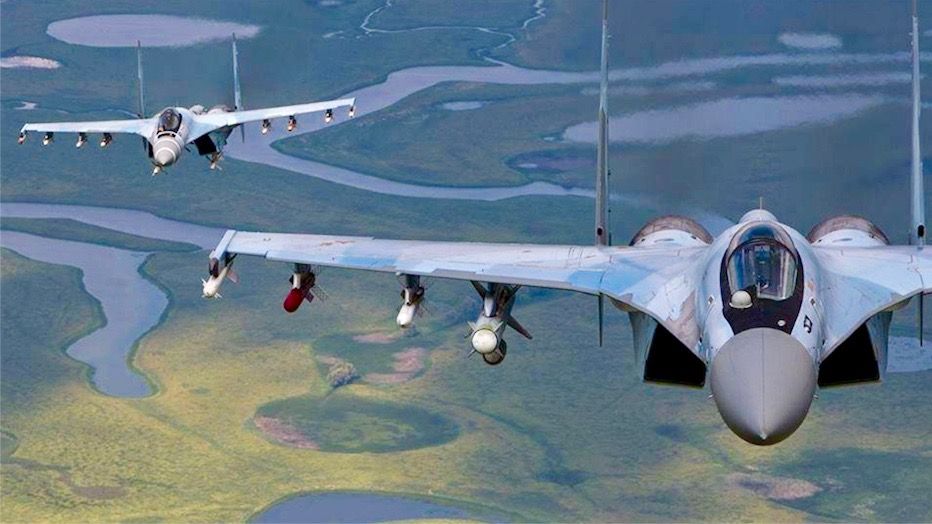
Su-35 Air Superiority Fighters
With the United States, Britain and France all reportedly making preparations to launch a major offensive against Syria, and threatening use of force on a scale far larger than that of the attack carried out in April 2018, Russia has notably responded by moving naval assets to the Mediterranean and deploying its warships in defensive positions to deter a potential second Western attack. While Russia has previously tolerated Western interventions against Damascus on a small scale, namely token missile strikes initiated with prior warning which were further blunted by Syria’s own air defences, a larger strike which could have a significant impact on the outcome of the war - at a time when Damascus’ forces and those of its allies prepare for a major ground offensive against the Jihadist held province of Idlib - could well cross a red line which would lead to Russian intervention on the side of its Middle Eastern ally. To be able to deter a Western attack however, Russia will need to demonstrate that it has a credible chance of protecting Syria against the combined firepower of its adversaries despite the far smaller size of its forces in the country - which pale in comparison to the massive Western military forces deployed throughout the Middle East and the U.S. and possibly French carrier strike groups which are likely to participate in an attack.
For Russia’s naval contingent in Syria to have a chance of deterring the Western fleets, it will need to rely on two critical assets - support from ground based aircraft and missile systems operating from Syrian territory itself, in some cases from as far as Russia’s own territory, and extensive use of asymmetric weapons systems which will leave Western assets such as warships, fighters and bombers vulnerable despite their numerical advantage. While Russia’s sole aircraft carrier is poorly suited as an asset for long range power projection, and is nevertheless currently undergoing a refitting and unavailable for frontline service, the country has an arguably far more valuable asset - Khmeimim airbase in Syria’s Latakia province. While modern Western carriers lack high performance air superiority fighters, the last of these having been retired by the United States Navy shortly after the Soviet Union’s collapse in favour of lighter unspecialised multirole aircraft, Russia’s Air Force contingent relies heavily on specialised heavy combat jets such as the Su-35, Su-30SM and Su-27SM air superiority fighters and Su-34 strike fighters. The first three of these enjoy considerable advantages in speed, operational altitude, engagement range, range and manoeuvrability over their counterparts in the U.S. Navy allowing them to protect Russian warships and Syrian assets from air attack even against enemy air contingents many times their size. The Su-34 meanwhile, as an advanced long range ship hunter armed with missiles such as the Mach 3 Kh-41, the Mach 3.5 sea skimming Kh-31A and the 300km range Kh-35U and P-800, can pose a major threat to hostile warships at considerable distances from Syrian coast - with missiles designed to evade the latest and most capable air defence networks fielded by the U.S. Navy.
Russia’s fighter contingent in Syria is currently estimated to consists of four Su-27SM, eight Su-30SM, four Su-35 and eight Su-34 jets - alongside the lighter and less specialised MiG-29SMT and older Su-24M4 strike fighter. Four Su-57 fifth generation air superiority fighters have also deployed to the theatre, though whether these assets are fully combat ready and armed with K-77 missiles needed for air to air engagements, or whether they were deployed solely for combat testing, remains in unknown. Russian fighters are backed by a number of the Air Force’s most formidable support assets - including A-50U AWACS platforms, which serve as a highly capable force multiplier able to coordinate strikes by combat aircraft and warn against incoming attacks using a powerful Vega-M radar. Other supporting air assets fulfilling complementary roles to the fighter fleet include Il-20M1 electronic radar reconnaissance aircraft and the new Tu-21R electronic intelligence aircraft - all of which are key to enhancing the combat potential of the fighter contingent deployed to Syria.
Continued in Part Two
