
INS Vikramaditya; How Russia Extensively Modified a Soviet Kiev Class Warship to Provide India with its First Modern Aircraft Carrier
Military Watch Magazine Editorial Staff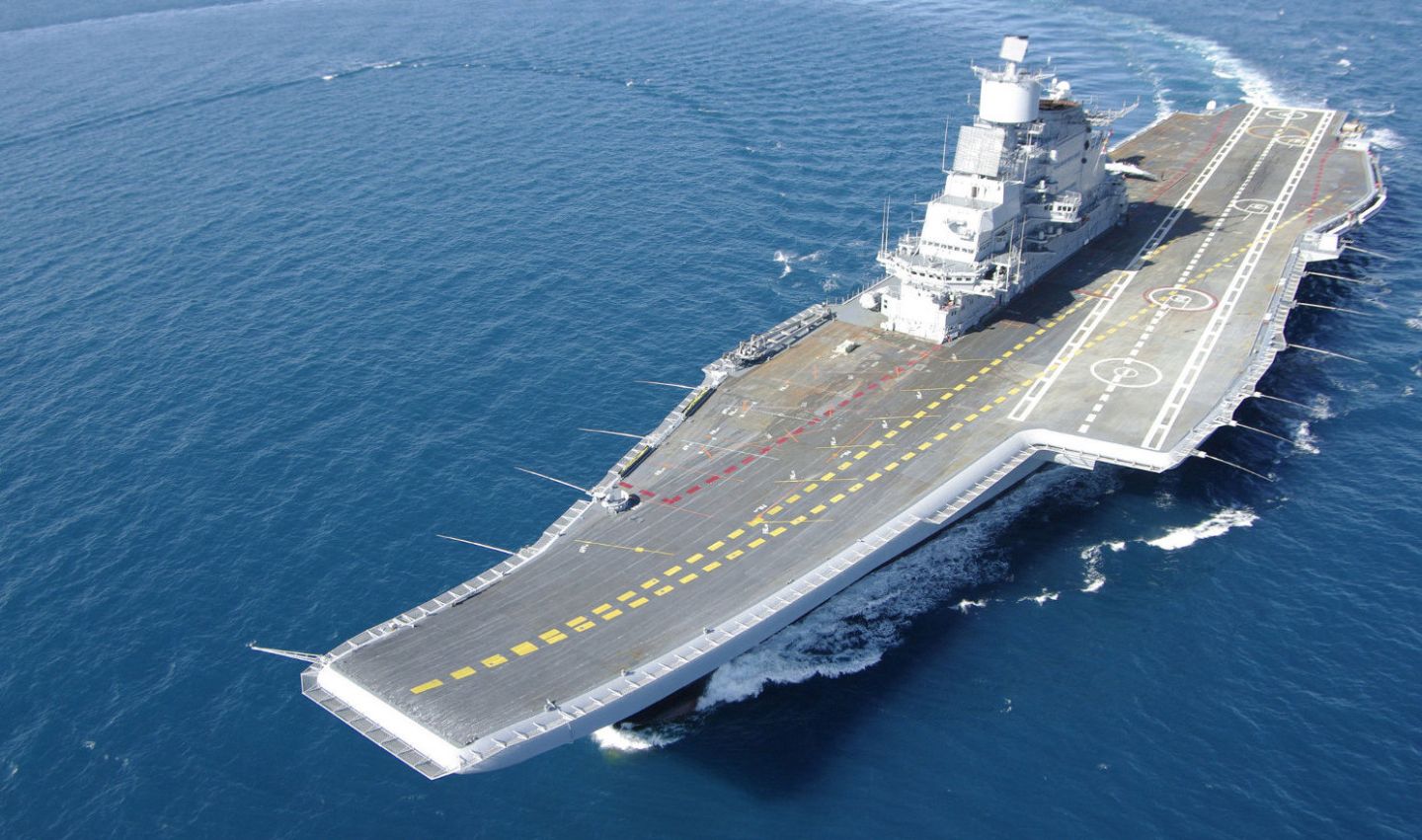
Indian Navy Carrier INS Vikramaditya
Entering service with the Indian Navy in 2013, the warship INS Vikramaditya remains one of the service's most formidable assets today - and is currently the country’s only aircraft carrier in active service. The means by which Delhi acquired the warship - possibly the last of its kind which India would ever acquire from abroad given the vast recent investments made in developing an indigenous carrier building capability, remains intriguing and highly unusual - with the Vikramaditya having briefly served in the navies of the Soviet Union and Russia before an extensive modification process and eventual sale to the South Asian state. The warship was laid down in 1978 and commissioned nine years later as the Soviet warship Admiral Gorshkov - the last of four Kiev Class ships to enter service in the Soviet Navy just four years before the state’s disintegration. Fielding a number of vastly improved characteristics relative to the standard Kiev Class ship, including a new phased array radar, electronic warfare installations, and a larger command and control suite, the Gorshkov was designed amid a vast carrier building program the USSR had initiated to allow it to better contend with the capabilities of the Western Bloc at sea. At 45,000 tons, while larger than any carriers elsewhere in Europe or Asia, it was nevertheless smallest of three major Soviet carrier classes.
Lacking runways or catapult launch systems, the Kiev Class ships could deploy only specialised combat aircraft designed for vertical takeoff and landing (VTOL). The Yak-38 served onboard the warships as a VTOL fighter with underwhelming capabilities, designed as an interim platform to acquaint the Soviet Navy with carrier operations until the far more advanced VTOL capable Yak-41, later known as the Yak-141, was ready to take its place. The Soviet Union’s disintegration however not only led to the cancellation of carrier construction, but also the retirement of three of Russia’s four Kiev Class ships and the termination of the Yak-141 program. With the Gorshkov’s fighter complement itself considered increasingly obsolete, and the now cash strapped post Soviet Russian state unable to fund the completion of the Yak-38’s replacement, Moscow moved to sell the Gorshkov in favour of retaining the new ski jump equipped Kuznetsov Class - which was capable of operating the conventional takeoff MiG-29 and Su-33 twin engine fighters. The Indian Navy, which at the time was seeking to expand its blue water capabilities and retire its antiquated Korean War era carrier INS Viraat, thus emerged as a leading client for the warship.
While the Gorshkov was of little interest to foreign clients without the Yak-141, under a deal signed in January 2004 India agreed to pay $800 million for an extensive modification and refit of the warship. The upgrade program involved stripping the carrier of its extensive missile armament and installing a large runway to allow the warship to deploy conventional takeoff fighters. The installation of arresting gear and a ski jump thus allowed the Gorshkov to operate fighters without VTOL capabilities, facilitating a further $1 billion deal to equip the vessel with a new armament and combat aircraft - initially 12 MiG-29K twin engine jets. India’s decision to purchase the navalised MiG-29 had considerable implications for Russia itself, as while many leading figures in the Russian Navy had strongly favoured the more capable Su-33 which flew alongside the lighter MiG on its own Kuznetsov Class carrier, the production of MIG-29K jets in far larger numbers to fulfil export orders made it a far more cost effective fighter than the Su-33 due to economies of scale.
The Kiev Class carrier Admiral Gorshkov, recommissioned as the INS Vikramaditya in November 2013, was considerably heavier and could deploy a far larger complement than the original Soviet vessel. While the Gorshkov had deployed 12 Yak-38 VTOL fighters and a further 20 helicopters, after its refurbishment it could accommodate a far larger complement of 26 MiG-29K fighters alongside 10 helicopters. New engines, diesel generators, cabling, radars, sensors, elevators and electronic warfare suites were all fitted alongside the LESORUB-E computer aided information system and CCS Mk II communications complex. With the warship’s capabilities being in many ways comparable to those of the Russian carrier Admiral Kuznetsov, albeit at a reduced size, the Vikramaditya appeared to be among the most cost effective carrier warships ever commissioned - acquired at a fraction of the cost of its highly similar domestically built successor INS Vikrant. Making use of a conventional rather than a nuclear propulsion system, operating without a complex and high maintenance catapult system and deploying high end but low cost fighter jets, the burden placed on the Indian Navy’s defence budget for carrier operations by the Vikramaditya are extremely low - the same which cannot be said for the planned third addition to the fleet INS Vishal. The warship is set to remain in service as a highly viable platform for decades to come, and the experience gained by the Indian Navy operating the warship will play a key role in facilitating further expansion of the country’s carrier fleet.
