
Will India’s Plans for a High Tech Third Aircraft Carrier Materialise? Why the INS Vishal is Likely Too Ambitious a Program for Delhi’s Defence Budget
Military Watch Magazine Editorial Staff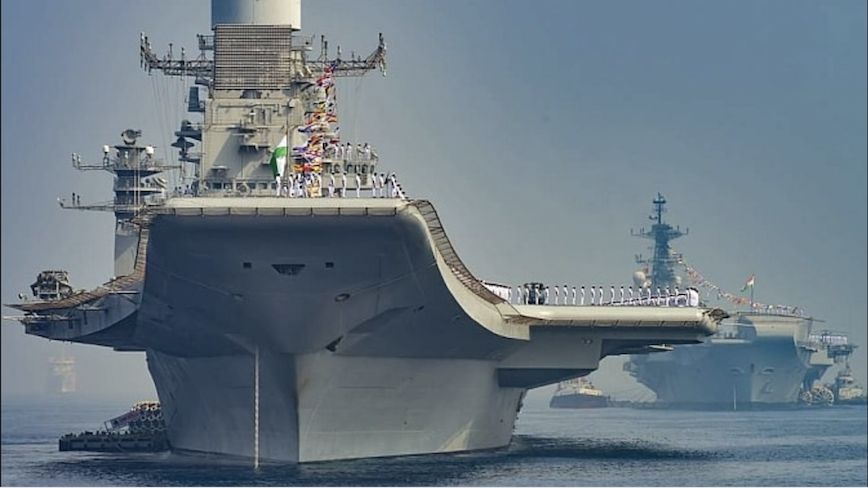
Indian Navy Carriers INS Vikramaditya and INS Vikrant
With the Indian Navy set to commission its second aircraft carrier INS Vikrant over 15 years after the initial order for the warship was placed, the fate of the country’s plans for a third carrier, INS Vishal, remain highly uncertain. While the Vikrant bears a number of similarities to the navy’s first carrier, the INS Vikramaditya, a former Soviet Kiev Class aircraft carrying cruiser extensively modified to deploy Russian MiG-29K twin engine fighters using a basic ski jump system, the heavier Vishal’s design is set to be more closely based on the U.S. Navy’s carrier designs, incorporating a number of the same cutting edge technologies recently deployed for the first time by the next generation supercarrier USS Gerald Ford. The warship is set to displace 65,000 tons, making it considerably smaller than American supercarriers or China’s Type 003 Class supercarrier currently under construction - though still over 50% larger than the French carrier Charles De Gaulle and approximately the same size as the Russian warship Admiral Kuznetsov. The INS Vishal will carry close to double the fighter complement of the country’s older carriers, and will deploy fixed wing aircraft using an electromagnetic launch system (EMALS) - allowing it to launch considerably heavier combat and support jets with more fuel and a higher weapons payload. With EMALS serving as an effective force multiplier, a capability India’s Navy will be the third in the world to field after the United States and China should the Vishal program materialise, the new carrier could we become the most capable in service anywhere in the world other than those fielded by the two superpowers.
While the INS Vishal is set to be a highly formidable warship, the Indian Defence Ministry has yet to approve the acquisition of the advanced warship. With the issuing of an Acceptance of Necessity note being the first official step for the country to begin the process of acquiring a new weapons platform, it is notable that despite years of design work the Ministry has yet to issue such a note for the Vishal. There are a number of critical factors influencing the Defence Ministry's decision against the acquisition of the new warship. Considerable troubles constructing the INS Vikrant, which has seen delays of over five years, and immense cost overruns, have meant that the warship’s initially planned acquisition cost of $500 million increased vastly to approximately $3.5 billion - 700% of the original price. Should the considerably more costly INS Vishal experience similar cost overruns it could well become one of the most expensive warships ever developed - likely far surpassing the $6.5 billion American Nimitz Class supercarriers and possibly even rivalling the USS Gerald Ford. This would be a catastrophe for the military’s defence budget - particularly considering the declining budget of the Indian Navy. Difficulties designing the carrier due to the country’s lack of experience in the field have been another factor, alongside the country’s highly questionable need for three carrier strike groups given its relatively neutral geopolitical stances, lack of considerable tensions with near peer adversaries and the strain that operating the strike groups - with necessary destroyer and submarine escorts - would place on the country’s economy.
The INS Vishal is set not only to add the burden of an additional carrier to the Indian Navy’s budget, but its operational costs are set to be considerably higher than those of the two prior ships the Vikramaditya and Vikrant. While India’s first two carries operated Russian MiG-29K platforms from their decks, approximately two dozen per ship, relatively simple and low maintenance fighter jets which cost little to operate, the F-18E Block 3 Super Hornets or Dassault Rafale M jets set to operate from the Vishal will not only be fielded in greater numbers from the warship’s larger deck, but they will cost several times as much both to acquire and to maintain. The F-18E Block 3 is estimated to cost over five times as much as the MiG-29K to acquire at minimum, and the less capable French Rafale’s price is similarly high. Designed to deploy 14 AIM-120D air to air missiles each, the missiles to equip a Super Hornet are set to cost almost $30 million per fighter - and though less heavily armed the Rafale’s European made Meteor missiles are even more costly per unit. E-2 Hawkeye airborne early warning aircraft, required to take full advantage of the capabilities of the new Western fighters’ high end capabilities, are also extremely costly both to acquire and to operate, and only the United States and France have made use of these platforms with China developing the lighter and less costly KJ-600. The Vishal is likely to require three of these costly aircraft - which alone would amount to considerably more than the total planned cost of the entire aircraft carrier INS Vikrant, over $700 million. Operating an electromagnetic catapult system is similarly ludicrously expensive, particularly when compared to a basic ski jump, and as a result of these factors combined the INS Vishal is set to cost several times as much to operate as a its predecessor INS Vikrant. The costs of manufacturing the warship, estimated at $6 billion at the very minimum - a target unlikely to be achieved based on experience developing its far simpler predecessor, will combined with these immense fighter acquisition and operational costs likely mean that the highly ambitious INS Vishal program will never be commissioned into service in its current form. Whether India will attempt to commission a simplified warship of similar size, possibly also making use of a ski jump system and Russian made fighter jets, or whether the Defence Ministry will cancel or postpone plans for third aircraft carrier entirely, remains to be seen.
