
The Legacy of the Soviet Union's Ambitious Aircraft Carrier Program - Part One
Military Watch Magazine Editorial Staff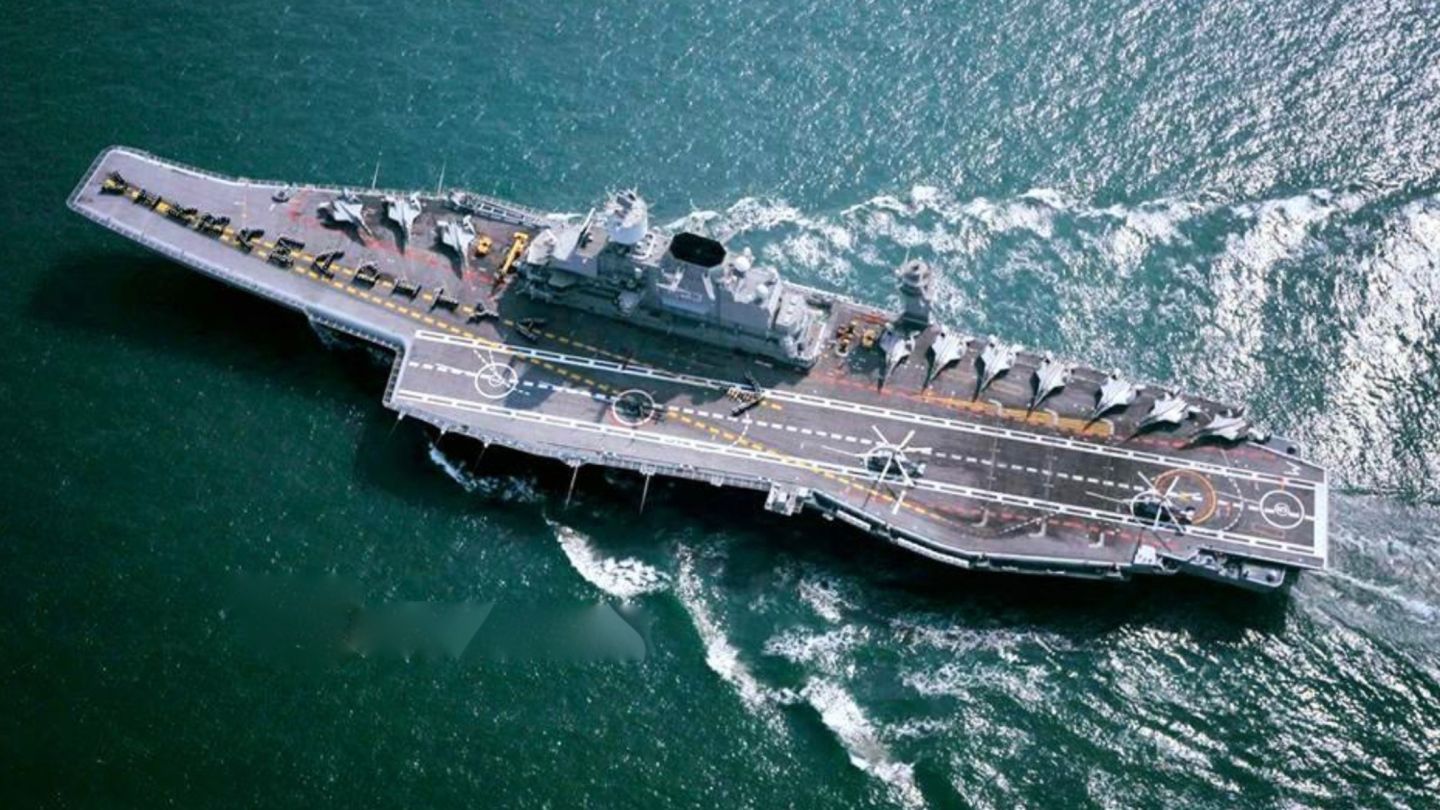
Modified Kiev Class Carrier with MiG-29K Fighters Serving the Indian Navy as INS Vikramaditya
During the Cold War the United States had relied heavily on its world leading aircraft carrier technology as its primary means of projecting power at sea, a capability in which it had retained global primacy since the fall of the Japanese Empire and has until today remained unmatched. The Soviet Union had largely neglected the development of a carrier fleet and had instead relied on its fleet of nuclear armed ballistic missile submarines, its navy's own field of naval technological primacy, to maintain a military presence across the world's oceans. The differences between the two strategies and the applicability of long range submarines and aircraft carriers differed significantly. Ballistic missile and later cruise missile armed submarines were a more useful asset in times of superpower confrontation when they could ensure that a second strike would destroy an enemy regardless of how successful their own strike on the Soviet mainland may be, providing a secondary nuclear deterrence. Their ability to deliver strikes unseen from anywhere in the world was invaluable. Aircraft carriers by contrast, though far less effective as a means for waging or deterring nuclear war, were potent conventional weapons which have been used in almost all the United States' many military interventions since 1945.
While each superpower specialised in its own means of naval power projection, each also tried to diversify its power projection capabilities by investing in the speciality of its adversary. To this end not only did the United States develop a ballistic missile submarine fleet following the Soviet lead, but the USSR also began to develop a carrier fleet in the mid Cold War. The U.S. submarines never matched those of the Soviets, and the Soviet carrier fleet remained negligible relative to that of the U.S. For the Soviet Union carriers could be used as a more visible conventional deterrent which could have proven a formidable asset in smaller scale conflicts. Deployment of Soviet carrier fleets to areas such as Vietnam or the Middle East during the Arab-Israeli wars, had they existed at the time, could have served as a warning to and limited the actions of Soviet adversaries had these assets been available. This remains a strategy commonly used by the United States, most recently with its deployment of three carriers near the Korean Peninsula in 2017 and regular deployments to the South China Sea.
The Soviet carrier program began with the commissioning of the first Moskva class helicopter carrier in 1967, and a second such carrier in 1969. Coming at a similar size to the modern Japanese Hyuga Class and South Korean Dokdo Class, these ships were a key stepping stone towards developing a larger carrier fleet. Each was capable of deploying up to 18 rotary wing aircraft, and the warships formed the flagships of anti submarine warfare groups tasked primarily with defending Soviet ballistic missile submarines from Western attack submarines - thus serving as a highly complementary asset to the Navy's other assets. From 1975 to 1987 the USSR then commissioned four small Kiev class heavy aviation cruisers. These 44,000 ton ships were not dedicated carriers, but rather cruisers with a limited capability to deploy aircraft. They were less than half the size of Nimitz class supercarriers, lacked nuclear propulsion systems and could carry only 30 aircraft. The Kiev Class' decks could only facilitate the deployment of specialised vertical takeoff and landing (VTOL) jets such as the Yak-38, the combat capabilities of which were extremely limited. Significant enhancements were planned for the ships' carrier air wings, with the Navy commissioning the development of a more capable VTOL fighter, the Yak-41 - later known as the Yak-141, to replace the Yak-38.
The modest capabilities of the Kiev class were set to be improved upon significantly with the commissioning of the Kuznetzov class aircraft carrying cruisers and the Soviet Union's first dedicated aircraft carrier - the Ulyanovsk class supercarrier. The Ulyanovsk Class ships would have given the Soviet Navy its first blue water carrier capabilities, and been a game changer for the balance of power at sea and the first challenge to the blue water primacy of the U.S. surface fleet since 1945. Had the Ulyanovsk class been commissioned as planned the USSR would have had a sizeable carrier fleet of ten carriers by the late 2000s - two of which would have been able to contend with the most potent U.S. warships on relatively equal terms. Had the carrier program continued to expand in line with the country's economy growth, it would have potentially posed a major threat to American blue water primacy by the late 2000s - likely forcing the United States to increase investments in its own carrier fleet.
Continued in Part Two
