
First Images of Egypt’s New Su-35 Heavyweight Fighters Leaked - Reports
Military Watch Magazine Editorial Staff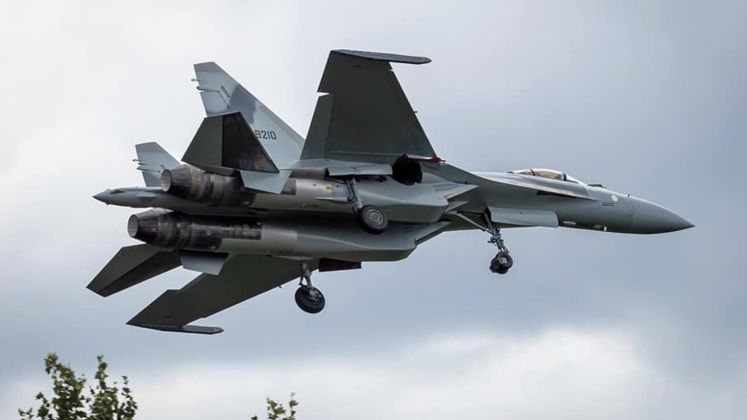
Egyptian Su-35 in Russia
A number of images have leaked of what are allegedly the first Su-35 ‘4++ generation’ heavyweight fighter jets ordered by the Egyptian Defence Ministry being flown in Russia. Egypt became the third foreign country in the world to order the Su-35 some time in late 2018, with the order for an estimated 24-28 jets announced in March 2019. The fighter will provide by far the most capable in the Egyptian Air Force and the only one from the heavy weight range, and comes as part of a major investment in upgrading Egypt’s aerial warfare capabilities underway since the overthrow of the country's Western-aligned islamist government in 2013. Previous prominent orders have included S-300V4 long range air defence systems - a platform technologically on par with the better known S-400 but more mobile, as well 50 MiG-29M and 24 Rafale fourth generation medium fighters, BuK-M2 air defence systems and R-77 active radar guided air to air missiles. Egypt has long faced a major capability gap with the F-15 Eagles of neighbouring Israel, with the country’s previous Anwar Sadat government securing a place as a very low level American defence client denied both high performance fighter jets and modern air to air missiles to equip its cheaper and lower end fighters which the U.S. was willing to supply.
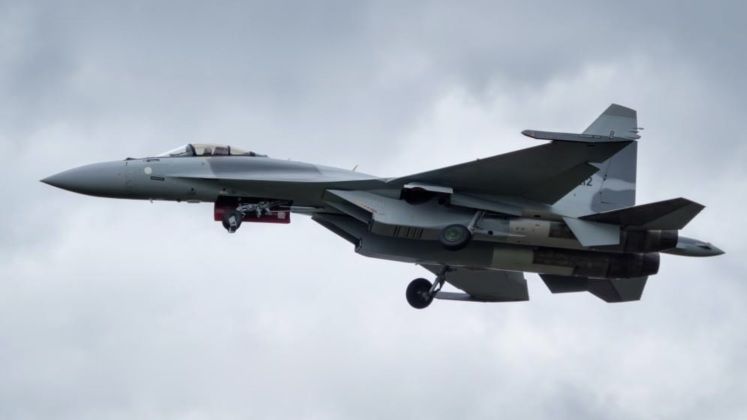
The colours of the Egyptian Su-35s leaked notably match those of Egyptian MiG-29M jets currently in service, and are distinct from those of any fighter in Russian service, meaning claims that the fighters pictured are indeed Egyptian are somewhat credible. Egypt is expected to receive its first new fighters before the end of the year, which will provide it with the most capable fighters in Africa or the Arab world - a title though to currently be held by the Algerian Air Force’s Su-30MKA jets and the Royal Saudi Air Force's F-15SA. The Su-35 is much more advanced than baseline fourth generation jets, including the Su-27 air superiority fighter on which it is based and which currently forms the backbone of the Russian fleet and the F-15C and F-15I jets which form the elite of the Israeli Air Force. The new Russian fighter boasts multiple performance advantages over the F-15, from manoeuvrability and situational awareness to payload and radar cross section - with the Su-35’s radar cross section approximately 75% lower than that of the Eagle. Compared to the F110 engines on an F-15, the Su-35’s AL-41 engines put out 142kN of thrust which is approximately 35% higher, and the AL-41 also has three dimensional thrust vectoring capabilities which no Western fourth generation fighters have integrated.
The Su-35 is also highly prized for its very long range and its access to hypersonic R-37M air to air missiles with very long 400km engagement ranges, allowing the aircraft to threaten targets much further from Egyptian territory than any of its predecessors. The Russian fighter’s only notable drawbacks in terms of performance are its high operational costs, although this is the case for all heavyweight jets and in the Su-35’s case is quite low for its weight range, as well as its mediocre stealth capabilities - still high relative to other fourth generation jets, and its use of a hybrid active-passive electronically scanned array radar rather than a purely active one.
