
British Challenger 2 and U.S. Abrams Tanks Deploy on Russian Borders For Manoeuvre Warfare Drills
Military Watch Magazine Editorial Staff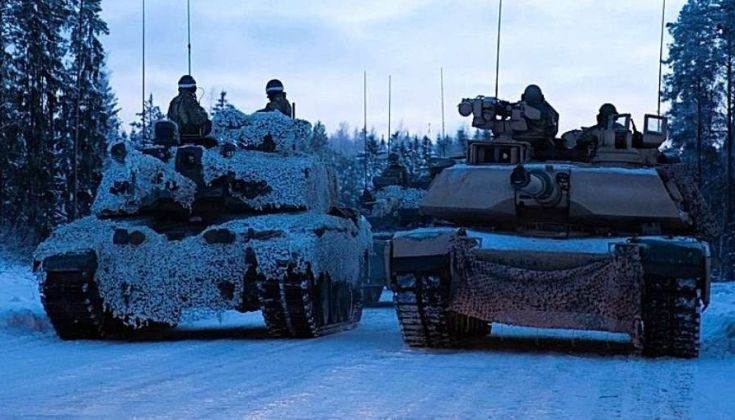
Challenger 2 (left) and M1A2 Abrams Tanks During Exercises in Estonia
US Army
The U.S. Army and the British Army have deployed their respective M1A2 Abrams and Challenger 2 main battles tanks to participate in Winter Camp exercise on the territory of the former Soviet Union, near Tapa in Estonia, located approximately 100 kilometres from the Russian border. The tank units are training for manoeuvre operations in sub-zero temperatures, in a region on on NATO’s northeastern axis where winter conditions strongly favour forces trained and equipped to fight in cold low-visibility conditions. The proximity to Russian territory, including the economic hub of St. Petersburg, is expected to send a strong signal to Moscow at a time of high tensions between Russia and the Western Bloc states, and as Western forces on the ground in Ukraine continue to play a central role in the ongoing Russian-Ukrainian War.
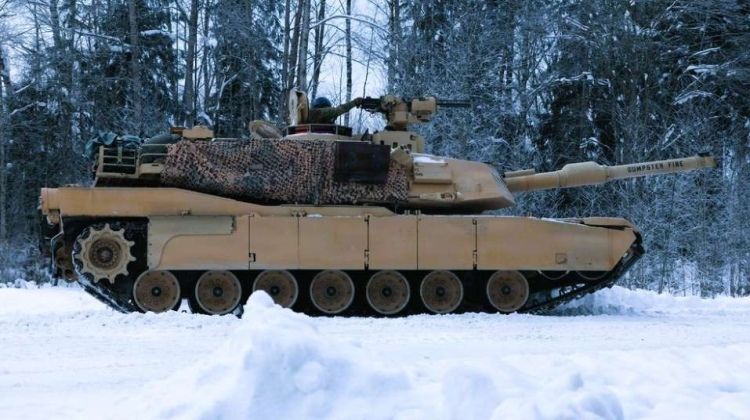
U.S. Army Abrams tanks have been involved in multiple exercises near Russian territory in recent months. In late November the tanks were deployed to the Bemowo Piskie Training Area in neighbouring Poland, and conducted intensive training. Less than ten days later Army Abrams tanks were deployed to participate in live-fire exercise in Lithuania, during which they demonstrated the engagement capabilities of their 120mm main guns. In the final week of January it was confirmed that the Army will deploy an Abrams-equipped detachment as part of its normal rotational forces in Romania. In early February the Army also deployed M2A3 Bradley Fighting Vehicles for live fire exercise in Poland. Although the United States Armed Force have sought to reduce personnel numbers in Europe, analysts have pointed to a qualitative improvement in the forces deployed, including greater quantities of advanced armour.
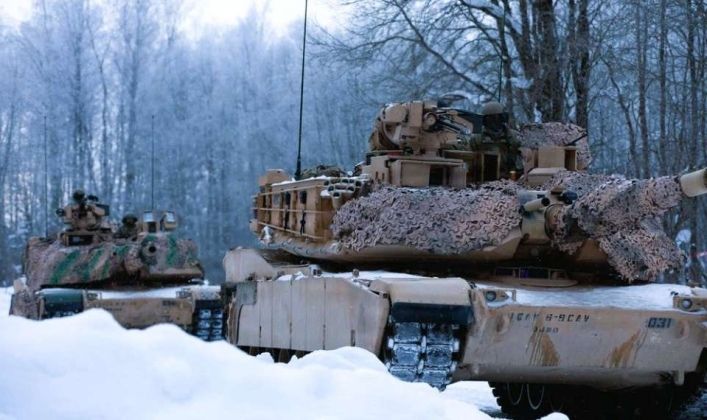
Although the British Challenger 2 entered service 18 years later than the Abrams, first joining the British Army in 1998, its capabilities are significantly less advanced than those of the latest M1A2 variants due to the lack of production of modern variants, and the very conservative nature of modernisation efforts. The British tank’s use of a rifled gun, aging fire controls, and poor power to weight ratio are among its leading shortcomings. With a 70 ton weight making it one of the most expensive tanks in the world, reliance on a 1,200 horsepower engine has seriously constrained its mobility. Challenger 2 tanks have been deployed for operations in Eastern Europe multiple times, with the British Army in 2025 having expanded its fleet by 32 percent, after bringing 69 of the vehicles out of storage and into service. The capabilities of the Challenger 2 have been repeatedly brought to question, with Ukrainian crews considering it to be underpowered.
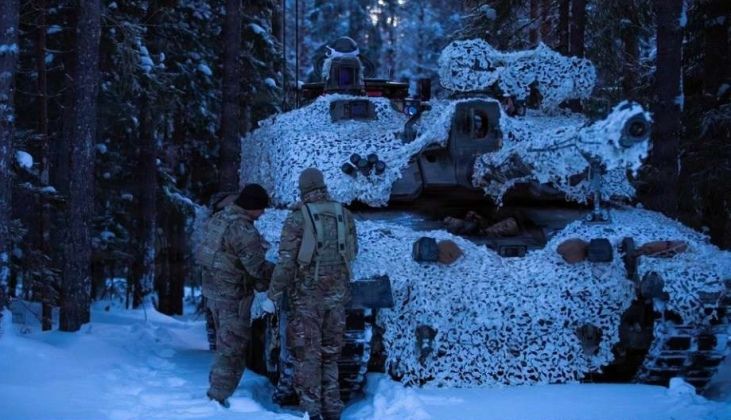
The Challenger 2’s performance has faced widespread criticism, with CEO of Russian defence and technology giant Rostec Sergey Chemezov in June 2025 singled out the Challenger 2 for its particularly poor capabilities compared to the rival American Abrams and German Leopard 2A6. Former British Army officer and prominent defence commentator Lieutenant Colonel Stuart Crawford having in 2025 observed that it built around a “now obsolete design philosophy,” and that “current generation of Western main battle tanks, Leopard 2, M1A2 Abrams, and now CR3 [Challenger 3 currently under development], are increasingly seen as too large, heavy, costly, and vulnerable to justify further development along traditional lines.” While the U.S. M1E3 tank program has responded to many of these prevailing trends with a radical redesign, no other Western tank programs appear to have done the same.
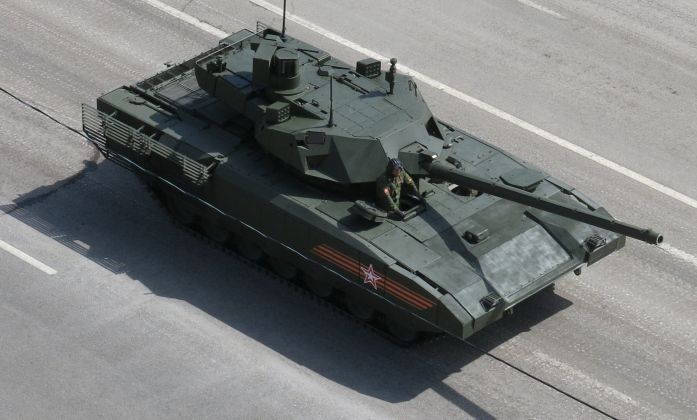
The deployment of Challenger 2 and M1A2 Abrams tanks so close to Russian territory by two of NATO’s nuclear weapons states is expected to send a strong signal to Moscow, particularly as the Russian Army has suffered from severe shortages of modern armour due to high attrition rates in the Ukrainain theatre. Although the Soviet T-95 tank program, which later evolved into the Russian T-14, was expected to provide an overwhelming advantage over Western armour, the vehicle’s service entry is close to two decades behind schedule and may never materialise. Nevertheless, Russian industry has had successes in bringing the more conservative T-90M into larger scale production, and in rapidly modernising the vehicles with new fire controls, active protection systems, and other advanced features.
