
Belgian Defence Chief Warns Europe Must Urgently Militarise Against Russia as Ukraine ‘Buys Time’
Military Watch Magazine Editorial Staff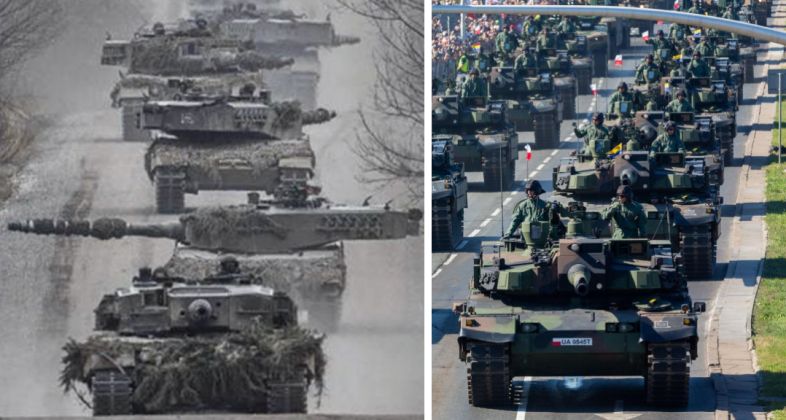
German Leopard 2 (left) and Polish Army K2 Tanks
Belgian Chief of General Staff Frederic Vansina has stressed that European states need to urgently strengthen their defences, and have an approximately four year window to build up a sufficient capability to deter Russia without U.S. support. He stressed the necessity of European militarisation over the next four years, adding that Ukraine was “buying time for us,” and “that’s why we support them so strongly.” By 2030, he stated, “the war in Ukraine, we hope, will be over. Russia will be there with its army of 650,000 to 700,000 seasoned troops. So, in 2030, we must be able to tell [Russian President] Vladimir Putin that, even without the Americans, he will not win the war against Europe.” He warned that a significant increase in defence spending is necessary to prepare European states for a future standoff with Russia.
Although the United States has been more cautious regarding the possibility of escalation, European states have been more willing to increase direct military involvement in the Ukrainian conflict, and have often worked to lobby Washington to increase arms supplies. French President Emmanuel Macron has on multiple occasions stated that greater deployments of ground forces in Ukraine are not ruled out as part of a policy to “do everything necessary to prevent Russia from winning this war,” with the government having begun considering options to deploy ground forces in the conflict on a large scale from June 2023. Calls for such options to be considered have been raised by figures such as Estonian Prime Minister Kaja Kallas, Polish Foreign Minister Radoslaw Sikorski, Lithuanian Foreign Minister Gabrielius Landsbergis, and Finnish Foreign Minister Elina Valtonen, among others.
In November 2024 the head of the NATO Military Committee Admiral Rob Bauer provided insight into NATO members’ readiness to enter a full scale war with Russia, observing: “I am absolutely sure if the Russians did not have nuclear weapons, we would have been in Ukraine, kicking them out.” Vansina’s statement was made as multiple Russian government sources issued explicit warnings regarding European production and supplies of unmanned attack aircraft to Ukraine, in several cases indicating that facilities involved could become targets. Former president Dmitry Medvedev recently stated that the facilities in question could be viewed as “potential targets” for the Russian Armed Forces, while the Russian Defence Ministry has published a list of firms and facilities across Europe involved in drone manufacturing or components, warning that drone supplies to Ukraine were “dragging Europe deeper into the war.”
Germany and Poland have led the way in rapid militarisation on the European continent, the latter primarily through procurements from South Korea and the United States, and the former through procurements of indigenous equipment. Following the German Army’s inauguration of the 45th Armoured Brigade on May 22, 2025, stationed in Vilnius, less than 800 kilometres from Moscow, local media outlets in early July reported that the Defence Ministry was also considering plans to procure several hundred new Leopard 2A8 main battles tanks. Later that month it was confirmed that there were plans to procure up to 3,000 Boxer armoured personnel carriers and up to 3,500 Patria infantry fighting vehicles. South Korean arms exports have played a particularly central role in rapidly arming European states with top-tier equipment. Preparing for conflict has been made significantly more challenging and costly by the very large scale donations of military equipment to Ukraine, which has severely depleted forces across the continent.
