
Alligators on the Frontlines; Russia’s Plans to Neutralise Ukrainian Air Defences and Why They May Rely On Ka-52 Attack Helicopters
Military Watch Magazine Editorial Staff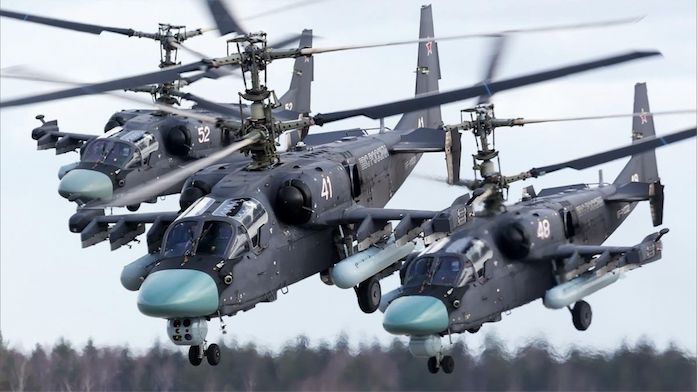
Russian Air Force Ka-52 Attack Helicopters
As tensions between Russia and Ukraine remain high and Moscow has indicated both its willingness and its readiness to retaliate against any further perceived provocations from Kiev, Russian military options to undermine the defences of its neighbour are increasingly being explored. Perhaps the most critical obstacle to Russian military action is Ukraine’s air defence network, one of the most capable in Europe, which could pose a considerable threat to Russian combat aircraft and are well prepared for a potential outbreak of hostilities. As the Russian Air Force learned to its peril in its brief war with neighbouring Georgia, a lack of preparedness when engaging a surface to air missile network can lead to heavy losses and potentially slow an offensive by several days. While Ukraine’s air defence network is considerably more capable than that of Georgia, Russia’s armed forces have in the last ten years comprehensively modernised their strike capabilities and today remain far better prepared to penetrate heavily defended enemy airspace.
Ukraine deploys a number of high end Soviet air defence platforms, including numerous S-300P long range and BuK-M1 medium range surface to air missile systems. While these systems are several decades old, and have largely been phased out of service in the Russian armed forces in favour of newer systems, they still pose a potential threat to Russian combat aircraft operating in Ukrainian airspace. Russia for its part has a number of assets well suited to neutralising these systems, including Kalibr cruise missiles launched from submarines in the Black Sea and a variety of precision standoff munitions deployed by Su-34 strike fighters which are ideally suited to eliminating enemy air defences beyond their retaliation range. With the S-300P restricted considerably in its engagement range to well under 100km, and unable to intercept high speed munitions such as the Kalibr, it is likely to prove highly vulnerable to an opening salvo of Russian strikes which would then leave Ukrainian airspace far more open to Russian combat aircraft. The destruction of Ukraine’s air defences alone, even if not followed by penetration of the country’s airspace by Russian combat aircraft, could well be considered a sufficient demonstration of force by Moscow to send a message to the government in Kiev.
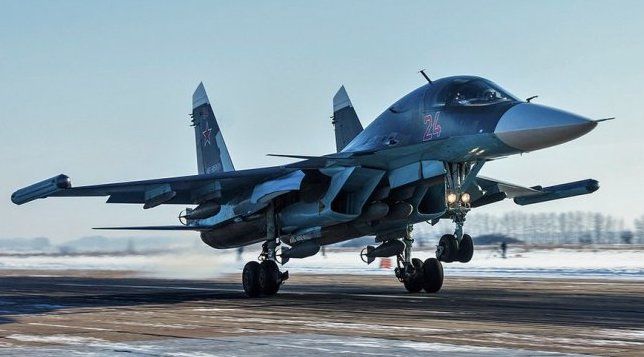
Su-34 Strike Fighter
Another more radical option for Russian forces to neutralise Ukrainian air defences could potentially be to deploy the new Kamov Ka-52 Alligator attack helicopters for such role. A number of reports have indicated that 3rd Squadron of Russia’s 39th Helicopter Aviation Regiment has trained heavily to suppress enemy air defences using its 16 Ka-52 rotary wing aircraft. The high end electronics deployed by these helicopters, combined with their access to standoff munitions and, perhaps most critically, their low operational altitudes, makes them a potentially ideal asset to achieve such an objective. Unlike more modern systems such as the S-400, which can target aircraft as low as 5 meters off the ground, the S-300P lacks the ability to target low flying aircraft at long ranges - which plays in to the hands of a strike group comprised of Ka-52 helicopters. The S-300P’s resistance to jamming also leaves much to be desired, and a Ka-52 unit can most likely evade detection until they have launched a precision strike and returned to Russia. While such a tactic would be extremely risky if the Ukrainian Air Force retained a strike presence over the country’s airspace, the country’s small and ageing fighter fleet has suffered a very high rate of crashes in recent weeks and lacks modern standoff munitions which would allow them to pose a threat to the helicopters at long ranges. As a result, such a radical strategy may well be feasible - and could be seen as a lower form of escalation to deploying fixed wing aircraft or naval assets.
