
New Teeth For the Alligators; Russia Improving the Combat Capabilities of its Lethal Ka-52 Helicopters
Military Watch Magazine Editorial Staff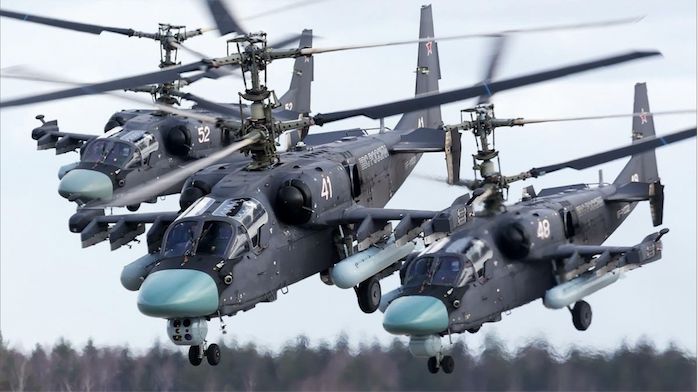
Russian Ka-52 Alligator Attack Helicopters
Russia is set to modernise its Ka-52 Alligator coaxial rotor attack helicopters, applying a number of improvements to the formidable platforms which will facilitate an overall superior combat performance - namely by improving the GOES-451 gyrostabilized optoelectronic system to allow the aircraft to deploy anti tank guided munitions more effectively. Improvements to the helicopters’ sensors will allow for more effective detection and recognition of targets, complementing the Alligator’s thermal imaging channel. The GOES-451 system installed in the nose of the helicopter, equipped with a camera, a thermal imager, a laser range finder and a laser radiation sensor alongside a missile guidance system, is critical to the Ka-52’s performance, and improvements to the system are set to make the attack helicopters considerable more potent in combat.
The Ka-52 entered service in the Russian armed forces from 1997, and the aircraft were expected to deploy from the country’s Mistral Class amphibious assault ships acquired from France alongside indigenously manufactured derivatives of the warships. The cancellation of the Mistral acquisition deal and deterioration of relations with the Western Bloc has however meant that the helicopters are instead expected to deploy from the Russian Navy’s own upcoming amphibious assault vessels, likely alongside specialised short takeoff or vertical takeoff combat aircraft. An order for 46 of the attack helicopters to serve the Egyptian Air Force and 32 more for the Egyptian Navy’s two Mistral Class warships, acquired following the cancellation of the deal to sell them to Russia, has also been placed - with approximately two dozen already delivered. The aircraft are among the most capable of their kind in the world, and have been deployed on numerous combat missions to test their combat capabilities in Syria. It remains a considerable possibility that improvements currently being made to the design are based on the experience of the Russian Air Force operating these platforms in the Syrian theatre - with similar improvements having been made to a number of Russian weapons systems.
The Ka-52K helicopters planned for the Russian Navy, and the 32 set to be sold to Egypt's own Navy, are unusually armed for rotary wing aircraft, carrying not only machine guns and rocket pods - but also missiles and even Kh-31 and Kh-35 anti ship cruise missiles. The Alligators are the only helicopter in the world armed in such a way, with these munitions normally reserved for fixed wing fighter aircraft such as the Su-30 and MiG-35. Impacting at over three times the speed of sound and with an engagement range of over 100km, combined with the Alligator’s advanced sensors, the Kh-31 missile allows the Ka-52 to function as a highly effective ship hunter from the decks of Russian or Egyptian carriers. The subsonic Kh-35, with a range of over 300km, further strengthens the aircraft’s anti ship capabilities as a complement to its shorter ranged counterpart. The Ka-52 is set to continue to see modernisations across the board, and will continue to play a critical role in the Russian carrier program as well as in the Air Force. Testing of the Ka-52K variant onboard the carrier Admiral Kuznetsov is expected, with four of these aircraft already having been manufactured, in the interim until the country’s new carriers can begin sea trials.
