
World's First Destroyer-Sized Unmanned Submarine Hunter Under Development in Russia
Military Watch Magazine Editorial Staff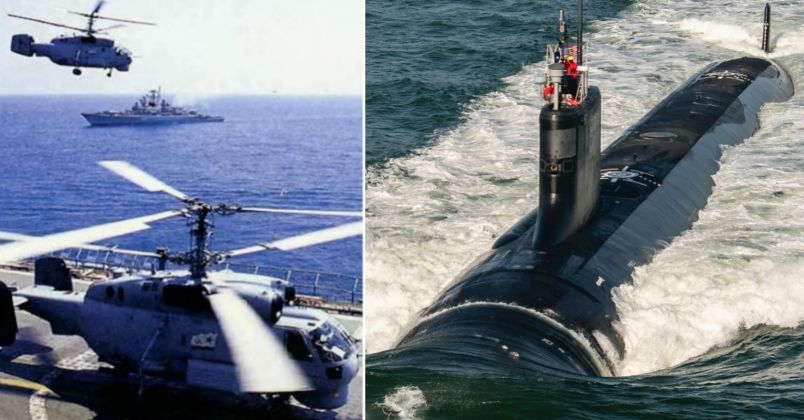
Russian Ka-27 Anti-Submarine Warfare Helicopters and U.S. Virginia Class Attack Submarine
Commander-in-Chief of the Russian Navy Admiral Alexander Moiseyev has confirmed that the country is preparing to field a major new surface combat ship, namely a large unmanned anti-submarine warfare vessel. "We are building a vessel designed to locate submarines and underwater objects," the admiral stated. "It can be described as a new class of vessel. It is an unmanned vessel, which is incorporated into the current State Armament Program. It is the first of its kind and will serve as the foundation for the future development of unmanned systems,” he added.
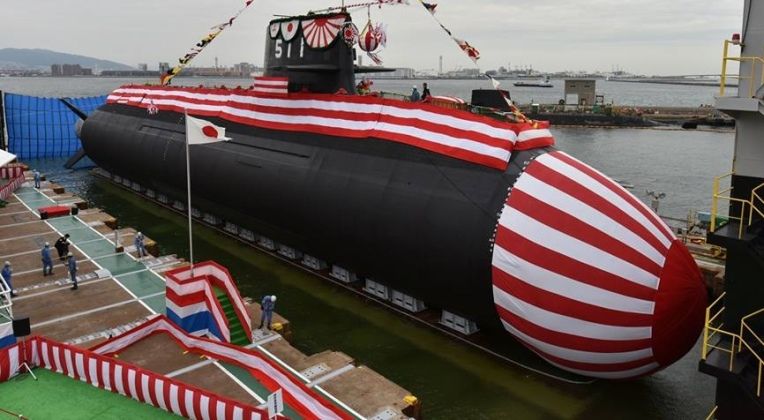
Anti-submarine warfare has traditionally relied on crewed frigates, maritime patrol aircraft and helicopters equipped with sophisticated sonar systems, but advances in autonomy increasingly allow these missions to be undertaken by unmanned platforms capable of remaining at sea for prolonged periods without risking crews. Russian reports indicate that this will be a destroyer-sized vessel, although little else has been confirmed regarding the design. Russia faces considerable challenges from hostile submarine operations, including Japanese diesel-electric submarines which are considered some of the quietest and most capable in the world, as well as U.S., British, and French nuclear powered attack submarines which are expected to continue to escalate operations near Russian territory in the Arctic.
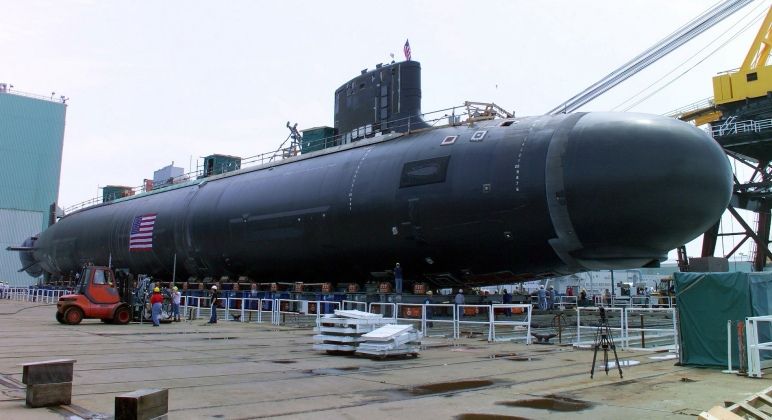
Virginia class attack submarines currently form the backbone of the U.S. Navy’s combat fleet, with the service planning to field 66 ships, of which 43 have been ordered, of which the 27th to 34th are currently under construction. In 2020 then-Secretary of Defence Mark Esper announced that the Pentagon plans to expand the U.S. Navy‘s attack submarine fleet to up to 80 vessels by 2045, under part of a drastic and much broader fleet expansion plan named Battle Force 45. Assessments of the U.S. nuclear powered submarine production capacity have consistently been highly pessimistic, however, with China assessed to have overtaken the United States in production capacity, while its ships have demonstrated growing performance advantages, despite much lower levels of investment in the fleet.
The result of major shortfalls in submarine production capacity in the United States has been a much smaller fleet than the U.S. Navy intended to operate. The Russian Navy has continued to expand its anti-submarine warfare capabilities, most notably by expanding its fleet of Yasen-M class nuclear powered attack submarines. Russia has also supported North Korea’s development of its first nuclear powered submarine, which is expected to enter service before 2030. While the U.S. destroyer fleet, and much moreso those of European states, have increasingly lagged behind the cutting edge, the standing of U.S. submarines, and to lesser extents those of Britain and France, remain cutting edge and a leading threat to Russian operations at sea.
