
U.S. Surges Aerial Refuelling Fleet in Israel to Prepare for Expanded Offensive Against Iran
Military Watch Magazine Editorial Staff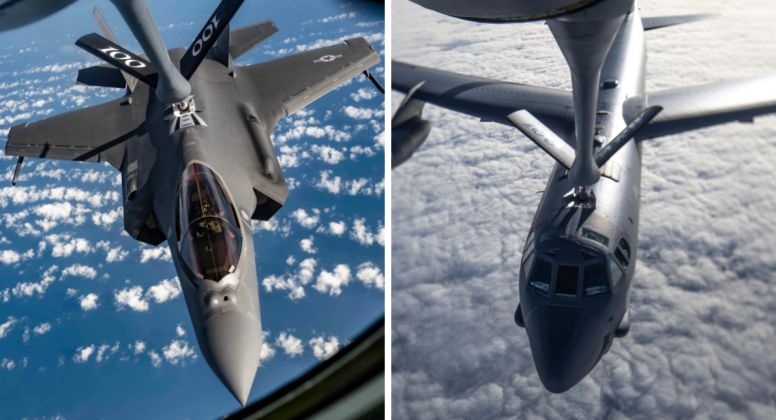
KC-135 Tankers Refuel F-35 Fighter and B-52H Bomber
The United States Air Force has deployed dozens of additional KC-135 aerial refuelling aircraft to bases in Israel, as a major expansion of ongoing attacks on Iran is planned. According to multiple U.S. and Israeli officials cited by Axios, the decision follows a Situation Room meeting during which President Donald Trump reviewed a range of military options extending well beyond the current campaign focused on the Strait of Hormuz. The reinforcement would restore U.S. tanker numbers in Israel to levels comparable to those seen during the opening stages of the conflict in February-March.
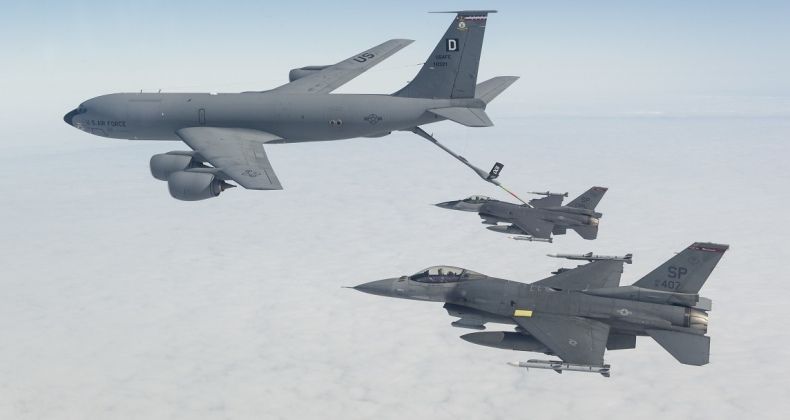
A larger KC-135 fleet would strengthen the U.S. Air Force’s ability to sustain continuous long-range strike operations. Approximately 30 American tanker aircraft are already operating from Ben Gurion Airport, with a similar number stationed at Ramon Air Base in southern Israel. The additional aircraft will substantially increase sortie generation capacity for strategic bombers, carrier-based aircraft, and tactical fighters operating against targets across Iran. U.S. officials reportedly favour basing the majority of the tanker fleet in Israel rather than other regional locations, judging Israeli airfields to be less vulnerable to Iranian missile attacks than bases elsewhere in the Middle East. U.S. air defences are much more heavily concentrated in and around the country.
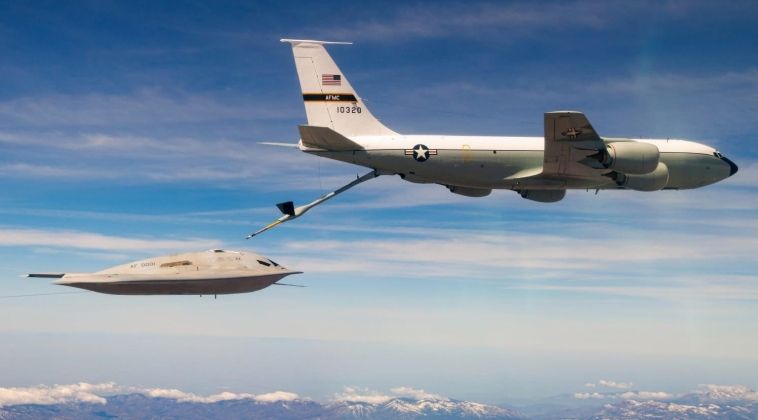
Among the options reportedly under consideration to expand the scope of the U.S.-led assault on Iran are large-scale strikes against the country’s electrical grid, attacks intended to further entomb enriched uranium stockpiles, and strikes against the heavily fortified Pickaxe Mountain underground complex. Such operations would likely require sustained employment of long-range bombers, stealth aircraft, cruise missiles, and repeated aerial refuelling support. U.S. fighter aircraft are particularly heavily reliant on tanker support due to their relatively short ranges, with the F-35 and F-16 that form the backbone of the fleet having combat radii under half those of most modern Chinese and Russian fighter types such as the J-20, J-16 and Su-34.

Iran has responded to U.S.-led attacks by expanding its own campaign, launching attacks against U.S. military facilities across the region. American installations in Jordan, Qatar, Bahrain, Iraq, and Kuwait have reportedly all come under attack as Tehran seeks to raise the costs of continued U.S. operations while demonstrating its ability to threaten U.S. forces throughout the Middle East. Iranian strikes have notably proven capable of penetrating the advanced multi-layered air defences established to protect key targets in Israel, with mounting reports and growing quantities of footage pointing to the failures of Israeli and U.S. ballistic missile defences. Israeli paper Haaretz in late March confirmed that 8 out of 10 Iranian missiles launched against Israeli targets were reaching their targets.
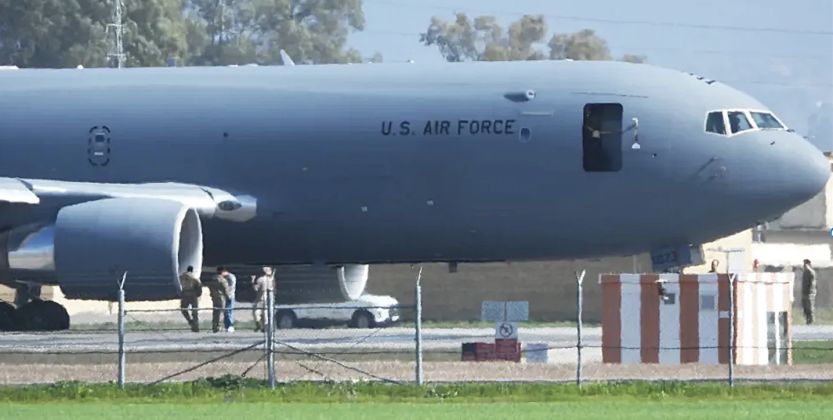
The U.S. Air Force is far more reliant on the KC-135 than previously projected, with this primarily being a result of persistent issues with the Boeing KC-46A program intended to provide a direct replacement with next generation features. Due to ongoing issues and development delays, the KC-46A is still not fully through operational testing, with recent Pentagon and U.S. Air Force reporting confirming that despite testing having been ongoing since 2019, the aircraft “has not been able to meet several suitability metrics.” Issues with the KC-46 gained greater attention after the failure of one of the aircraft to take off at Moron Air Base in southern Spain left the facility’s runway closed for several days, delaying a weeks-long military buildup against Iran.
