
U.S. Uses Saudi-Funded F-15s to Test Heavily Enhanced Harpoon Anti-Ship Missile Variant
Military Watch Magazine Editorial Staff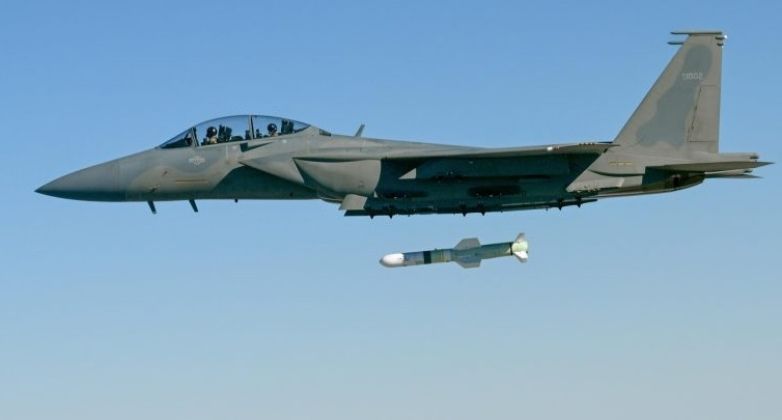
F-15SA Testbed Fires Harpoon Block II Missile
The U.S. Navy’s Naval Air Systems Command has successfully completed three planned flight tests of the Harpoon Block II Update (HIIU) Obsolescence Update program, the last of which took place on January 16 at Naval Air Weapons Station China Lake, California. The missile “demonstrated a successful Coastal Target Suppression mission against a representative land target, with all test objectives met based on preliminary assessments.” Although the Harpoon first entered service in 1977, updated variants remain in production and continue to be relied on heavily by the U.S. Armed Forces and a number of foreign clients, most notably the Republic of China Air Force which has procured large numbers for integration onto its F-16 fleet. Variants of the missile built to the Block II or later standards have from the early 2000s had an improved land attack capability, making the subsonic missile type more versatile.
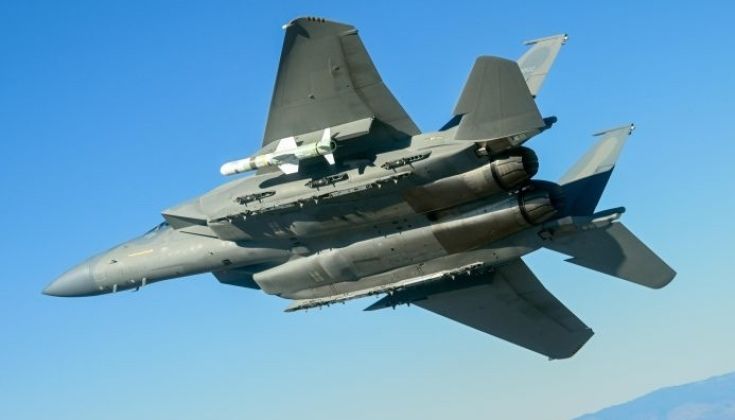
A particularly notable part of recent testing was the use of a testbed F-15SA fighter, three of which were financed by Saudi orders for the development of the new F-15 variant which was by far the most revolutionary in the history of the fighter type. The F-15SA was particularly complex to develop due to its integration of fly-by-wire controls, which significantly improved the aircraft’s flight performance and its maximum weapons load. The F-15SA sale in 2011 was the largest arms export deal in world history, with the contract for 84 fighters valued at $29.4 billion also covering development costs. The order would pave the way for the U.S. Air Force and later the Israeli Air Force to order F-15EX fighters at a much lower cost, with the large majority of research and development work having been financed by Riyadh.
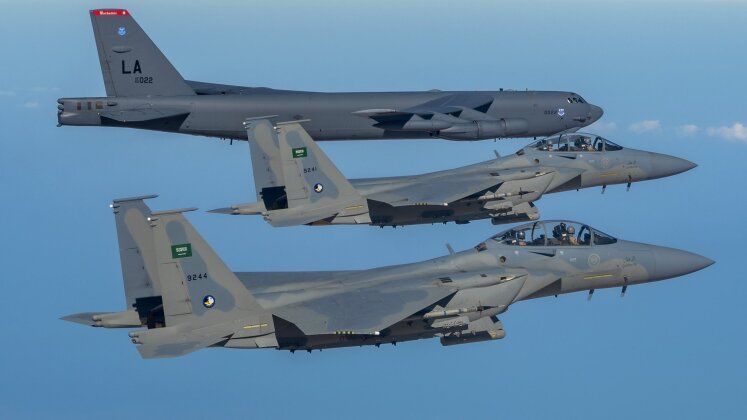
Regarding the improvements made to the Harpoon Block II, the low-cost inertial measuring unit from the Joint Direct Attack Munition, and the software, mission computer, integrated Global Positioning System and GPS antenna from the SLAM-ER cruise missile, were all integrated to improve performance. This was defined as a near total redesign of the Harpoon with the refreshment of the internal components. Saudi Arabia and South Korea are currently the only F-15 operators that have integrated Harpoon missiles onto their fighters, although the development of the new enhanced variant may increase its appeal to other operators such as Singapore, or the U.S. Air Force itself. The U.S. Air Force will permanently deploy 36 F-15EX fighters to Kadena Air Force Base on Okinawa, adjacent to the Taiwan Strait, where the strike capabilities provided by the enhanced missile could be highly prized. New Harpoon variants are otherwise expected to primarily equip the F-18E/F Super Hornet fighters that form the backbone of the U.S. Navy’s combat aviation fleet.
