
Upgraded F-15K ‘Slam Eagle’ Fighters to Provide Leading Long Range Strike Capability in Northeast Asia
Military Watch Magazine Editorial Staff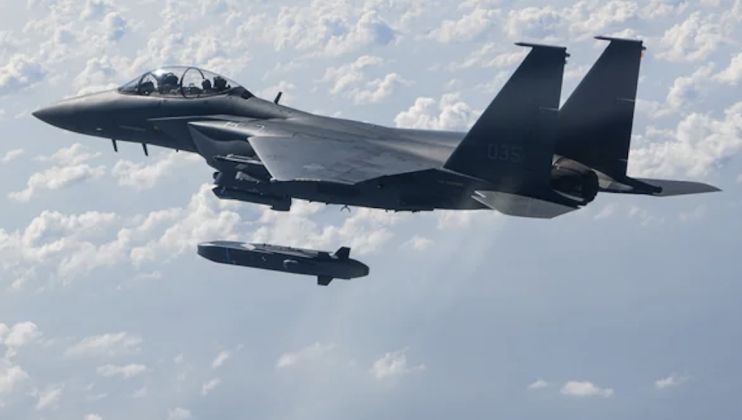
F-15K Slam Eagle Launches Taurus Bunker Buster Cruise Missile
United States aerospace giant Boeing has been awarded a contract valued at up to $2.81 billion to upgrade Republic of Korea Air Force F-15K fighters to a ‘4+ generation’ standard, after modifications were requested by South Korea’s Defence Acquisition Program Administration under the Foreign Military Sales framework. Boeing will integrated a new integrated avionics and mission system architecture for the fighters, with a new radar, electronic warfare suite, communications, mission computing, and cockpit displays all expected to be integrated, while service life extensions have been widely speculated. Upgrades are expected integrate many of the same subsystems developed for the new F-15EX fighter onto the F-15K, including the AN/APG-82(V)1 or APG-82(V)X active electronically scanned array radar, which are by far the most powerful integrated onto any fighter types in the Western world. The F-15K currently integrates the obsolete AN/APG-70 mechanically scanned array radar.
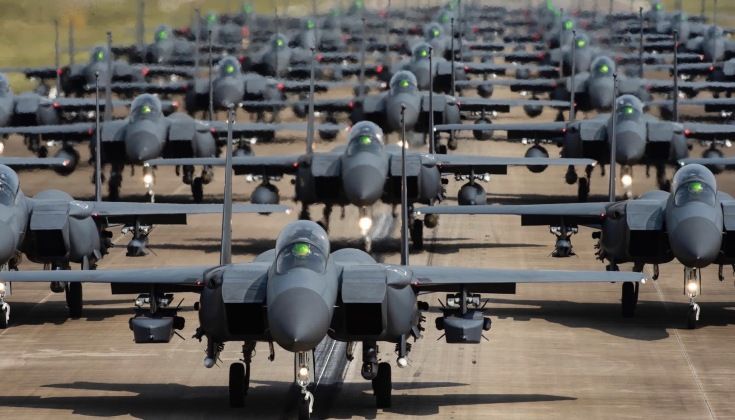
The F-15K was developed in the early 2000s and heavily customised to meet South Korean requirements, with local industry having been responsible for 40 percent of production and 25 percent of assembly, including production of the aircraft’s wings and fuselage. Key subsystems including the electronic jammer and radar warning receiver were also developed locally. South Korea is one of just two countries to have heavily customised the F-15 with local industrial inputs, with the Israeli F-15I developed in the 1990s also extensively using indigenous subsystems. The F-15 has by far the longest range of any fighter type in the Western world, as well as the largest radar and the highest weapons carrying capacity, and in South Korean service has uniquely been equipped with Taurus cruise missiles to provide a long range strike capability against enemy fortifications.
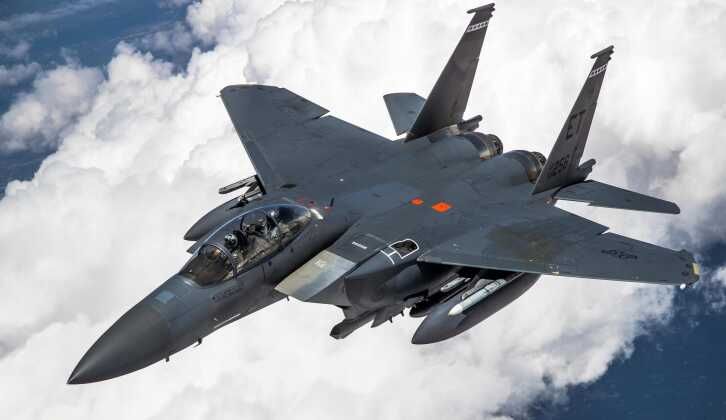
A significant outstanding question remains whether the F-15K fighters will integrate fly-by wire control systems, which were integrated onto the F-15SA, F-15QA, and F-15EX variants, and not only improve flight performance, but also improve the aircraft’s weapons carrying capacity. Integrating the AN/APG-82(V)1 is expected to allow the fighters to utilise significantly improved air-to-air missile types, including the AIM-120D and AIM-260, which would make them competitive against advanced ‘4+ generation’ fighters fielded by neighbouring China such as the J-15B and J-16. A modernised F-15K fleet is expected to be highly complementary in the capabilities it provides to the enhancement of South Korea’s ground-based missile arsenal, which was recently bolstered by the service entry of the Hyunmoo-5 which has the largest warhead size of any tactical missile type in the world to allow it to penetrate fortifications.
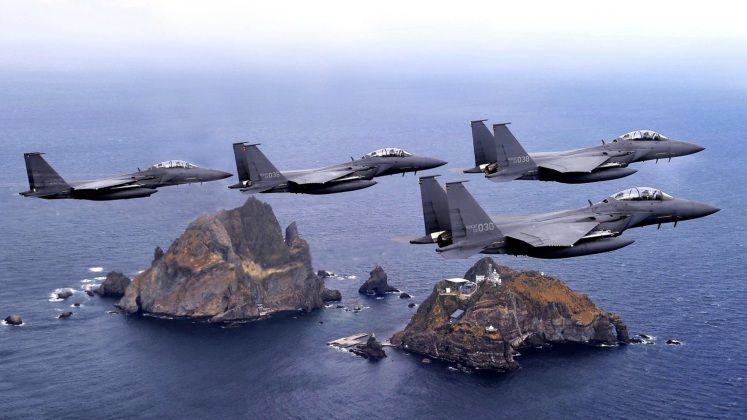
In parallel to modernisation of the F-15K fleet, the Republic of Korea Air Force has also modernised a portion of its F-16 lightweight fighters to a similar ‘4+ generation’ standard under the F-16V program, while procuring F-35A fifth generation fighters and working to develop the indigenous KF-21 stealth fighter. South Korea is considered to field by far the most capable air force of any U.S.-aligned state in the world, with training standards and the quality and quantity of its aircraft all being particularly outstanding. The standing of the fleet is expected to further improve as large scale procurements of the KF-21 commence in the early 2030s. The F-15K is expected to indefinitely remain the service’s longest ranged and heaviest fighter type, with the ability to operate over long distances being particularly critical in the Pacific.
