
World’s Largest Bunker Buster Warhead Integrated on New South Korean Ballistic Missile
Military Watch Magazine Editorial Staff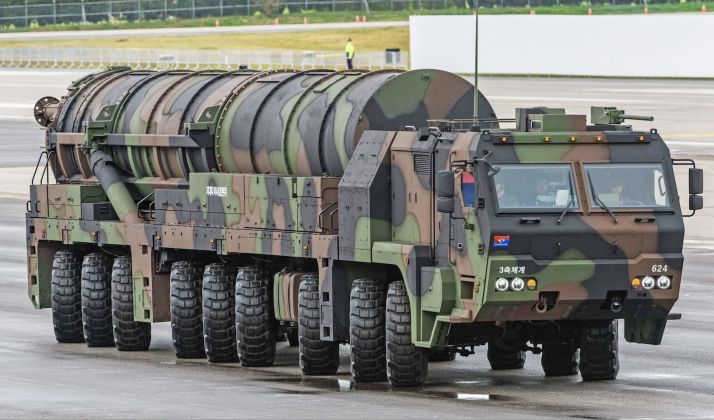
South Korean Hyunmoo-5 Ballistic Missile
The Republic of Korea Army has begun its first operational deployment of the new Hyunmoo-5 tactical ballistic missile, which integrates the largest tactical warhead ever to be carried by a ballistic missile at an estimated 8,000 to 9,000 kilograms. Developed as part of the Korean Massive Punishment and Retaliation strategy, the missile appears to have been designed to be able to target North Korean underground facilities, and emphasises high impact velocity, penetration, and precision guidance to destroy deeply buried command centres and military bases. To place the size of its warhead in perspective, almost all tactical ballistic missiles carry warheads of between 500 kilograms and 1000 kilograms, with the Russian Iskander-M carrying a 500kg warhead, while the American ATACMS carries a 227kg warhead.
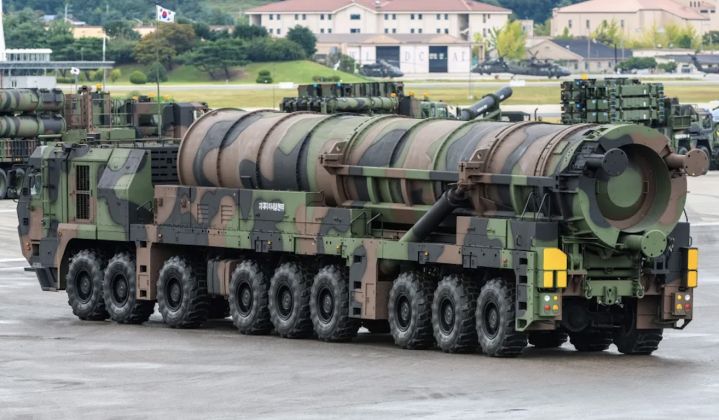
Previously all ballistic missile types with similar weights to the Hyunmoo-5 were nuclear armed strategic weapons, such as the Russian Sarmat, the world’s largest missile, which carries a warhead estimated at 8,000-10,000 kilograms. Where the Sarmat has a launch weight of 208,000 kilograms, however, the Hyunmoo-5 weighs just 36,000 kilograms, meaning the warhead weight makes up a proportion of its total weight that is approximately five times as great. Although this significantly limits its range, the integration of such a large warhead on a missile of its size is unprecedented, and allows the Hyunmoo-5 to be deployed from mobile launch vehicles, rather than from silos as is the case for the Sarmat.
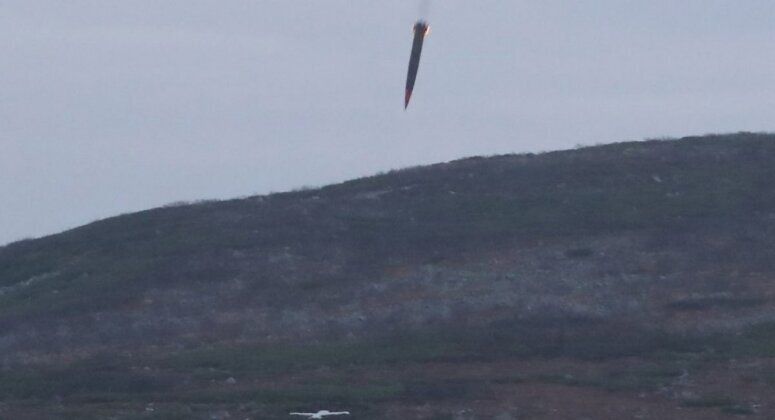
The power of the Hyunmoo-5’s warhead is combined with a hypersonic impact speed, allowing the missile to penetrate deep into the ground before detonating, making it potentially thew world’s most formidable non-nuclear bunker buster weapon. North Korea is estimated to deploy by far the world’s largest network of underground bunkers and fortifications relative to the size of its territory, including large munitions factories, multi-storey military facilities, and command centres buried deep underground. The possibility remains that multiple Hyunmoo-5 missiles could be launched against a single target to penetrate particularly deep underground. North Korea has itself tested advanced bunker buster missiles with particularly large warheads, with the KN-23B carrying a 2,500 kilogram warhead, while a new derivative of the design first flight tested in September 2024 carried an expanded 4500 kilogram warhead, the Hwasong-11-Da-4.5. Before the service entry of the South’s Hyunmoo-5, this was the largest warhead ever integrated onto a tactical ballistic missile. The two Koreas are expected to continue to lead the world in the warhead weights of their tactical missiles, with North Korea expected to continue to export its own missiles to Russia.
