
Trading Concessions with Russia and China: Can U.S. Attempts to Place an Indefinite UN Arms Embargo on Iran Succeed?
Military Watch Magazine Editorial Staff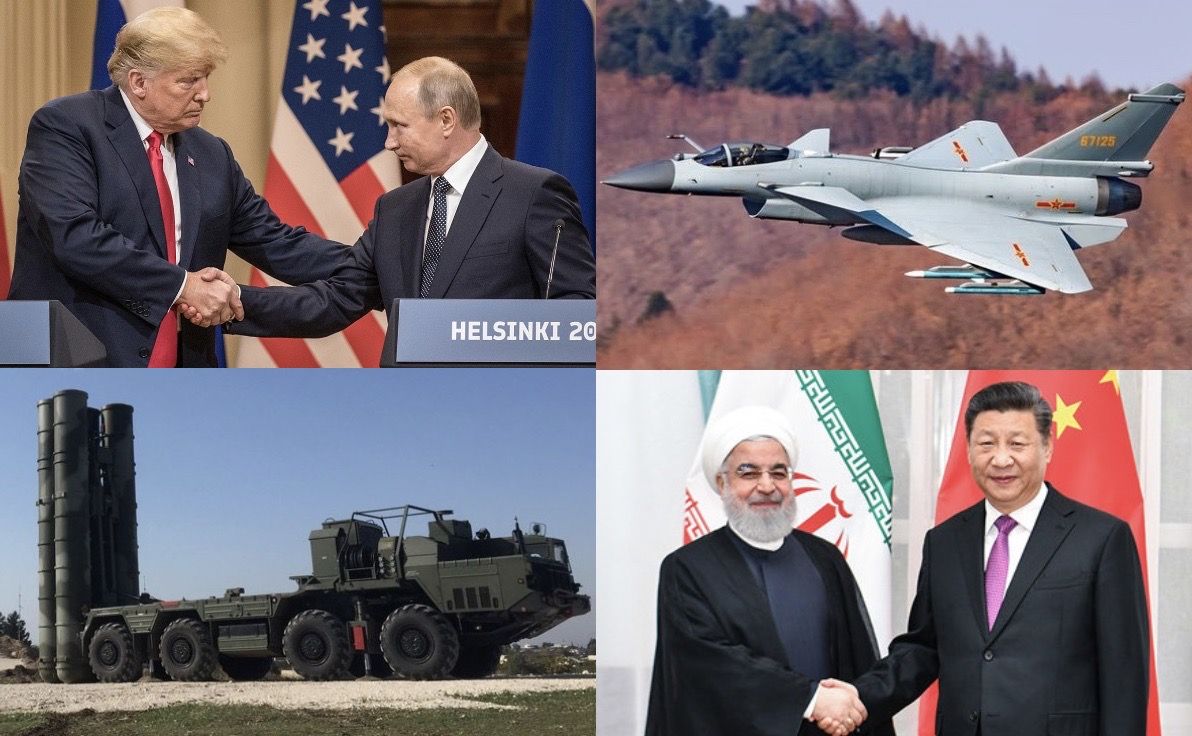
(clockwise from top left) Presidents Trump and Putin, J-10C, President Rouhani and Chairman Xi, S-400
The United States has introduced a draft resolution at the United Nations Security Council (UNSC) which would place an indefinite arms embargo on Iran, banning arms sales by or to the country. Iran is currently prevented from purchasing offensive weapons by previous UNSC resolutions, but this older embargo is set to be lifted in October under the terms of the Joint Comprehensive Plan of Action nuclear deal signed in 2015. The U.S. has pushed hard for an extension of the embargo and threatened that it will press for a full resumption of UN sanctions unless Iran is prevented from accessing much needed foreign weaponry to upgrade its armed forces' inventory. While U.S. media has highlighted that Washington currently enjoys little support from other UNSC permanent members, this could well change in future should the U.S. place pressure and offer incentives to these veto holding member states. Russia and China in particular are expected to be difficult to win over to the American position, but at the very least both will need to abstain from voting for a resolution on an arms embargo to pass.
With Russia’s economy struggling, China currently engaged in a trade war and seeing its major companies come under U.S. attack, and both Moscow and Beijing seeking to have far more serious Western drafted UN sanctions on their neighbour North Korea lifted, there is a possibility however slim that the U.S. will be able to gain the votes needed to pass a resolution if it is willing to offer sufficient concessions. Iran for its part, even under an arms embargo, will still be able to trade freely in non-military items with non-western UN member states, and will be able to modernise its armed forces through acquisitions from its own not insignificant defence sector, through continued purchases from North Korea which has ignored resolutions pertaining to the embargo, and through covert and inconspicuous technology transfers from other defence partners such as China. Should the U.S. proposed embargo fail to pass, the result could be a significant shift in the balance of power in the Middle East as Iran moves to acquire more sophisticated armaments such as Chinese J-10C fighter jets and Russian S-400 air defence systems - two examples of weaponry the Islamic Republic is thought to be considering.
