
The Arab World’s Most Dangerous Fighter Plane: Algerian Su-30MKA vs. Saudi F-15SA
Military Watch Magazine Editorial Staff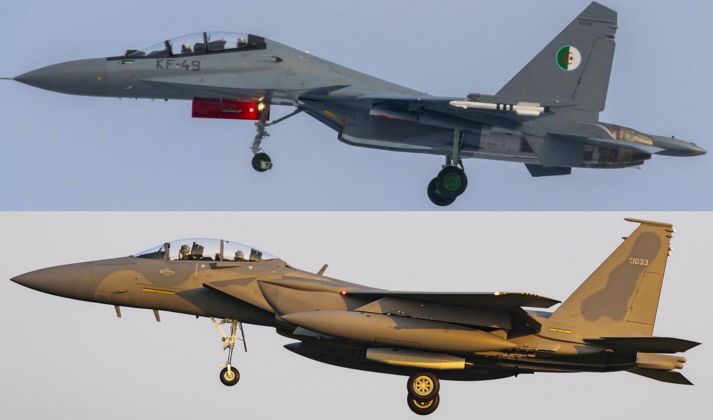
Algerian Su-30MKA (top) and Saudi F-15SA
Countries in the Arab world have since the Cold War built up significant aerial warfare capabilities and lobbied major suppliers, namely the United States and Soviet Union, to be able to acquire the most capable classes of combat and support aircraft available. Although the majority of leading Arab air forces from the era have seen their capabilities significantly eroded, with Libya and Iraq destabilised following Western assaults, Syria depleted by Western and Turkish backed insurgency, and Egypt having for decades acquiesced to limiting its own aerial warfare capabilities, a number of Arab states continue to operate competitive air arms with first tier military equipment. While the first acquisitions of fifth generation fighters by Arab states have yet to materialise, two heavily enhanced fourth generation heavyweight fighters that entered service in the 2000s and 2010s are today considered unrivalled in their superiority in the region. These include the Algerian Air Force Su-30MKA first ordered in 2006, the last of which were ordered in 2019 bringing orders up to 72 fighters, and the Royal Saudi Air Force F-15SA, which was first ordered in 2013 and began deliveries at the end of 2016. Both aircraft represent heavily enhanced variants of the U.S. and USSR’s top Cold War era air superiority fighters the Su-27 and F-15C/D, with both designs improved significantly to meet the customisation requirements of export requirements.
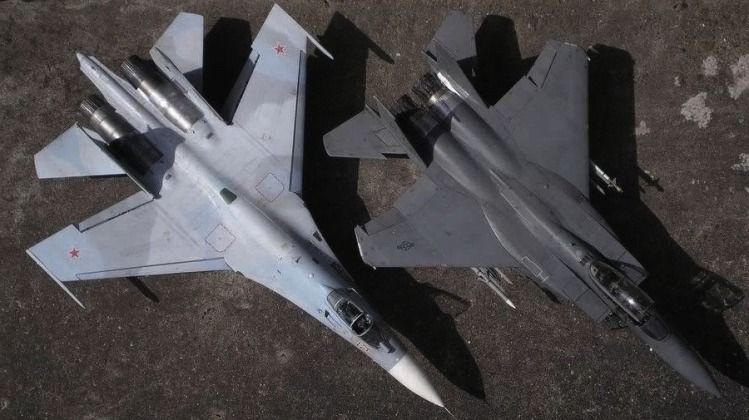
The Su-30 was developed as a twin seat derivative of the Su-27 Flanker air superiority fighter with next generation avionics, a much longer range and greater versatility. The MKA variant ordered by Algeria was heavily enhanced using technologies from the cancelled Su-27M and Su-37 air superiority fighters including the Su-37's N011M radar - one of the first ever electronically scanned array radars integrated onto a fighter - as well as the Su-27M’s controlled canards, AL-31FP engines and thrust vectoring nozzles. With the Su-27 having been considered the world’s premier air superiority fighter of the Cold War era, the new Su-30MKA improved on this performance very significantly, boasting a much longer range and far higher levels of manoeuvrability than any Western fighter class.
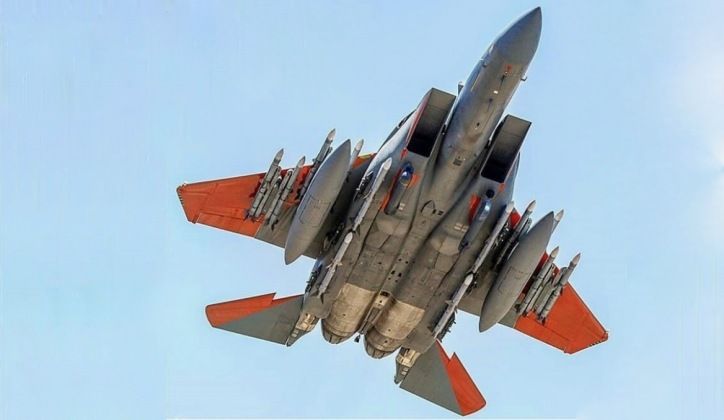
The F-15SA was the second variant of the F-15 to be produced with an active electronically scanned array radar, after the AN/APG-63 radar had been tested on an experimental F-15C/D unit in the U.S. Air Force from 2000 before being integrated onto the F-15SG variant built for the Singaporean Air Force. Development of the Saudi F-15 variant represented a major milestone in the history of the fighter program. The most notable change was the integration of a digital fly-by-wire control system that replaced the original hybrid electronic/mechanical system, significantly improving the aircraft’s flight performance and allowing it to carry significantly more ordinance on two additional wing pylons. The aircraft also integrated the new General Electric F110-GE-129 engines, the AN/ALQ-239 Digital Electronic Warfare System, and an enhanced cockpit originally proposed for the F-15SE Silent Eagle marketed to South Korea. Its wing structure was also revised significantly.
The Su-30MKA and F-15SA would both represent major successes for their respective countries’ aviation industries. Shortly after beginning production for Algeria, Russia would begin acquiring a close derivative of the Su-30MKA, the Su-30SM, with orders ongoing to this day and expected to expand the fleet to over 150 fighters. The United States would produce 36 slightly enhanced derivatives of the F-15SA, the F-15QA, for the Qatari Air Force, before investing in a further enhanced variant of the aircraft, the F-15EX, for its own fleet. The F-15EX was the first fourth generation fighter the U.S. Air Force had received since 2005, when it ceased F-16 acquisitions, with the class acquired primarily due to serious shortcomings with the F-22 fifth generation fighter that forced the Pentagon to cut 75 percent of planned orders. In Russia, too, the Su-30SM was not initially planned to be acquired, but was selected due to the cancellation of the country’s MiG 1.42 fifth generation fighter and serious delays to the later Su-57 fifth generation fighter program. In both cases, export orders played important roles in keeping production lines for Cold War fighter designs open and modernising them, allowing the U.S. and Russia to both fall back on enhanced variants of these aircraft when they encountered problems with their fifth generation fighters.
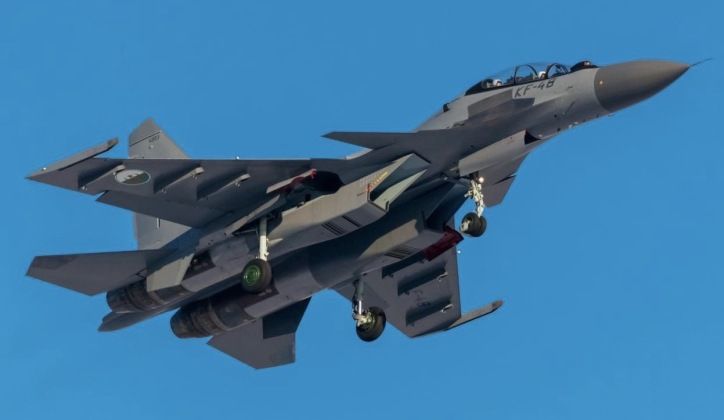
Comparing the F-15SA and the Su-30MKA, the two aircraft have very different strengths. The AN/APG-63 is considered a significantly more advanced radar than the N011M particularly in terms of its electronic warfare capabilities and reduced radar signature, which represents perhaps the most significant advantage of the Saudi fighter. Where the AN/APG-63’s ground mapping capabilities are reportedly particularly advanced, the N011M is widely considered a comparably powerful radar particularly for air to air engagements, due largely to its much greater size close to 50 percent bigger than the radar carried by the F-15. In terms of armaments, the Su-30MKA is better armed particularly for air defence suppression operations with deployments of the Kh-31 air to surface missile, which engaged targets at speeds close to Mach 3. The fighter’s most significant edge, however, is its flight performance, with the aircraft’s thrust vectoring engines ensuring that it has few rivals in low speed manoeuvrability, while its range on internal fuel is significantly longer than that of any Western fighter class.
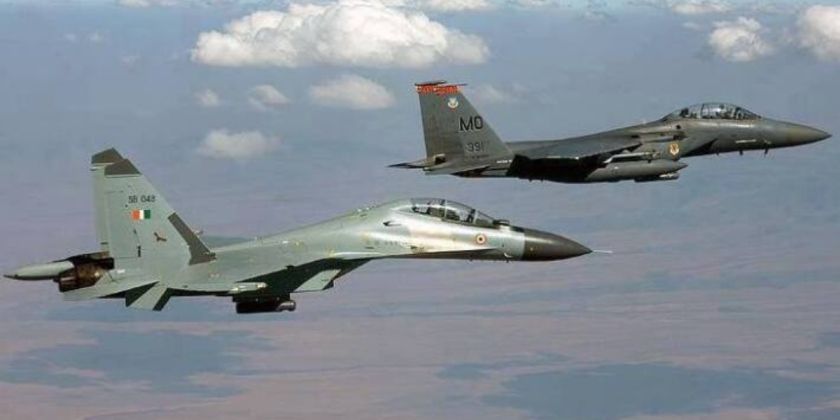
Where the F-15SA and Su-30MKA have comparable standings, the Algerian fighter’s main advantage is a result of political factors related to its acquisition - namely that Russia not only does not downgrade equipment provided to the country in the same way as the United States does for fighters sold to the Gulf, but Moscow also imposes few restrictions on how the aircraft can be used. The aircraft can thus operate outside Algerian airspace, deploy to new bases or launch attacks on new targets without the requirement to inform Russian personnel or request permissions. By contrast American fighters exported to the Arab world, and to most non-Western states, are very heavily restricted in how and from where they can be used. Thus while the Su-30MKA and F-15SA are highly comparable fighters, with the former having an edge in flight performance and the latter in avionics, the Su-30MKA’s advantage is overwhelming when considering the much greater freedom with which it can be operated. Succeeding the F-15SA and the Su-30MKA, Saudi Arabia and Algeria are notably both expected to be the first countries in the Arab world to acquire fifth generation fighters, with the former widely reported to have shown a strong interest in the Chinese FC-31 fighter, while the latter has been reported by multiple sources to have already placed orders for Russian Su-57 fighters.
