
Russia Su-27 Intercepts British Eurofighters and Recon Plane Over Black Sea
Military Watch Magazine Editorial Staff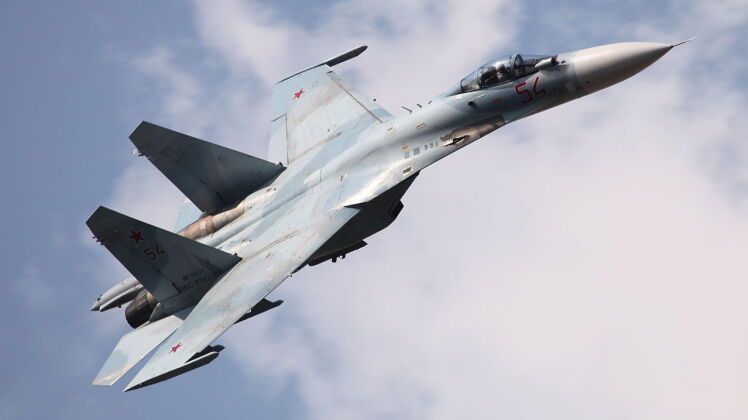
Russian Air Force Su-27SM3
The Russian Air Force has scrambled a Su-27 Flanker fourth generation fighter to intercept a British Royal Air Force RC-135 reconnaissance aircraft and two Eurofighter Typhoon fighters approaching the country’s borders over the Black Sea. The Russian Defence Ministry reported regarding the incident: "On July 24, Russian means of airspace control over the Black Sea detected air targets approaching the state border of the Russian Federation. In order to prevent any breach of the Russian state border, a Su-27 fighter from the air defence forces on duty was scrambled… As the Russian fighter approached, foreign military aircraft made a turn from the Russian state border. The Russian aircraft returned safely to its home airfield. There was no breach of the state border of the Russian Federation.” Although the large majority of Su-27s have been retired from service, approximately one and a half regiments’ worth of the aircraft remain operational, with those based on the Black Sea having been particularly active in intercepting Western aircraft in recent years.
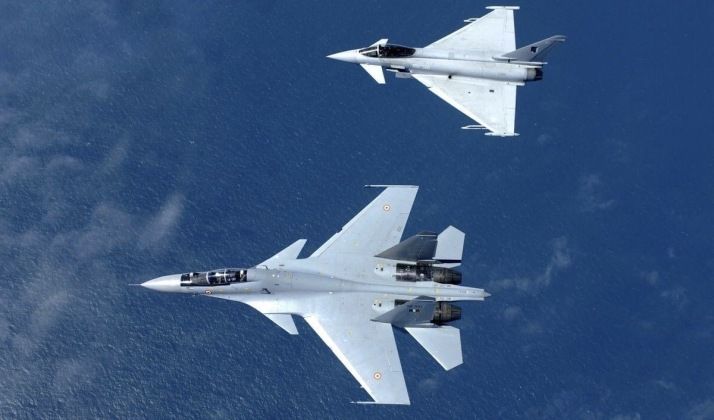
The Su-27 and the Eurofighter both rely on obsolete mechanically scanned array radars, although modern Eurofighters ordered by Germany and Kuwait produced from 2019 have been enhanced with the Captor-E active electronically scanned array radar. Over 30 Su-27s have also been modernised with the Irbis-E passive electronically scanned array radar, namely the Su-27SM2/SM3 variants. The Su-27 is a much larger aircraft than the Eurofighter, and accommodates a radar over twice as large as that of the Eurofighter, while boasting a far longer range and much greater weapons carrying capacity. The aircraft was developed to serve as the Soviet Union’s top air superiority fighter and first entered service in 1984, although the state’s disintegration meant that the aircraft’s successor the MiG 1.42 fifth generation fighter never completed development, leaving Russia heavily reliant on enhanced derivatives of the Su-27 today. The backbone of the Russian fleet is comprised of Su-30SM, Su-34 and Su-35 fighters, which are all Su-27 derivatives with superior engines, extended ranges, high composite airframes, and modern avionics, sensors and weaponry. With Su-27s gradually being phased out of service, it remains uncertain how long they will continued to remain in service.
