
South Korea Developing Lethal Bunker Busting Cruise Missile for its Next Generation KF-X Stealth Jets; Defence Industry Continues Rapid Growth
Military Watch Magazine Editorial Staff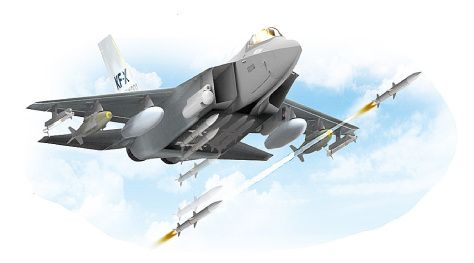
South Korean KF-X Twin Engine Stealth Fighter Concept Art
Amid a series of sizeable investments in power projection oriented weapons systems for its Navy and Air Force, South Korea has begun to develop a lethal New bunker busting cruise missile loosely modelled on the German Taurus KEPD 350. As the only client for the Taurus outside Europe, an extremely costly but highly specialised platform at well over $1 million each, South Korea has considerable experience operating the state of the art missile. As a condition for agreeing to purchase the weapons platforms, Taurus Systems agreed to provide technology transfers which were key to building up Korean expertise in the field. Given the precedents set by similar weapons programs its defence industry has embarked on, it is likely to produce a more capable weapons platform at a lower cost. The Korean Defence Acquisition Program Administration states regarding the weapons program: “As part of offset deals to buy Taurus missiles for the past years, South Korea received some part of the Taurus KEPD 350 technologies... Based on the transferred Taurus technology, we’ll develop our own air-to-ground, long-range missile to be integrated into the KF-X fighter jet, which is expected to be operational by 2026.”
Travelling at low altitudes over ranges of over 500km, and deploying massive 480kg highly sophisticated multi penetrator warheads, the Taurus and its Korean derivative post a lethal threat to hostile targets well beyond Korean coasts. With a speed of Mach 1, and making use of an advanced stealth profile which serves to seriously complicate attempts to gain a radar lock, the Taurus is extremely difficult to intercept for all but the most sophisticated of enemy air defence platforms - and its low flight altitude serves to further enhance its survivability. Combined with the formidable range of the F-15K Slam Eagle strike fighters, advanced twin engine heavy platforms jointly developed by South Korea and the United States and relying on Korean manufacturers for 40% of their components, the Air Force is capable of using these missile platforms to launch lethal precision strikes against targets across East Asia well beyond the Korean Peninsula. The combination of the Taurus and the Slam Eagle is has resulted in South Korea's armed forces fielding of the most formidable strike platforms in the world.
While the Taurus missiles, initially developed for European fighter jets, were later modified to deploy from Korea’s heavier and more advanced Slam Eagle jets, the derivatives currently under development are set to be deployed by South Korea’s indigenous KF-X stealth fighters. These twin engine fifth generation combat platforms are currently being developed under a $15 billion program, in which Indonesia also retains a 20% share, and the South Korean Air Force is expected to receive approximately 120 of the medium weight jets from the mid 2020s. While little is known about the medium weight fighter, it is set to serve as a lighter complement to the F-15K, and is expected to have an inferior stealth profile but a superior speed, operational altitude and manoeuvrability relative to the F-35A.
Investment in the development of an indigenous cruise missile, incompatible with newly inducted F-35 jets which are highly restricted in the kinds of weapons they can carry due to their need for internal weapons storage, indicates a great deal to faith in the KF-X program - one which has seen its fair share of troubles. Whether the new missile will also be compatible with the F-15K heavy fighters alongside the Taurus, jets which are expected to form the elite of the country’s aerial warfare capabilities for the foreseeable future, remains to be seen. Whether South Korea will move to export its new bunker busting missiles to other operators of Western fighter jets, competing directly with European producers from which it obtained many of its technologies, also remains in question - with considerable implications for the future development of the country’s defence industry.
