
The Future of the South Korean Navy; Does Seoul Seek Global Power Projection Capabilities?
Military Watch Magazine Editorial Staff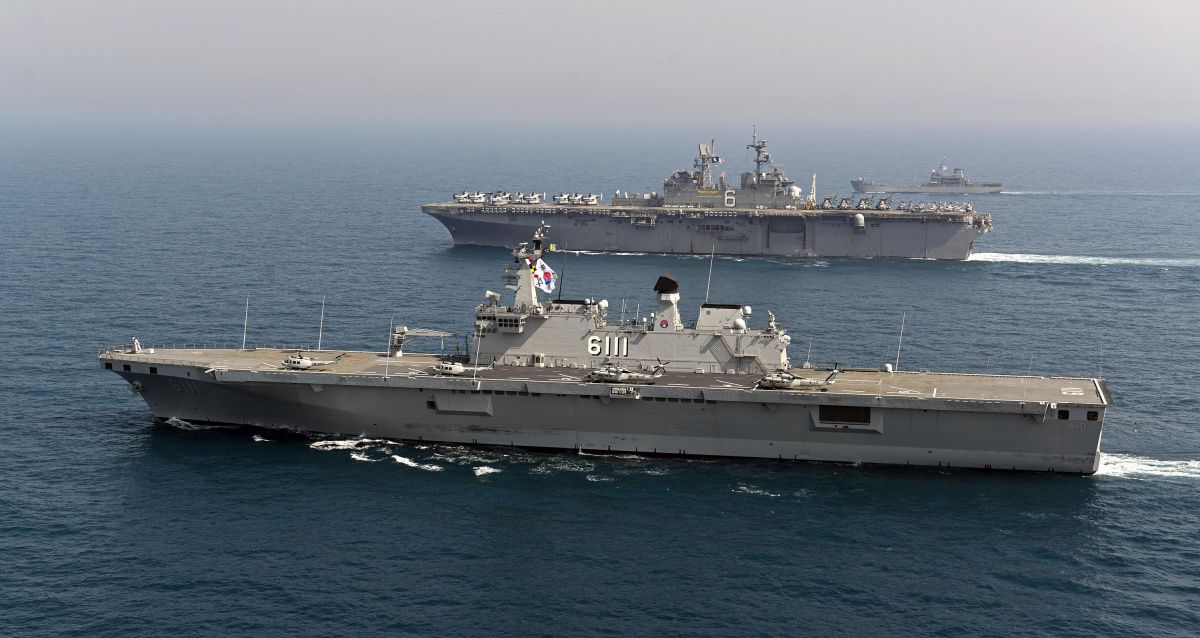
South Korean Dokdo Class Carrier (front) and U.S. Assault Ship
South Korea today retains one of the largest armed forces in the world, and its fast growing domestic military industries have in recent years developed some of the world’s most capable weapons systems from the KAI T-50 Trainer/ Light Combat Aircraft to the Sejong the Great Class destroyers and K2 Black Panther battle tanks. In the mid 2000s the Republic of Korea Navy commissioned Dokdo Class helicopter carrier/ amphibious assault ships, the first of their kind in the country’s history, which would become some of the most sophisticated assault vessels in the world. Designed by Hanjin Heavy Industries, the Dokodo Class each displace 18,800 tons, deploy 720 marines and can carry up to 10 helicopters for combat and search and rescue operations. Some reports have indicated that the ships can in fact operate up to 15 helicopters without compromising efficiency.
Despite being a similar size and having similar, if not slightly superior, capabilities to the French Mistral Class, the South Korean Dokdo Class have been produced at approximately half the cost of the European warships - a testament to the cost effectiveness of Korean shipbuilding - particularly relative to those of Western Europe. The first Dokdo Class warship, ROKS Dokdo, was commissioned in 2007, while the second, ROKS Marado, was launched in May 2018. The warships can sail at almost 41km per hour, and are heavily armed with a 20mm Phalanx close in weapons system and a 30mm Goalkeeper gun. The relatively short range of the warship's defences means it will rely on accompanying destroyers for air defence. The Dokdo Class currently deploy UH-1 and UH-60 helicopters, though they are set to accommodate navalised variants of the indigenous Surion and potentially even dedicated attack helicopters in future.
The commissioning of the Dokdo Class warships has been hailed as potentially the first step towards developing a blue water navy, and South Korea's naval might is restricted primarily by its lack of naval ambitions rather than technological or financial constraints. With the military’s primary task being combatting North Korea in the case of war on the peninsula, Seoul has perceived little need for a blue water Navy capable of deploying aircraft and projecting force far from its shores. There have however been some signs that this may change in future, particularly in the early 2000s when development of the carrier warships begun. In a speech delivered in March 2001, then President Kim Dae Jung expressed his goal to make South Korea a world power with a Navy which "will defend the national interests in the five oceans and perform a role in defending world peace." He noted that by the year 2020, the navy would deploy two or three rapid response fleets each comprised of one Dokdo Class serving as flagship alongside two Sejong the Great Class, four Chungmugong Yi Sun Sin Class, one Gwanggaeto the Great Class destroyers - accompanied by lighter Incheon Class frigates and two to three Type 214 submarines.
President Kim Dae Jung’s aspirations appear not to have been taken forward by his successors, with the Dokdo Class carrier program temporary halted after the first warship’s completion and the third warship cancelled entirely. A report by Korean news agency Yonhap in December 2017 however noted that the Korean military was considering modifying the Dokdo Class to operate F-35B short takeoff vertical landing (STOVL) stealth fighters. Unlike other warships operating the F-35B, the Dokdo lacks the size to operate them efficiently, and unlike the Japanese Izumo Class it was not built to accommodate the fighters. While converting the Dokdo Class into fixed wing aircraft carriers is highly unlikely, the warships could well be the first of many carrier warships produced by South Korea and provide Seoul with an excellent stepping stone from which to pursue development of larger and more capable carrier warships should it for any reason seek to pursue blue water power projection capabilities and the accompanying global power status. Indeed, given that the warship class has been named after a disputed island chain also claimed by Japan, itself a fast growing carrier power, the Dokdo Class could well be seen as an attempt by South Korea to retain parity at sea with its larger neighbour - in which case the commissioning of more carriers remains a distinct possibility given the fast growth of the Japanese fleet.
Considering the size of the South Korean economy, ground forces and military budget, development of blue water capabilities and lager carrier warships remains highly feasible should it be seen as a desirable course of action. Such warships could potentially operate catapults and conventional takeoff fixed wing aircraft such as the F-35C or carrier based variants of the indigenous KAI KF-X stealth fighter, though other than prestige South Korea’s uses for such warships at present remain unclear. It is also highly possible that the Dokdo Class will be the beginning and the end of the Korean carrier program, at least for the coming years, and that Seoul will continue to focus its military’s efforts on preparing for an inter-Korean conflict with the fast modernising North Korean military rather than pursuing global power projection capabilites.
