
Russian Combat Potential Has Doubled in Last Eight Years - Defence Minister
Military Watch Magazine Editorial Staff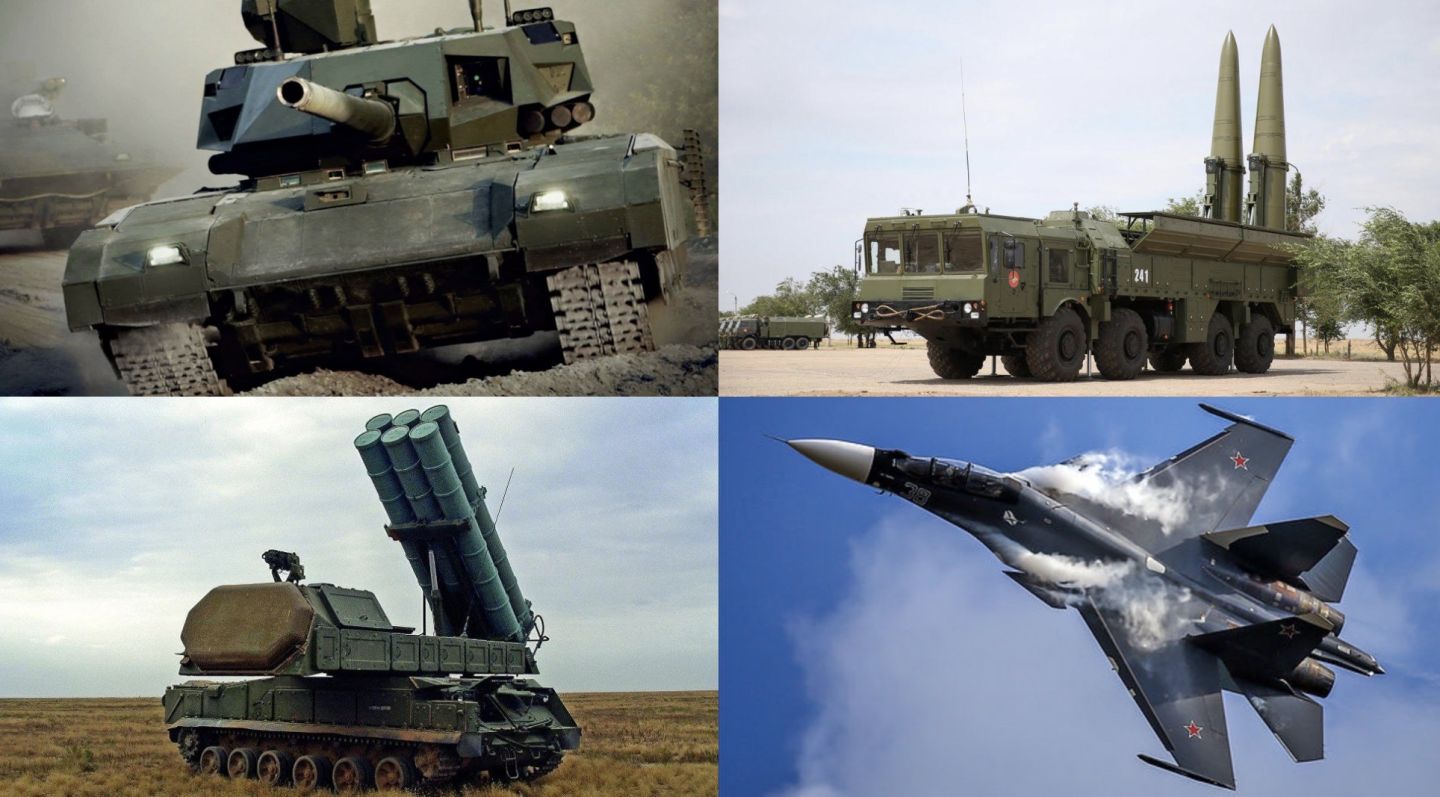
(clockwise from top left) T-14, Iskander, Su-30SM, BuK-M3
Russian Defence Minister Sergei Shoigu has expressed considerable confidence in his county’s continued strategic parity with NATO, elaborating in a statement on March 25th regarding military modernisation efforts: “The share of modern weapons and equipment has been brought up to 68.2 percent and by the end of the year, it will reach the target of 70 percent.” The statement was made at the Federation Council upper parliament house, where Shoigu added that the share of modern weapons in Russia’s strategic nuclear forces had exceeded 87%. Russia’s armed forces embarked on an ambitious ten year modernisation plan from 2008, spurred by both underperformance in the war with Georgia and a perceived growing threat from the Western Bloc. Defence spending has been cut considerably since the program was completed ini 2018, although the cost effectiveness of the country’s defence products has meant that modernisation of frontline units from battle tanks to intercontinental range ballistic missiles has continued apace.
Russian President Vladimir Putin assured in June 2019, a year after cuts were made, that Russia’s defence sector was still qualitatively outpacing competition in all major sectors. Among the more prominent advancements in Russian strategic capabilities have been its induction of new intercontinental range nuclear delivery systems such as the Sarmat missile and Avangard hypersonic glide vehicle, new missile defence systems such as the S-500 and A-235 and new bombers and submarines capable of nuclear delivery. Russian tactical assets have also improved drastically, from the Kinzhal and Zicron hypersonic anti ship missiles which entered service in 2018 and 2019 respectively to new T-90M and T-14 battle tanks and a range of new combat aircraft such as the Su-30SM and Su-34 fighter jets.
