
Russian Army Receives New T-90M Tanks as Incremental Modernisation Further Boosts Performance
Military Watch Magazine Editorial Staff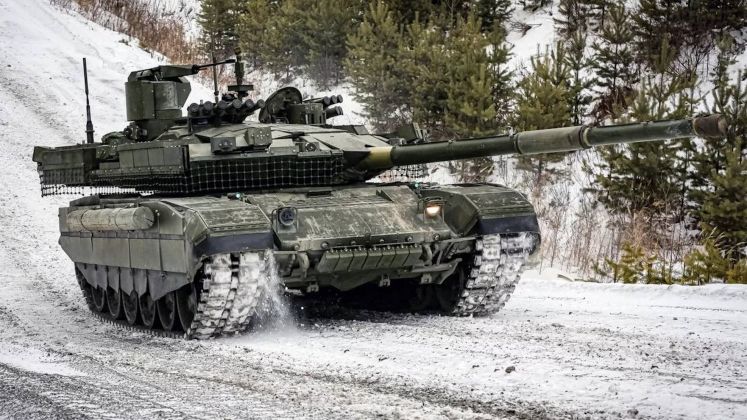
Russian Army T-90M Tank
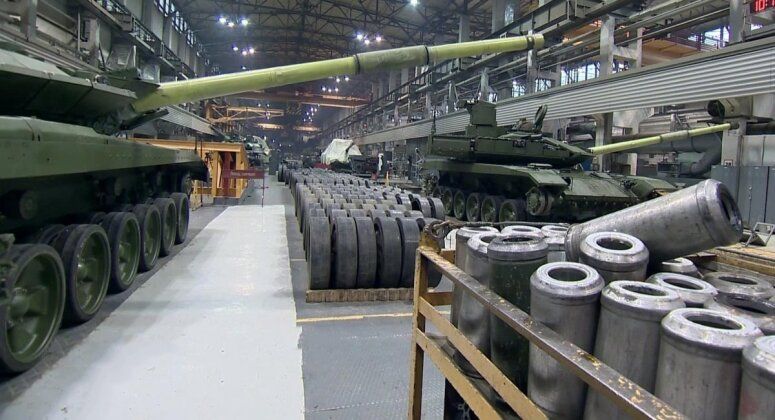
The Russian Army has received a new batch of T-90M main battle tanks from the country’s sole tank manufacturer Uralvagonzavod, with footage broadcast on Russian national television showing the tanks leaving the factory floor and being transported by rail. This follows the delivery of a prior batch to the Army’s Nevsky Volunteer Brigade in September. Production of T-90 tanks has increased rapidly from approximately 90-110 tanks per year in 2020-2021, to an estimated output of 280-300 tanks in 2024, according to reports by open-source investigators from the Conflict Intelligence Team. The investigators assessed that Russia’s defence sector will further significantly expand production to reach an output of 1,000 tanks by mid-2028, and is on track to reach an out put 3000 tanks annually by mid-2035.
The T-90M is the only type of Russian main battle tank currently in production, although preparations are underway for the Omsktransmash plant near the Kazakh border to resume production of the T-80, a more costly tank design with higher mobility which saw production terminated in the early 2000s due to its significantly higher costs. The future of the much more ambitious and costly T-14 tank program remains highly uncertain, and although it was first unveiled as early as 2015, statements from Russian government sources indicating it could enter service in the near future have consistently failed to materialise. Although previously expected to serve as a stopgap until the T-14 enters service, the T-90M has been widely praised by both military and civilian officials for its performance in the Ukrainian theatre. Separation of the tank’s ammunition and crew, and a significant increase in the levels of protection surrounding the autoloader carousel, have been major contributors to its survivability, as have its strong base armour and very wide coverage using Relikt explosive reactive armour.
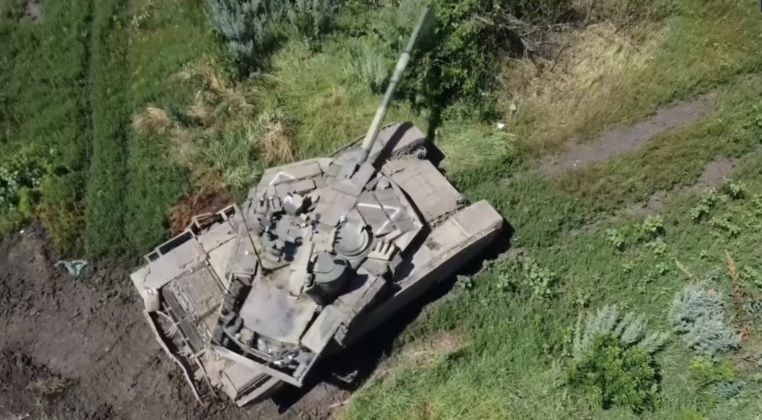
The T-90M first entered service in the Russian Army in April 2020, two months after completing state trials, with its armour protection configuration having from late 2022 been adopted to significantly enhance the survivability of older T-72 tanks. The baseline T-90M has already seen its capabilities improved significantly over time, with a notable example being the integration of the country’s first hard kill active protection system, Arena-M, from late 2024. It was confirmed in early January that a new variant of the Arena-M system capable of intercepting single use drone and loitering munition attacks has completed development. Further improvements to survivability are expected as production transitions to the further enhanced T-90M2 variant later in 2026.
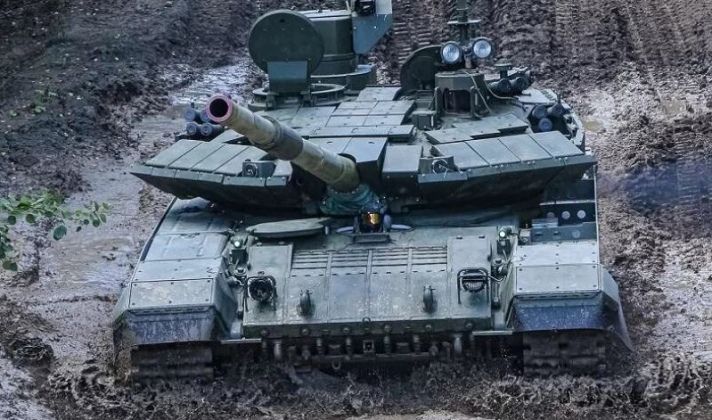
Elaborating on one of the most signifiant advantages Russian tanks have maintained over their Western counterparts, CEO of the Russian state defence conglomerate Rostec, Sergey Chemezov, observed:
"Our armoured vehicles can often be repaired almost in the field. There are cases when the T-90M Proryv repeatedly returned to service after serious hits, each time managing to return to combat condition. That is, from the point of view of maintainability, modern domestic tanks continue the traditions of the legendary T-34. That's not going to work with Abrams, as it will require factory specialists. If at all it is possible to retrieve the damaged colossus from the battlefield with its mass.”
Despite the T-90M’s advantages over much heavier Western tank designs, a consensus has growing regarding the inadequacy of conventional Cold War era designs, with the United States as a result seeking to develop its most revolutionary new tank in close to half a century under the M1E3 program. This adopts many common design features to China’s new Type 100 unveiled in September 2025, and has the potential to leave the T-90M far behind in performance.
