
A Firepower Boost For The Su-57: Several New Missiles Developed to Equip Russia's Next Generation Fighter
Military Watch Magazine Editorial Staff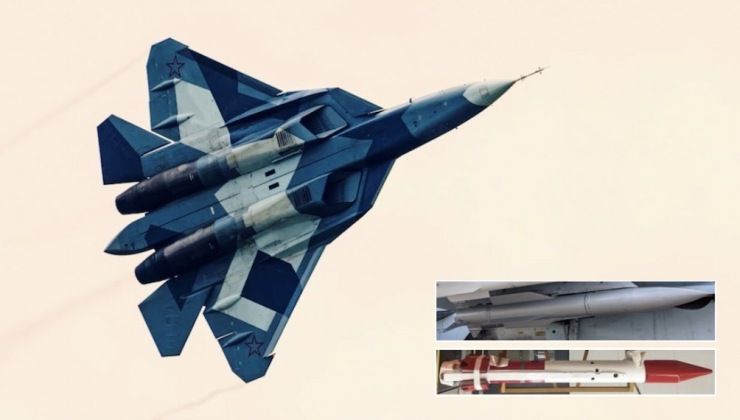
Su-57 and New Long Range Air to Air Missiles
Russia’s Su-57 next generation heavyweight fighter entered mass production in July 2019, and approximately 80 are expected to be in service by the end of the current State Armaments Plan in 2027. While the fighter itself boasts a number of next generation systems, many of them totally unique from cheek mounted and rear facing radars to laser defence systems, the Su-57's ability to go head to head with the elites of enemy air fleets will depend heavily on its access to more advanced classes of missile. Two notable new missile designs developed to allow the Su-57 to counter threats from advanced enemy aircraft are the K-77 and the R-37M long range air to air platforms. The former retains a range of around 195km and makes use of a special active phased array antenna guidance system, making it extremely difficult to evade even for highly manoeuvrable fighters at long ranges. The R-37M, meanwhile, has an unrivalled 400km range and is capable of impacting targets at hypersonic speeds exceeding Mach 6. The R-37M is in limited service today, while the K-77 is thought to be in the advanced development stages.
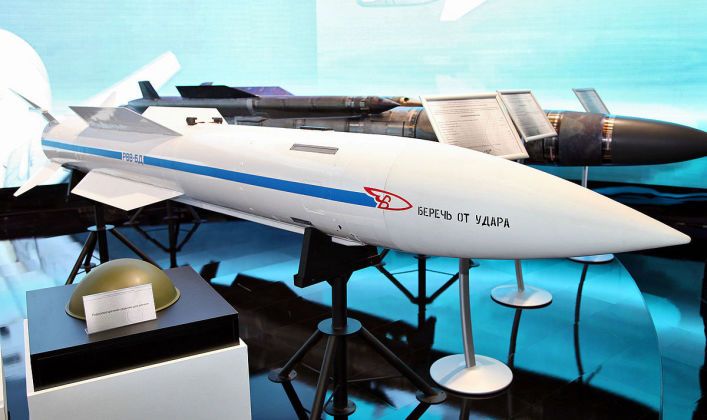
A third new munition planned for the Su-57 was been unveiled at Vympel NPO's I. I. Toropov design facility in Moscow. The new missile appears to be derived from the R-77, Russia’s equivalent to the American AIM-120C AMRAAM, but is notably considerably smaller than the original platform. With Russia having made considerable progress developing more efficient engines and and fuel composites to make its missiles both smaller and longer ranged, the R-37M being a key example building on the technologies of the much heavier R-37 and R-33, development of a compact version of the R-77 without sacrificing capabilities remains highly possible. Such a light missile would not only allow Russian fighters such as the Su-35 to carry more munitions without sacrificing range, but would also allow the new Su-57 to carry more missiles in its internal weapons bays. While the Su-57 is capable of carrying ten air to air missiles, the two weapons bays at the roots of its wings are too small to carry normal sized long range missiles - but could potentially carry the unnamed new platforms. It is also possible that the fighter's main weapons pay could store the missiles for an increased payload - possibly from eight for normal sized munitions to around 12-16 of the smaller ones.
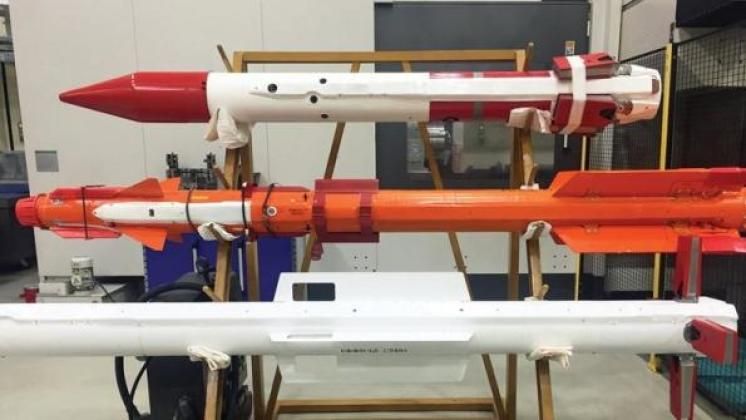
The unnamed new small missile appears to have a diameter similar to that of the R-77, but is approximately 33% shorter at around nine feet long. It notably has small apertures for a laser proximity fuze, indicating it is likely to deploy a high-explosive blast-fragmentation warhead. It remains uncertain whether these missiles are fully combat ready or when they entered development, but they are but one of several new air to air missile types which have been designed specifically for the Su-57. With the United States beginning to field the AIM-120D as its primary air to air platform, which is overall considered superior to the R-77 and R-27 Russia currently relies on, and also developing the much more capable AIM-260 and Peregrine for its new generation of fighters, it is imperative for Russia to seriously improve the capabilities of its own without delay. The Su-57 is also being equipped with a range of new air to ground ant anti shipping missiles to enhance its strike capabilities - most notably a hypersonic ballistic missile based on the Kh-47M2 Kinzhal currently deployed by Russian MiG-31K Foxhound jets. The fact that the Su-57’s bomb bays are larger and deeper than those of rival stealth fighters such as the American F-22 and Chinese J-20 will allow it to deploy ballistic missiles despite their considerably greater diameters relative to air to air missiles.
