
Russia Reveals Su-57 Stealth Fighter in New Expanded Firepower Air Defence Configuration
Military Watch Magazine Editorial Staff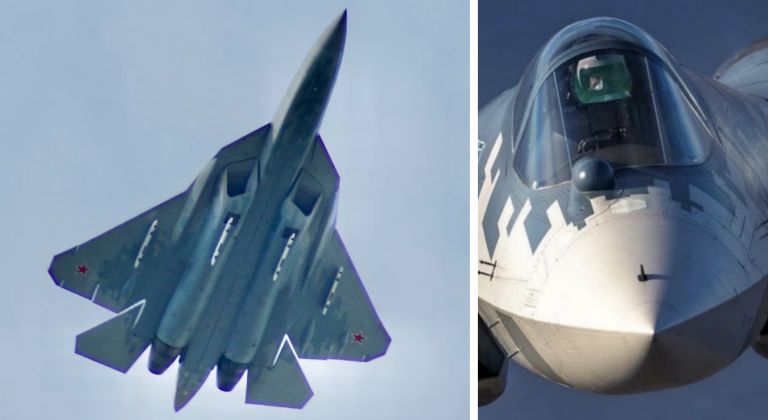
Su-57 with External R-77 Missiles (left) and Su-57
New footage released on July 3 has shown a Russian Aerospace Forces Su-57 fifth generation fighter carrying four externally mounted R-77 active radar guided air-to-air missiles, with the new configuration appearing to be optimised for medium range air defence operations. With the Su-57 estimated to be able to carry up to six R-77M missiles internally in its primary weapons bay, the carriage of four external missiles increases its total payload to ten beyond visual range missiles. While internal missile carriage allows fifth generation fighters to maintain their radar-evading stealth profiles, reliance exclusively on internal carriage limits fighters’ total missile payloads. The decision to prioritise missile volume over the survivability of the aircraft indicates that the Su-57 seen in the recent image was operating behind friendly lines for an air defence mission, for which a configuration with ten R-77 missile could be highly favourable.
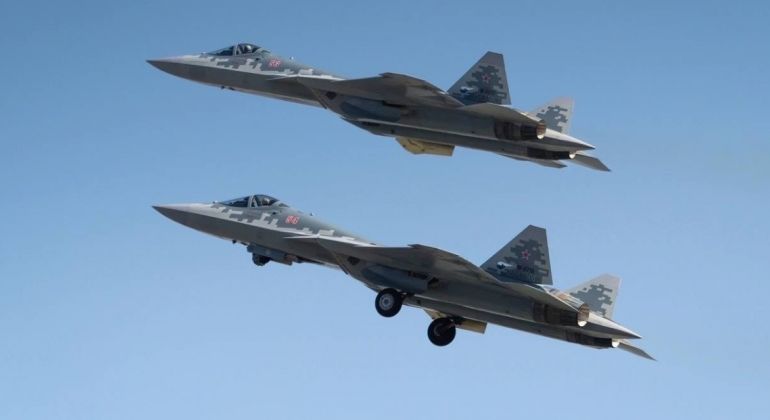
One likely explanation for the aircraft’s configuration is that it was operating in a homeland air defence role. When operating over Russian-controlled territory, the aircraft is expected to face little risk from missile fire, with the Ukrainian Air Force fielding no long range air-to-air missiles. Su-57s in this configuration are expected to be relied on for intercepting cruise missiles, unmanned aircraft, or hostile aircraft approaching Russian airspace The Su-57 is particularly well optimised for such roles, with its sensor suite being considerably more advanced than those of other Russian fighter types, and integrating five AESA radars distributed across its airframe, while its endurance is outstandingly high allowing it to patrol and loiter for considerable periods.
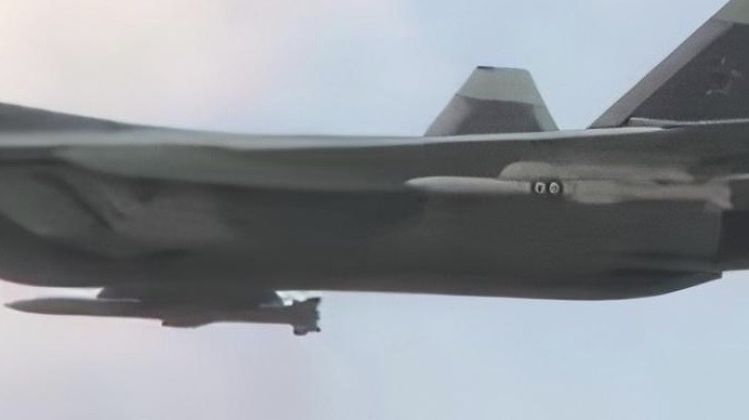
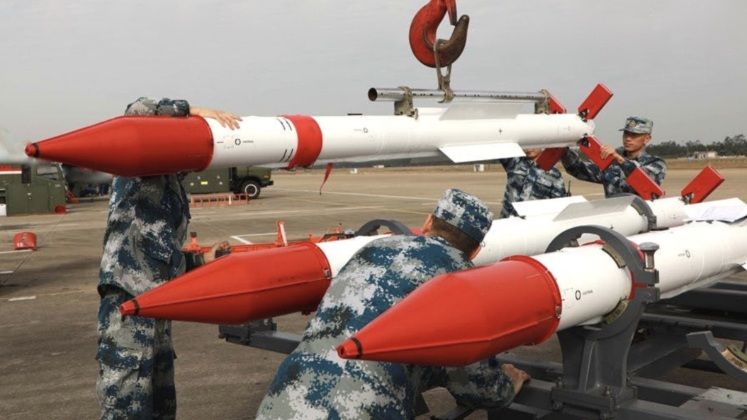
While R-77M missiles have cropped fins to fit inside the Su-57’s internal weapons bay, the older, shorter ranged, and less advanced R-77-1 can only be carried externally. These may have been mounted on the fighter seen in the latest footage, with the clarity in of the image making it difficult to discern which R-77 variant was carried. It remains uncertain whether the Russian defence sector will phase the R-77-1 out of production, as while it is much less capable than the new R-77M, it is thought to be considerable less costly to produce. Although its designation indicates that the R-77M is an incremental improvement over the R-77-1, the extent of the design changes made makes it effectively a new missile. The missile’s range is extended from 110 to 200 kilometres, primarily due to its integration of a dual-pulse solid rocket motor and aerodynamic improvements, while its AESA radar and near unique active phased array antenna make it far more challenging to jam or evade.
Su-57 fighters were first reported to have been deployed for air-to-air operations in 2022, with a later report in January 2023 by the British Defence Ministry noting that the fighters were “launching long range air-to-surface or air-to-air missiles into Ukraine,” and had been “since at least June 2022.” The language used by the British Defence Ministry, launching missiles “into Ukraine” from long standoff ranges, indicated that upper medium range or long range missiles were being used. The British conservative outlet The Conversation reported in mid-February that year that “The Russian MiG-31 and Su-57 operating the R-37M long range hypersonic missile have engaged Ukrainian aircraft at a range of over 200kms from the safety of Russian airspace.” The complexity of the aircraft’s operations in the theatre have increased significantly over the past three years, as the number of Su-57s in service has more than doubled, and as the Air Force has developed new means of operating the aircraft.
