
Russia’s Most Effective Fighter? Defence Ministry Continues to Place Large Orders for Elite Su-30SM Air Superiority Jets - New Batch of 36 Incoming
Military Watch Magazine Editorial Staff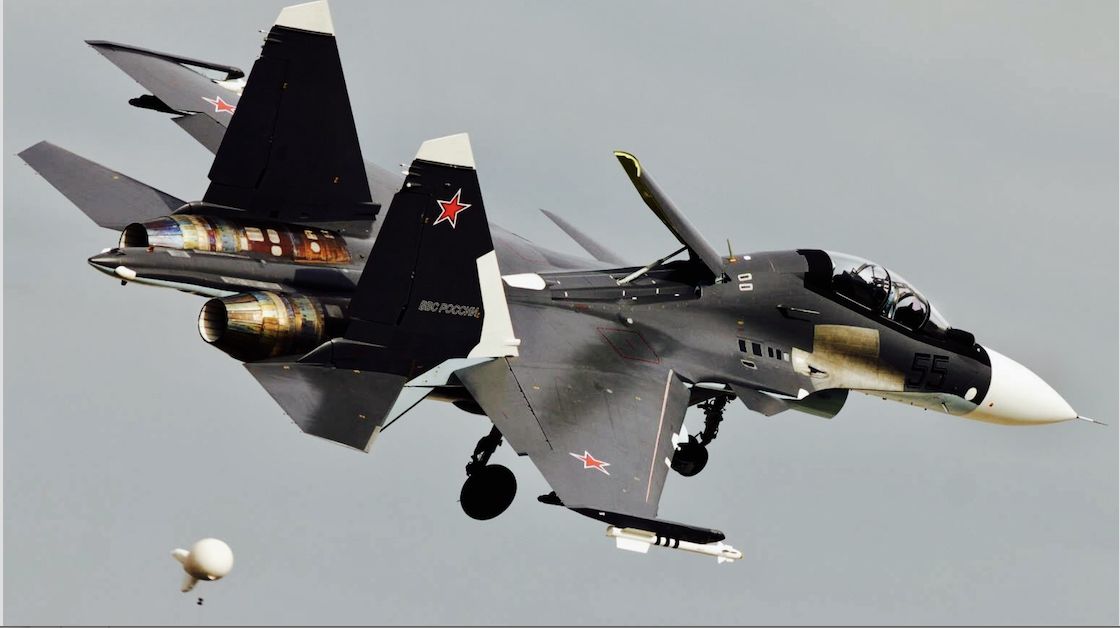
Russian Su-30 Air Superiority Fighter
With production lines for the Su-34 strike fighter and Su-35 ‘4++ Generation’ air superiority fighter working to manufacture approximately 200 fighters since 2014 with hundreds more planned, and with orders for the latest MiG-35 light fighter and Su-57 stealth jet currently growing, the Russian Air Force has also eyed making a new and less prolific order for an older model of combat jet - the Su-30SM. A design dating back 25 years to 1993, the fighter is a twin engine air superiority platform based on the Su-27 Flanker, and bearing a number of enhancements relative to the original including frontal canards on its airframe, a fly by wire control system, a longer range and more capable avionics. Perhaps the most notably enhancement to the Flanker design was the integration of two dimensional thrust vectoring capabilities, similar to those later installed on the F-22 Raptor though less advanced than the three dimensional systems used by the Su-35 and MiG-35, which made the aircraft by far the most manoeuvrable of its time and allowed it to perform extremely complex manoeuvres. The Pugachev's Cobra and the tailslide are the most prolific of these, allowing the jet to quickly decelerate - which in visual range engagements cause pursuing fighters to overshoot, and break radar lock.
The Russian Defense Ministry is reportedly planning to contract 36 of the air superiority jets from United Aircraft Corporation (UAC) for approximately 70 billion rubles ($1 billion). The design has proven among the most popular in the Russian military’s combat fleet, with the Ministry having already contracted 116 Su-30SM fighters in the six years since 2012 alone. UAC President Yury Slyusar said that the contract for the elite air superiority platforms would “ensure the loading of the IAZ in the coming years at the level of 12-14 cars per year". Slyusar further noted that the fighters has good export prospects, and had proven highly popular with foreign clients in the past, stating: “the Su-30 has good export prospects... The aircraft are sold in a large number of countries and, we hope, will be sold more."
The Su-30, while less capable than the elite Su-35 derived from the same airframe, remains an arguably more cost effective jet in the Russian fleet at present - with capabilities which are highly similar in most fields but at a far lower price. With the Su-27 having been designed to surpass the U.S. F-15C in its air to air combat capabilities during the Cold War, the Su-30SM continues to surpass the capabilities of all Western fourth generation rival platforms despite being manufactured at a fraction of the cost. A sizeable proportion Su-30SM orders have been made for the Russian Navy’s small fighter fleet rather than that of the Air Force, and the 36 additional fighters are reportedly all set to go to the Navy as well. These fighters are prized by the service due to their long range and their versatility, which allows them to serve in ship hunting as well as air superiority roles. Carrying cruise missiles such as the Kh-31, the fighters can pose a threat to enemy warships far out to sea in theatres such as the Pacific, while in the Black Sea they ensure Russian control of the skies over the strategically critical waters from bases on land - thus eliminating the need for carrier warships to fulfil such a task.
The Su-30 may well replace the Su-27 as the mainstay of the Russian Air Force’s air superiority fleet, a realistic goal given its low cost, and the fighter has already replaced the older Flanker as the most popular air superiority fighter for export. While the Su-27 was initially in high demand from China, Vietnam and Indonesia to East Africa, the Su-30 has found a rapidly growing number of clients in several African and Southeast Asian states as well as China, India, Myanmar, Belarus and Venezuela. With Iran reportedly planning a sizeable order of new fighters, possibly over 100 making it the largest export client for the design other than India, the cost of the jets may well fall further as production facilities continued to benefit from economies of scale. While overshadowed by the more capable and specialised Su-35 and Su-34, as well as its next generation analogue the stealthy Su-57, the Su-30 plays an arguably more critical role in the Russian armed forces due to its unique combination of an advanced combat performance and a low acquisition cost - particularly as Russia continues to balance the need to defend itself against growing threats near its borders with the need to lower its defence budget to provide a much needed stimulant to economic growth.
