
Russia’s Deadly and Mysterious 9M729 Cruise Missile - What Can it Do and Why Does it Worry NATO?
Military Watch Magazine Editorial Staff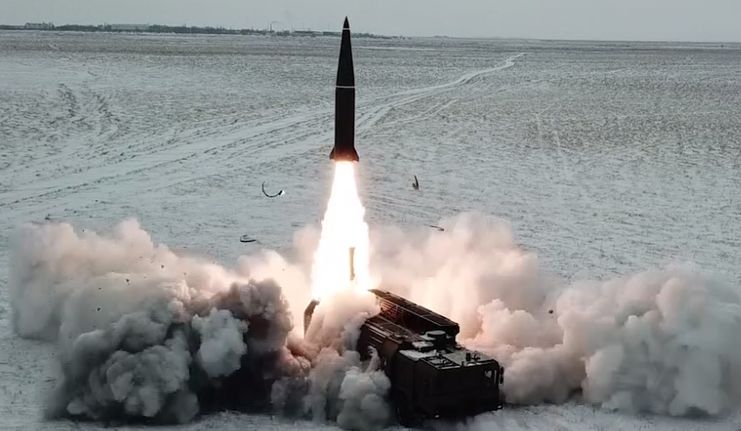
Russian Iskander Missile System
The Russian military’s 9M729 cruise missile has reportedly been deployed to the European theatre in considerable numbers - a development which has been met with much apprehension by a number of Western powers. The platform’s capabilities remain something of a mystery, and have thus been cause for much speculation. The 9M729 was developed to be deployed from the Iskander-K weapons platforms - a variant of the Iskander system developed to launch cruise missiles where the better known Iskander-M deploys ballistic munitions. The Iskander has gradually come to replace the ground based tactical missile arsenal Russia inherited from the Soviet Union, comprised mainly of Scud-B and OTR-21 Tochka ballistic missiles, which have since been phased out of service in favour of the newer platform. While the Iskander-M has long been hailed as a major threat to the Western Bloc’s assets in the event of a potential war, and has been deployed to the Crimean Peninsula in growing numbers in light of escalating tensions there, the Iskander-K is increasingly emerging as a leading threat in the eyes of the NATO’s military leadership in light of its cutting edge capabilities - namely the speculated capabilities of the 9M729.
The 9M729 is speculated to be a land based variant of the Russian Navy’s Kalibr cruise missile - which depending on the variant have ranges of either 300km and speeds over Mach 2.5 or ranges over 2000km and subsonic speeds. Taking Russian claims at face value that the ground based missile does not violate the Intermedia range Nuclear Forces (INF) Treaty which prohibits the deployment of tactical missiles with ranges over 500km, the 9M729 is likely to have capabilities resembling the shorter ranged Kalibr variant. This gives the missile a high supersonic speed and high manoeuvrability capable of penetrating enemy air defences, and a high level of precision allowing it to strike targets near the limits of its range within 3 meters and a with a warhead of up to 500kg. The missiles can also deploy nuclear warheads, and are ideal delivery vehicles for tactical nuclear strikes and the penetration of enemy fortifications.
An alternative theory regarding the 9M729 is that it is a land based variant of the Kh-101/102 air launched cruise missile - which entered service in 2012 and has revolutionised the capabilities of the Russian bomber fleet. The Kh-101 has been deployed extensively by Russian Tu-160 ‘White Swan’ heavy bombers against jihadist targets in the Syrian theatre - where the new munitions made their debut in 2015. The missiles retain a range of up to 5000km and have an advanced stealth profile allowing them to better evade enemy air defences. Stealth capabilities are key to compensating for the missiles' subsonic speeds - which make them considerably easier to intercept - by providing a considerable improvement to survivability. The Kh-101/102's range allows it to strike targets across approximately half of the United States or Africa when deployed from Russian military bases, and should the 9M729 represent a shorter ranged land based variant of the same system it could comfortably cover the entire European theatre from deep inside Russian territory with a heavier payload than its air launched counterpart. A ground based variant of the Kh-102, a derivative of the Kh-101 with a nuclear rather than a conventional warhead, could also potentially be deployed from the Iskander-K. Such long ranged munitions, if deployed from land based weapons systems such as the Iskander, would violate the INF treaty. According to Russia such weapons treaty violating weapons have not been developed, but should the United States go through with its withdrawal from the treaty they could very soon be deployed and exported to Russian defence clients abroad.
