
The Bear’s New Claws; Game Changing New Kh-101 Missiles to Be Deployed by Russia’s Tu-95 Bombers - Part Two
Military Watch Magazine Editorial Staff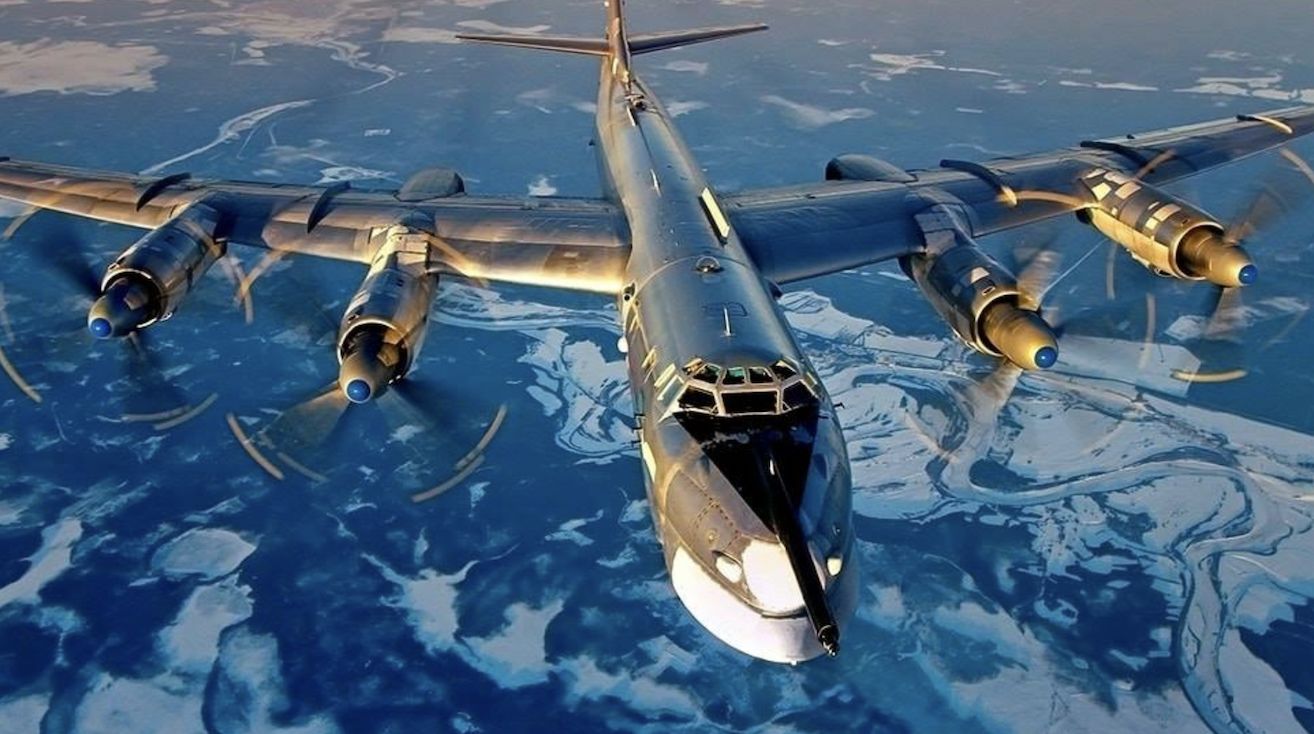
Russian Tu-95 Heavy Bomber
Modernising the Tu-95MS to the MSM will expand the bomber’s missile carriage with four additional external pylons - each of which can carry two missiles. The new bomber is designed to operate advanced Kh-101 and Kh-102 cruise missiles, platforms without peer outside Russia and designed for the more modern Tu-160 Blackjack - an elite supersonic swept wing bomber which is currently undergoing its own modernisation program, and is fielded in smaller numbers alongside the Bear in a complementary role. Because of the new missiles’ considerable length, and the Tu-95’s smaller airframe than the Blackjack, the missiles must be carried externally - hence the need for new external pylons - six in total. The pylons are also compatible with the older Kh-55 cruise missiles, which were previously deployed internally using a KMU-6-5 rotary launcher.
While the Kh-55 was restricted to an engagement range of 3000km, still a phenomenal distance allowing the bombers to strike targets as far as Greenland in North America and the entire European continent without leaving Russian airspace, the Kh-101 has an extended range of 5000km and an advanced stealth profile allowing it to better evade enemy air defences. With the standoff missiles lacking the immense hypersonic speeds of shorter ranged platforms such as the Kh-47M2 Kinzhal deployed by Russia’s MiG-31 interceptors, the enhancement to their survivability provided by radar evading capabilities is a highly prized asset. The missile is capable of carrying out precision strikes against high value targets across approximately half of the United States or Africa when deployed by bombers circling over Russian airfields, and should the Bear fly beyond the country’s borders they will retain a truly global strike range. The Kh-101 is heavily based on the Kh-55 design, and can deploy either high explosive, penetrating, or cluster warheads depending on the nature of the target. The Kh-102 is a variant of the same design deploying a tactical nuclear warhead.
The Kh-101 saw its first combat test in November 2015, one of many new Russian weapons platforms which made their debut during the Syrian conflict, with the advanced cruise missile having been deployed by Tu-160 bombers against Islamist militant targets in the country. The modernisation of Russia’s Bear bombers to carry these new munitions puts their strike capabilities on par with the Tu-160, and though they lack a number of the White Swan’s cutting edge capabilities particularly in terms of speed and survivability the Tu-95 aircraft come at a fraction of the cost both to acquire and to operate. Other than the ability to deploy new cruise missiles externally, the Tu-95MSM variant has an enhanced airframe with strengthened wings to better facilitate the safe carriage of a larger payload. According to some sources, the bombers will also deploy with new engines and propellers to improve the Bears’ flight performance. The aircraft will also receive new radars and data display systems for improved situational awareness. While Russia’s Tu-95 is old, it is likely to remain viable and in service into the late 2030s, and is almost certain to receive further enhancements including the potential deployment of hypersonic cruise or ballistic missiles to further improve its standoff capabilities. While Russia currently fields 60 of the heavy combat platforms, as the cost of upgrades continues to rise and the country begins to induct more capable Tu-160M3M and PAK DA bombers, some of its Bear bomber fleet may begin to be retired - particularly with the recently announced resumption of production of the Tu-160 which will begin to shoulder more of the burden in the Russian bomber fleet.
Part One is available here
