
Russia Fields the World’s First Intercontinental Range Fighter: How the Su-34 Can Fly From Moscow to Washington
Military Watch Magazine Editorial Staff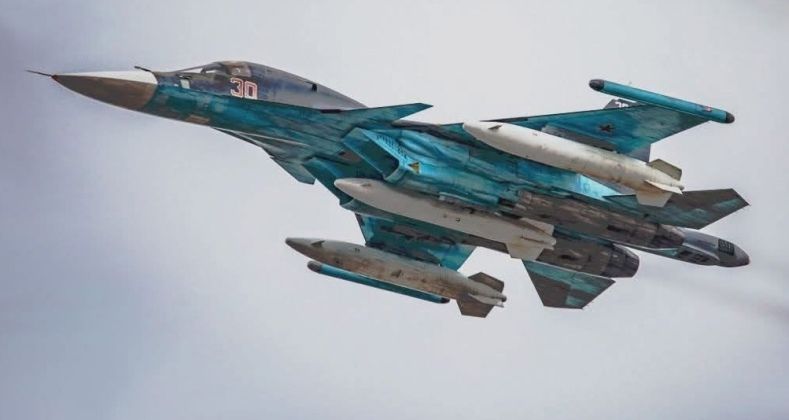
Su-34 with 3000 Litre External Fuel Tanks
The Russian Su-34 strike fighter is currently the longest ranged tactical combat aircraft operational anywhere in the world, with its endurance being comparable to those of many types of strategic bombers, providing operational flexibility for a wide range of mission requirements from extended loitering to deep penetration missions. In contrast to fighters in the Western world, Russian fighters are rarely sighted carrying external fuel tanks, with their much longer ranges using internal fuel allowing them to operate effectively over long distances without needing to impose additional drag, lower their thrust/weight ratios, and limit the number of available weapons hardpoints by using such tanks. Nevertheless, the rare sighting of a Su-34 with three PTB-3000 3,000 litre external fuel tanks has highlighted that the aircraft has a unique ability to be configured for operations at truly intercontinental ranges.
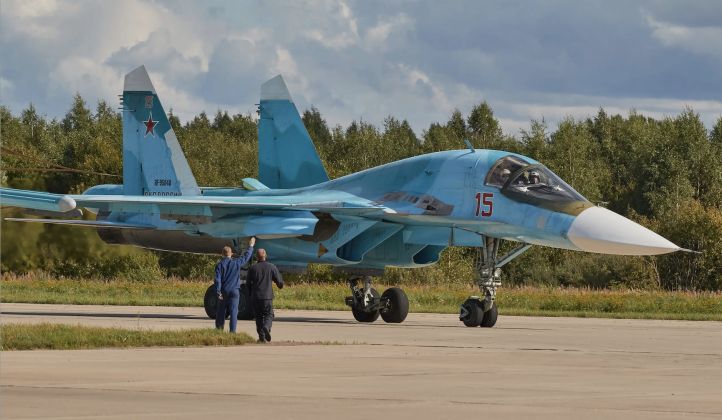
The Su-34 was developed as a derivative of the Soviet Su-27 air superiority fighter, which was by far the longest ranged fighter type fielded by the Soviet Air Force or by any Western air force in the 20th century. The new fighter was approximately 50 percent heavier than the Su-27, which was already by far the largest fighter fielded by Russia or by any NATO air force, with its increased size combined with the integration of more fuel efficient AL-31FM2 engines, and a much higher use of composite materials to achieve a more efficient design, facilitating a much longer range. Where the Su-27 had a maximum ferry range of 4,000 kilometres on internal fuel, that of the Su-34 was closer estimated at approximately 4,800-5,000 kilometres. With an intercontinental range defined as a range of over 5,500 kilometres, this brought the Su-34 close to being able to reach this major milestone.
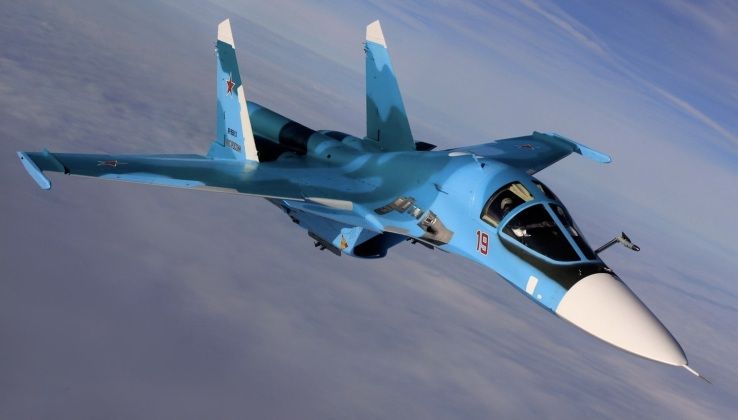
When carrying three 3,000 litre drop tanks, the Su-34’s ferry range can be increased to an estimated 8,000 kilometres when accounting for the penalties of the tanks’ additional weight and drag, which allows the aircraft to fly from Moscow to Washington DC. Nevertheless, this ferry range assumes an optimal flight profile with no manoeuvring and no weapons carriage, which would increase fuel consumption significantly. Thus while the Su-34 can fly over intercontinental distances without aerial refuelling support in ways Western fighter aircraft cannot, it cannot do so for combat operations. The aircraft may nevertheless retain some operational uses when operating over such ranges, with its ability to integrate a wide range of pods for electronic, radar and photo reconnaissance allowing it to still play important roles without a weapons load.
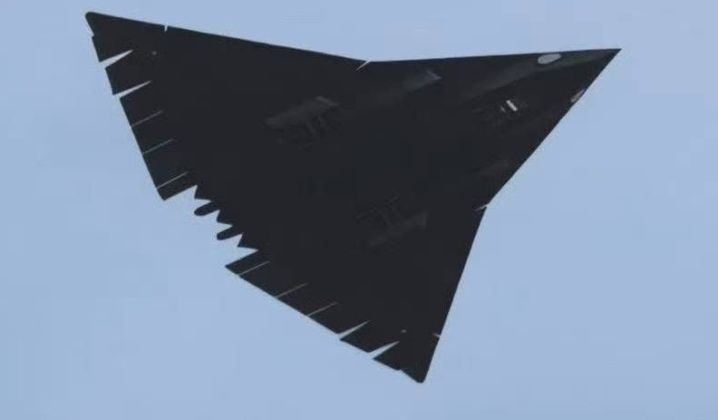
The Su-34 is expected to be surpassed in its position as the world’s longest ranged fighter with the service entry of a Chinese sixth generation fighter developed by the Chengdu Aircraft Corporation, which also appears to surpass the Su-34 as the world’s largest, and is optimised for very long range operations with advanced stealth capabilities. The Su-34 itself is nevertheless expected to see its long range engagement capabilities continue to improve as new missile types continue to be integrated, with a miniaturised variant of the Kh-101/2 5,500 kilometre range cruise missile reported to have been brought into service in 2024 without compromising on the original variant’s range. As the rate of the Su-34 fleet’s expansion has increased significantly, with production having more than doubled since early 2022 to facilitate deliveries of approximately 30 per year, it is expected that the scope of upgrades and new armaments developed will also continue to increase, some of which will improve its ability to engage targets thousands of kilometres from its operating bases.
A significant possibility which has been raised in the past is that the Su-34 will integrate the AL-51F engine developed for the Su-57 fifth generation fighter, which aside from improving flight performance and reducing maintenance needs, would also provide a far higher level of fuel efficiency, potentially allowing the aircraft to conduct truly intercontinental range strategic missions. The integration of the new engine, combined with new missile types and expanded aerial refuelling support, could allow the Su-34 to take on entirely new roles in the Russian Aerospace Forces, potentially extending to deployments under the Long Range Aviation Command, which is responsible for the strategic aviation fleet. Improvements to the aircraft’s reach have significant implications not only for Russia, but also for Algeria which is expected to begin receiving the aircraft in 2026, as well as for other potential export clients.
