
Pakistan's Nasr Nuclear Rocket Artillery and its Critical Role in Deterring India's Conventional Forces
Military Watch Magazine Editorial Staff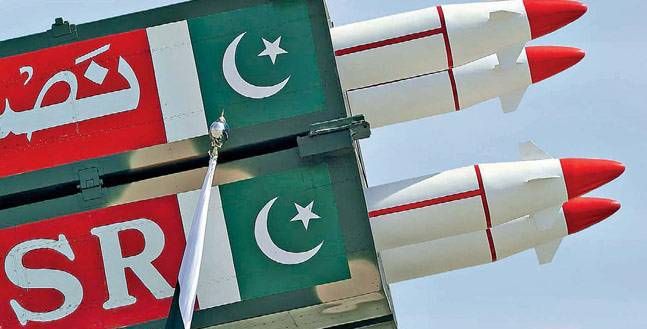
Pakistani Nasr Nuclear Rocket Artillery System
Since its acquisition of nuclear weapons in 1998, Pakistan armed forces have invested heavily in developing a wide array of delivery vehicles - some with strategic and others with tactical purposes, to comprehensively strengthen the country's nuclear deterrent. The primary role of the Pakistani nuclear arsenal is to deter aggression from what is perceived to be the greatest threat the state's sovereignty, the military of neighbouring India, and to deny it an nuclear advantage in a potential war. Because of this near exclusive focus on its neighbour, Pakistan has made no attempts to develop intercontinental ballistic missile capabilities and until 2017 the Pakistani Navy had no submarine based nuclear capable missiles. For delivery of its nuclear weapons against Indian targets, short and intermediate ranged delivery systems such as the respective Hatf III and Hatf V are sufficient - with the country long neglecting to develop an intercontinental range delivery vehicle.

Because of the vastly superior conventional capabilities of India's armed forces - fielding approximately 4 million soldiers including reservists compared to Pakistan's army of under one million and deploying advanced armour and aircraft such as the T-90 battle tank and Su-30MKI air superiority fighter well ahead of their Pakistani analogues - nuclear weapons have emerged as an essential asymmetric means of nullifying India's conventional advantage. To this end Pakistan has recently developed a short ranged rocket artillery system, the Nasr (Hatf IX), which deploys nuclear warheads intended to deliver low yield tactical strikes. The purpose is specifically to target Indian troop concentrations and armoured divisions - and thereby deny the country its conventional advantage.
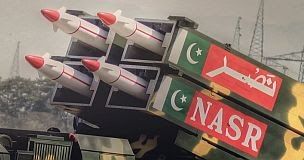
The existence of a Pakistani nuclear rocket artillery program was only revealed after a test launch in 2011 - and the Nasr is speculated to have entered service in large numbers from 2013. The system is capable of delivering a warhead with a payload of under five kilotons at a distance of 70km - increased from its initial range of 60km through various enhancements applied since. According to the Pakistani military the Nasr was designed to "add deterrence value at shorter ranges... with high accuracy shoot and scoot attributes." As it uses a solid fuel propellant, the missiles can be kept constantly fuelled on standby near the Indian border and used at any time to respond to border incursions into Pakistani territory (where liquid fuelled munitions would require fuel to be stored externally and thus have a considerably longer response time.) The munitions themselves are designed to be highly manoeuvrable in flight, allowing them to penetrate any Indian air defences. While some analysts have designated the Nasr a ballistic missile, its extremely short range and launch in salvoes from an A-100E 300mm Multiple Launch Rocket System makes rocket artillery a far more apt description based on the munition's design, capabilities and role. The A-100 was developed by the China Academy of Launch Vehicle Technology and first saw service in the year 2000. Each deploys four rockets and is capable of firing them in rapid succession at separate targets. Though it carries a nuclear warhead, the Nasr's low payload allows it to be launched at extremely short ranges without risk to the firing crew. This allows for a highly unconventional form of tactical nuclear strike - a tactic potentially derived from the low payload nuclear field artillery briefly deployed to the European theatre in the early years of the Cold War by the USSR and United States.
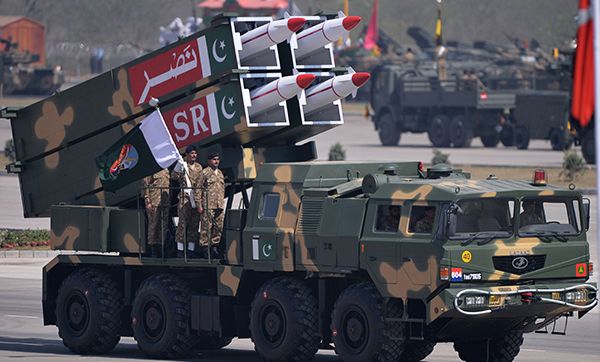
The Nasr has been highlighted as a potential ideal counter to the Russian made S-400 surface to air missile systems the Indian armed forces are set to shortly deploy, with the highly manoeuvrable artillery potentially challenging to intercept for even the high end air defence platform which is among the most advanced in the world. Deployment of the Nasr partly considered a response to India's 'Cold Start' doctrine for war with Pakistan - under which Indian ground forces would to launch multiple incursions into Pakistani territory and attempt to avoid nuclear escalation by deterring any Pakistani retaliation with its strategic weapons. Deployment of Nasr missile signals that Pakistan would use nuclear weapons in response to any attacks on its territory, conventional or otherwise, and retains the capability to escalate with tactical strikes without resorting to its strategic arsenal. The missile thus provides an effective tactical nuclear deterrent to any potential Indian efforts to exercise conventional superiority, complementing the Pakistani strategic deterrent comprised of larger warheads on missiles such as the Hatf V (an advanced variant of the North Korean Rodong-1) aimed at Indian cities. The Nasr tactical nuclear missile provides a lower level form of deterrence below that of the strategic arsenal - giving Pakistan a way of countering Indian conventional superiority without escalating to the strategic level. This unique capability makes the Nasr among the most valued weapons systems in the Pakistani arsenal.
