
Oman Could Soon Field the Most Advanced Battle Tanks in the Middle East; Kingdom Mulls Order for 72 South Korean Black Panther Tanks
Military Watch Magazine Editorial Staff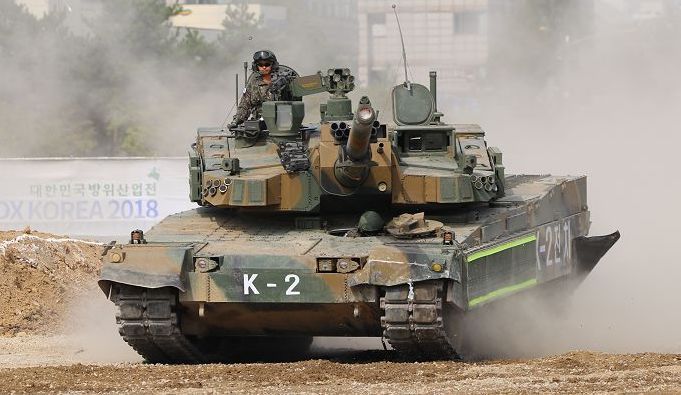
South Korean K2 Black Panther Battle Tank
Following Hyundai Rotem’s unveiling of a desert warfare variant of the K2 Black Panther fourth generation battle tank at Defence Exhibition DX Korea, reports have emerged that the armed forces of the Kingdom of Oman is seriously considering the acquisition of 76 of the elite combat vehicles under an $885 million contract. While South Korea itself has little need for desert warfare capabilities, the development of such a weapons platform represented growing efforts to market advanced defence products abroad - to the Middle East in particular where Korean arms have often been highly popular. According to a number of industry sources, Hyundai has already conducted test trials for the K2 in the Omani desserts - with the desert variant being marketed for export equipped with a shade on top fo its turret, new air conditioning systems, a fan on the right of its turret and a sand camouflage colour scheme. Development of the desert variant has also focused heavily on the development of engine cooling systems.
The K2 is a leading contender in Oman’s tender to acquire 76 high end battle tanks, to replace the ageing British Challenger 2 and American M60. The tank is widely considered the most capable in the world, and is one of just three fourth generation battle tanks in service alongside the Japanese Type 10 and Russian T-14. With Japan far less willing to export its own design, and Western Clients under considerable pressure not to acquire high end Russian arms - or else face economic sanctions under CAATSA, South Korea’s platform is well ahead of any potential competition for the tender. South Korea does, however, lack the political leverage over Oman and other Middle Eastern states which a number of Western manufacturers do - which can play a considerable role in influencing the outcome of potential clients’ decisions regarding which weapons systems will be acquired.
The K2 incorporates reverse engineered elements of some of the world's most potent platforms, combining them with domestic innovations to produce a highly potent battle tank. While its predecessor the K1 was heavily reliant on U.S. corporations for joint manufacturing, and was closely based on the U.S. Army’s M1 Abrams, the K2 is almost entirely indigenously manufactured. The platform’s fire control system and autoloader are derived from those of the French Leclerc, providing a firing rate of 10 round per minute. The tank’s 120mm cannon were adopted from the German Leopard II, and are augmented by a lengthened barrel for a greater muzzle velocity and superior accuracy. Snorkel capabilities were also incorporated - derived from those of the Russian T-80 acquired in the 1990s. Some prominent high end indigenous components include advanced hydropneumatic suspension, a unique application of an integrated millimetre band radar to predict uneven terrain, and an advanced laser warning system - which serves to turn its turret towards sources of hostile fire extremely quickly and allows it to return fire in shorter time. Indigenous KSTAM munitions further allow the tank to effectively act a highly mobile artillery piece with a formidable eight kilometre range - a capability unique to the K2.
Should Oman acquire the K2, it will field the most sophisticated armoured warfare capabilities in the Middle East - surpassing those of even the Russian T-90 and Merkava IV fielded by Iraq and Israel respectively. Turkey has also shown considerable interest in manufacturing several hundred K2 tanks domestically as the Altay battle tank, though whether these variants will be as capable as the Korean manufactured original remains to be seen. While it is an extremely low profile actor in the Middle East, and has long been a neutral state, Oman's armed forces have long prioritised acquiring world leading hardware. An acquisition of the K2 and potentially further Korean weapons platforms such as T-50 trainer jets, would mark a major enhancement to the country's warfighting capabilities.
